



Introduction
The easiest way to overestimate an AI coding tool is to judge it by the first five minutes. Ask for a landing page, watch several polished files appear, and the product feels almost magical. The harder test comes later: the page must work at mobile widths, the form must validate correctly, the new dependency must not weaken security, the change must fit an existing repository, and a human must be able to understand what happened before merging it.
That is the level at which OpenAI Codex should be judged. It is not merely a code-completion box, and it is not a substitute for software ownership. It is an agent that can inspect files, reason about a repository, edit code, run commands, use development tools, check its work, and return a reviewable change. The buying question is therefore larger than “Can it write code?” It is: Can Codex move a real task from request to verified result with less total effort than the alternatives?
OpenAI began on December 11, 2015, as a nonprofit research organization. Its founding announcement named Sam Altman and Elon Musk as co-chairs, Greg Brockman as chief technology officer, Ilya Sutskever as research director, and Trevor Blackwell, Vicki Cheung, Andrej Karpathy, Durk Kingma, John Schulman, Pamela Vagata, and Wojciech Zaremba as the other founding technical members. The stated purpose was to advance digital intelligence in ways likely to benefit humanity broadly rather than optimize first for financial return.
Codex has since referred to two related but different things. The 2021 Codex launch introduced a GPT-3 descendant trained to translate natural language into code; it also powered the original GitHub Copilot. Those early Codex models were deprecated in March 2023. OpenAI later revived the name for a development product: a local command-line agent arrived in April 2025, and a cloud software-engineering agent followed on May 16, 2025. That agent relaunch established the pattern buyers now recognize—give an agent a repository and a task, let it edit and run code, then review the resulting patch.
By our September 16, 2026 research cutoff, Codex was no longer one interface. It could work through the terminal, beside code in an IDE, from a desktop command center, in an isolated cloud environment, on the web and through iOS. This breadth matters because the same developer may want a quick local edit in the morning, several longer-running desktop or cloud tasks during the day, and a pull-request review before shipping. It also creates confusion: Codex is the product, GPT-6 Astra is a model available inside it, and ChatGPT Plus or another ChatGPT tier is the plan that pays for access. Those names should not be treated as interchangeable.
That breadth also defines Codex’s clearest audience. It is best for end-to-end implementation, verified changes, browser-assisted web development, and developers who want terminal, IDE, desktop, and cloud workflows in one system. A user who only wants autocomplete may find it more machinery than necessary. A user who wants one agent to move from an unfamiliar repository to a tested patch and to leave behind a diff, command output, and review trail will understand why Codex finished only 0.03 points behind Claude in our ranking.
Scale figures need the same care. OpenAI reported on August 6, 2026, that 1 billion people used ChatGPT each week, according to its usage disclosure. That was a weekly-user figure for ChatGPT, not a paid-subscriber count and not a Codex figure. The latest defensible Codex-specific number we found was OpenAI’s March 31, 2026 statement that Codex had more than 2 million weekly users in a company update. OpenAI had not published a current paid-Codex subscriber total by our cutoff, so substituting the much larger ChatGPT number would mislead readers.
Our study compares Codex with Claude, Cursor, Devin, GitHub Copilot, and Replit. We scored all six across seven factors: AI intelligence, speed, coding and web-development quality, prompt accuracy, user rating, review confidence, and features and usability. The scorecard is our weighted research judgment, not an official ranking or a universal truth. This article therefore starts with the work Codex actually performs, the conditions that make it useful, and the risks a buyer must manage. The 9.33 result comes later, once there is enough context to understand why we finalized it.
Performance
What Codex is and what it can replace
Codex is most useful when work requires a loop rather than a single answer. That loop is: inspect the environment, form a plan, make a change, run a check, interpret the result, revise if necessary, and present the evidence. A chat model can suggest a function; an agent can find the function in a repository, trace its callers, modify it, run the relevant tests, and show the diff. The distinction is execution, not simply better prose.
The interface changes how that execution feels. In the terminal, Codex works close to the repository, and the commands developers already use; OpenAI’s CLI documentation describes it as an agent for reading, changing, and running code from the command line. The terminal is a natural fit for debugging, dependency work, test failures, migrations, and tasks where command output is the evidence.
The current CLI is also a visible control surface, not a black box. A developer can choose the model and reasoning effort, inspect or change permission boundaries, ask for a review of uncommitted work or a branch comparison, connect outside tools through MCP, and hand a longer task to the cloud. Those controls matter because “use the best model” and “let the agent do anything” are poor defaults for every job. A routine test update may need a fast model and narrow workspace access; a cross-service failure may justify deeper reasoning and a carefully approved network connection. Codex is strongest when the user can deliberately match capability, access, and cost to the task.
The IDE extension is better for short feedback loops. It can use open files and selected code as context, show edits beside the source, and hand longer work to a remote environment, according to the IDE documentation. This saves the mechanical work of repeatedly explaining which component, function, or error the user means. It is especially useful when the developer wants to remain the driver and ask for narrow changes rather than delegate an entire issue.
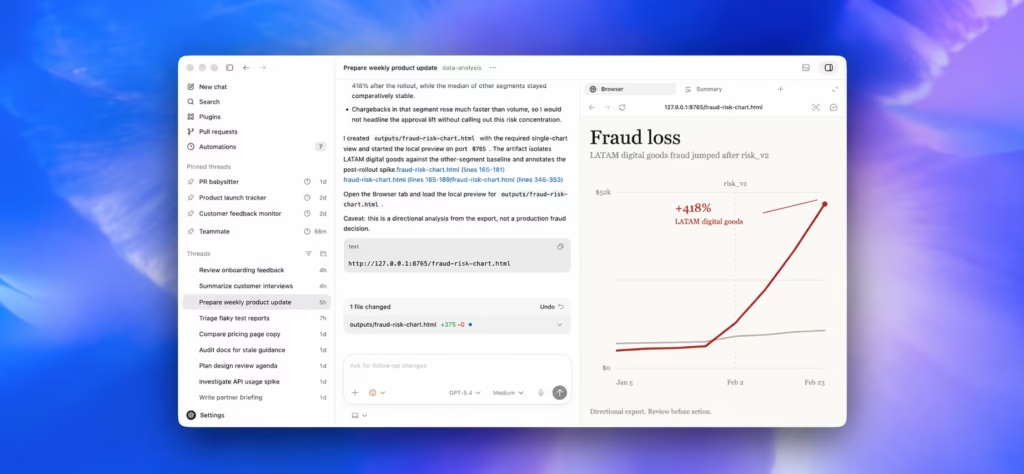
The desktop experience sits between the immediacy of the IDE and the delegation model of the cloud. It is useful when a developer wants a central place to supervise several local or remote workstreams without turning every task into a sequence of terminal commands. The important point is not that one surface replaces the others. It is that Codex can support a progression: investigate locally, supervise longer work from the desktop, move suitable jobs into an isolated cloud environment, then return to the repository or pull request for review. OpenAI’s developer overview presents local and cloud work as parts of the same development system.
Codex cloud serves a different need. It runs tasks in isolated environments, can reproduce repository dependencies, and allows several jobs to continue in parallel. Results return as summaries and diffs that can be revised or turned into pull requests; the cloud documentation emphasizes reviewing before merging. Cloud execution is valuable for a test suite that takes time, a self-contained backlog item, or documentation work that should not occupy the local machine. It is less attractive when the repository cannot leave a controlled network or depends on a complicated internal environment that has not been reproduced accurately.
Teams can also write durable repository instructions in AGENTS.md. Codex reads these before working and supports guidance that becomes more specific deeper in the directory tree, as its project instructions explain. This is more consequential than it sounds. A good instruction file can tell the agent which package manager to use, which test command is mandatory, which folders are generated, when it must ask before adding a dependency, and which architectural boundaries it must preserve. The benefit is consistency. The risk is that stale instructions quietly become institutionalized mistakes.
Skills, plugins, and non-interactive execution extend that consistency beyond one prompt. A skill can package instructions, scripts, and reference material for a repeatable activity such as release preparation, migration checks, or frontend QA; OpenAI’s skill guidance explains how those workflows can be reused. Plugins can bundle skills with tool or data connections, as the plugin guidance describes. Non-interactive codex exec runs can place the same agentic behavior inside scripts and CI, with structured output and an exit status that automation can inspect; the automation guidance covers that path. These features do not make a weak engineering process strong, but they can turn a good process from tribal knowledge into something repeatable.
Codex can therefore replace some searching, boilerplate, mechanical refactoring, first-pass debugging, test writing, and change summarization. It can reduce the time between an issue and a reviewable patch. It does not replace product decisions, ownership of the architecture, security accountability, acceptance testing, or the judgment required to decide whether a passing implementation is the right implementation.
How it handles the work developers actually do
For an existing repository, the highest-value first step is usually understanding rather than editing. A strong Codex task asks the agent to locate the relevant entry points, explain the current data flow, identify the likely change surface, and name the tests it expects to run. Only then should it implement. OpenAI’s prompt guidance similarly recommends naming the desired behavior, relevant code or reproduction steps, constraints, and verification. This plan-first approach is slower for a minute and often faster for the next hour because it exposes a wrong assumption before that assumption spreads across six files.
A useful request is concrete about the outcome and the boundary. “Fix checkout” is an invitation to guess. “Reproduce the duplicate charge when a payment retry receives a delayed success response; preserve the public API, do not change authentication, add a regression test and report the commands run” gives the agent a causal target, exclusions and proof requirements. That kind of prompt explains why prompt accuracy deserves substantial weight in our framework: a technically elegant patch can still be a bad result if it solves the wrong problem or changes forbidden code.
For a new website, Codex can scaffold the application, create components, connect routes, add server logic, integrate a database, and prepare deployment-related configuration. But “generate a site” is not a sufficient acceptance standard. A responsible workflow should define the audience, required pages, design constraints, content states, browser sizes, accessibility expectations, form behavior, error states, analytics or consent needs, and the command that proves the build succeeds.
Visual quality requires an extra loop. Code can be valid while the page is awkward: text may wrap badly, contrast may be weak, the mobile menu may cover content, or a loading state may shift the layout. Where browser access is enabled, Codex can use the running application rather than reason only from source: open the page, interact with controls, observe rendered states, compare the result with the request, return to the code and repeat. OpenAI’s browser guidance makes that workflow especially relevant to browser-assisted web development.
That is one reason Codex scores particularly well for full-stack and frontend work. It can connect a UI change to routes, server logic, data access, tests, and build commands, then add a visual check instead of treating the interface as a collection of syntactically correct components. The useful standard is still explicit: inspect representative widths, test keyboard navigation, trigger loading, empty and error states, and retain screenshots or reproducible browser steps as evidence. Browser assistance reduces the gap between “the code compiles” and “the experience works”; it does not eliminate the need for human design judgment or accessibility testing.
Debugging is where repository reasoning becomes more important than generation speed. A good agent should reproduce the symptom, identify the failing path, distinguish cause from downstream noise, and make the smallest change that explains the recovery. Codex is well suited to this loop when it can run the application or tests. It is less reliable when the failure depends on unavailable production data, an intermittent third-party service, or undocumented infrastructure. In those cases, it may confidently optimize the most plausible local explanation rather than the real remote cause.
Refactoring presents another trap. Passing tests can show that documented behavior survived; they cannot prove that undocumented behavior, performance characteristics, or operational assumptions survived. Before delegating a broad refactor, teams should identify compatibility contracts, add characterization tests where coverage is thin, and divide the work into reviewable steps. Asking an agent to “clean up the whole repository” produces a large diff that is difficult to trust even when much of it is good.
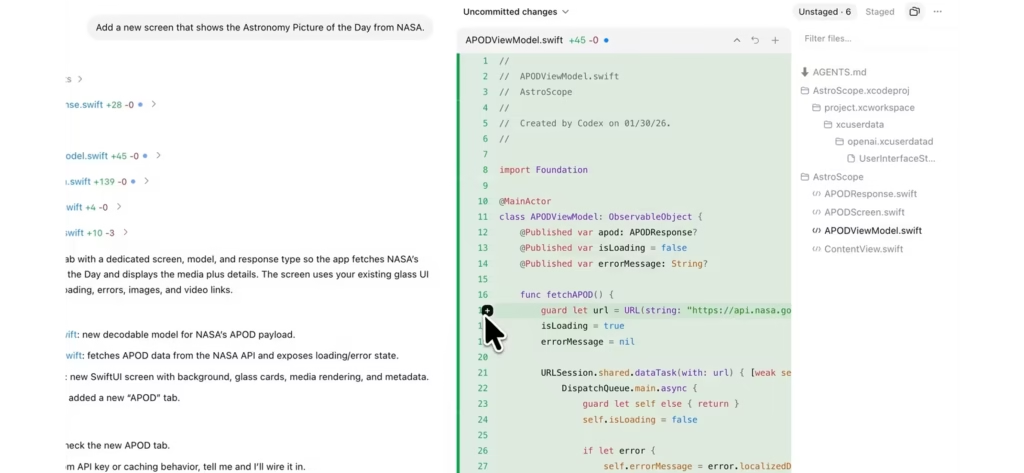
The last stage is review. Codex can inspect a branch, commit, working tree, or selected files and report prioritized findings without changing the code. Its review workflow supports line-specific feedback, staged and unstaged changes, and follow-up fixes. This is valuable, but using the same system to write and approve a change creates correlated blind spots. For security-sensitive or business-critical work, an independent human or at least a separate review pass with explicit adversarial criteria should challenge the assumptions made during implementation.
In practice, Codex delivers the most value when a task has five ingredients:
- a specific outcome rather than an open-ended wish;
- enough repository and environment access to investigate the real problem;
- explicit boundaries around files, behavior, and dependencies;
- executable checks such as tests, type checks, builds, or reproducible browser steps;
- a human prepared to inspect the diff and decide whether the evidence is sufficient.
Remove one of those ingredients and the review burden rises. Remove several and the agent becomes an unusually articulate source of unverified code.
The model behind the agent
The latest model officially available in Codex at our cutoff was GPT-6 Astra, selectable as gpt-6-astra. OpenAI began its rollout during the August 31–September 4 release window documented in its rollout record. By September 16, it was available to eligible Plus, Pro, Business and Enterprise accounts, with administrator enablement also required for Enterprise. Pro, Business and Enterprise users additionally received GPT-6 Astra Pro. OpenAI’s model documentation positioned Astra as its most capable option for complex work across code, applications, and research and listed it across the desktop and web apps, CLI, IDE extension, cloud, and API.
That release timing matters. Astra was less than two weeks old when our research closed, so its capabilities were current but its public track record was necessarily immature. OpenAI said Astra improved advanced reasoning, computer use, and judgment for complex workflows. In Codex, it could also continue working while asking an asynchronous clarification and use an experimental mechanism for preserving notes and searching earlier context windows. Those features address real agent problems: long tasks can drift, early constraints can disappear during compression, and a question to the user can otherwise stall the entire run. Experimental context support, however, is not the same as perfect memory.
OpenAI reported 57.9% for Astra on Terminal-Bench 4.0, compared with 37.3% for GPT-5.6 Sol and 55.8% for Claude Fable 5.1 in its release benchmark. That is evidence of stronger terminal-agent performance under OpenAI’s setup, not a promise that Astra will solve 57.9% of a buyer’s tickets. Harness design, tool access, reasoning effort, prompt construction, time limits, and grading all influence an agent benchmark.
Independent evidence both supports and complicates the vendor story. Artificial Analysis scored Astra in Codex at 62 on its Coding Agent Index, tied with Claude Fable 5.1 in Claude Code and ahead of GPT-5.6 Sol at 55. At maximum effort, it estimated $7.09 per task, about 15% more than Sol but roughly 40% less than Fable 5.1 for the same index score. Astra gained on Terminal-Bench and repository question answering but scored below Sol on DeepSWE, 68% versus 72%. The independent benchmark is useful because it shows that a newer flagship can be clearly better overall and still regress on a meaningful slice of coding work.
Model choice should therefore follow task economics. Astra is sensible for ambiguous bugs, architecture, cross-file work, and difficult reviews. A smaller, faster model can be the better tool for routine formatting, a known one-file change, or repetitive test generation. The most expensive model is wasteful if the task is already deterministic; the cheapest model is expensive if a senior engineer must repair its assumptions. Total cost is subscription or token spend plus waiting time plus reviewer time plus the risk of a defect reaching production.
Why our score lands at 9.33
Our weighting deliberately favors accepted output over spectacle. Coding and web-development quality receives 25% because a tool that produces fragile, insecure, or unmaintainable code creates downstream work. Prompt accuracy receives 20% because scope violations can be as damaging as syntax errors. AI intelligence and features each receive 15%, recognizing both the reasoning engine and the workflow around it. Speed and user rating receive 10% each. Review confidence receives 5% because public sentiment is useful only to the extent that its source, sample,e and product relevance deserve trust.
| Evaluation Factor | What It Measures | Weight |
|---|---|---|
| AI Intelligence | Architectural reasoning, repository understanding, causal debugging, context retention, tool selection, recovery from failed approaches, and handling complex multi-step work | 15% |
| Speed | Time and consistency from request to accepted, runnable code; includes latency, number of retries, tool-call efficiency, and time to a verified revision | 10% |
| Coding & Web Development Quality | Correctness, test pass rate, maintainability, architecture, security, frontend polish, responsiveness, accessibility, backend and database integration, and deployability | 25% |
| Prompt Accuracy | Fidelity to requested behavior, stack, file scope, UI details, constraints, exclusions, coding standards, and “do not change” instructions | 20% |
| User Rating | Normalized public satisfaction from credible software-review platforms, using the most product-specific and recent rating available | 10% |
| Review Confidence | Review authenticity, sample size, recency, source diversity, and whether the reviews describe the current product rather than an older version | 5% |
| Features & Usability | IDE, terminal, browser, cloud-agent and Git/PR workflows; repository indexing; previews; testing; deployment; rollback; integrations; controls; onboarding; and learning curve | 15% |
The 9.6 AI-intelligence score reflects more than code recall. Our definition includes architectural reasoning, repository understanding, causal debugging, context retention, tool selection, recovery from failed approaches, es and complex multi-step work. Codex can inspect unfamiliar code, use commands to test a hypothesis, and revise when the first attempt fails. That makes it credible for maintenance work, where the problem is rarely “write a function from scratch.” It still needs access to the evidence: no model can infer a private production trace it has never seen.
Coding and web-development quality also scored 9.6 and contributes 2.40 points more than any other factor. We finalized that high score because Codex combines code generation with the surrounding work that makes code usable: tests, architecture, frontend polish, responsive behavior, accessibility, backend and database integration, security considerations, and deployability. The score means “excellent under our framework,” not “4% of outputs are wrong.” The supplied evidence does not contain enough task-level data to translate it into a failure rate.
Prompt accuracy scored 9.3. This is strong but meaningfully lower than the two 9.6 scores because following the requested behavior, stack, file scope, UI details, exclusions,s and “do not change” rules is a separate capability from writing good code. A system can understand a repository and still broaden scope unnecessarily. The practical response is not a longer prompt filled with every imaginable warning. It is a clearer contract: desired outcome, non-goals, allowed change surface,ce and verification steps.
Features and usability scored 9.4. Codex covers desktop, IDE, terminal, cloud-agent, and Git or pull-request workflows while supporting repository indexing, browser-assisted checks, tests, deployment-related work, rollback, integrations, and permissions. The CLI exposes model choice, reasoning effort, review modes and cloud handoff; MCP connections extend the tools it can reach; skills, plugins and CI execution let a team reuse a workflow instead of rebuilding it in every prompt. That combination is why we describe Codex as an end-to-end option rather than a code generator with extra buttons.
The score stops short of perfect because breadth has a cost. More surfaces mean more configuration, more permission decisions,s and more ways for local, cloud,ud and organizational policies to diverge. It also creates lock-in pressure. Once a team stores instructions, review policies and integrations around one agent, switching costs grow. Important engineering standards should remain in portable repository files, CI configuration, and human-readable documentation rather than exist only inside a vendor account.
Speed scored 9.0. Our definition measures time from the request to accepted runnable code, including latency, retries, tool-call efficiency,y and the time needed to verify a revision. This is why we did not reward fast text generation by itself. Codex can return an answer quickly and still lose on speed if a reviewer must ask twice for the missing test. Its 9.0 is strong, but Cursor at 9.4 and Replit at 9.3 have a better argument for users whose work consists mainly of short, rapid iterations.
User rating scored 9.4, while review confidence scored 7.6, the lowest confidence score among the six products. We separated these factors deliberately. The first captures how positive the selected public signal is after normalization; it is not a mechanical “stars multiplied by two” formula. The second asks how much weight that signal deserves based on authenticity, sample size, recency, source diversity, ty and whether reviews describe the current product. Codex can have a perfect 5.0/5 headline rating and still receive a lower confidence score because the selected source contains only 87 reviews and other direct professional sources are positive but not perfect.
The total reaches 9.33 because the four factors covering intelligence, code quality, prompt accuracy, and features account for 75% of the framework, and Codex scores between 9.3 and 9.6 on all four. Review uncertainty lowers the result, but only at its stated 5% weight. This is also why readers should not borrow our ranking without examining our priorities. A team that doubles the importance of IDE speed could put Cursor first; a team that emphasizes the hardest reasoning and architecture work could widen Claude’s lead.
There are visible methodological limits. The attached scorecard does not publish task counts, repository languages, project sizes, hardware, test environments, error distributions, or confidence intervals. The weights reflect our view of buyer value. Consequently, Claude’s 9.36, Codex’s 9.33 and Cursor’s 9.29 form a practical top tier, not three statistically proven levels of quality. Two decimal places make the arithmetic transparent; they do not make the underlying judgment more certain than the evidence.
Comparisons Before You Buy
Choose the workflow before the log.o
The overall ranking is Claude 9.36, Codex 9.33, Cursor 9.29, Devin 9.03, GitHub Copilot 8.,91 and Replit 8.87. Those numbers are useful summaries, but a purchasing decision should start with the kind of work being purchased.
| Product | Overall Score | AI Intelligence | Speed | Coding and Dev Quality | Prompt Accuracy | User Rating | Review Confidence | Features & Usability | Best For |
|---|---|---|---|---|---|---|---|---|---|
| Claude | 9.36 | 9.8 | 8.6 | 9.7 | 9.5 | 9.4 | 8.8 | 8.8 | Complex debugging, refactors, architecture, workflows. |
| OpenAI Codex | 9.33 | 9.6 | 9.0 | 9.6 | 9.3 | 9.4 | 7.6 | 9.4 | End-to-end development across every workflow |
| Cursor | 9.29 | 9.4 | 9.4 | 9.1 | 9.1 | 9.4 | 9.4 | 9.6 | AI embedded across everyday development |
| Devin | 9.03 | 9.0 | 9.1 | 8.9 | 8.8 | 9.0 | 8.8 | 9.6 | Teams coordinating agents across workstreams |
| GitHub Copilot | 8.91 | 8.8 | 9.0 | 8.7 | 8.6 | 8.8 | 9.5 | 9.6 | GitHub teams wanting AI in-IDE |
| Replit | 8.87 | 8.7 | 9.3 | 8.4 | 8.7 | 9.0 | 9.3 | 9.5 | Rapid full-stack building with hosting |
Claude is the stronger choice for the hardest reasoning-led work. It leads Codex in AI intelligence, 9.8 to 9.6; coding quality, 9.7 to 9.6; and prompt accuracy, 9.5 to 9.3. That profile suits difficult debugging, architectural tradeoffs, large refactors,ors and workflows where one subtle decision matters more than interface breadth. Codex is faster, 9.0 to 8.6, and stronger on features, 9.4 to 8.8. A buyer should not interpret Claude’s 0.03 overall advantage as a universal win; it is a narrow result created by a specific strength profile.
Cursor is the stronger choice for an IDE-first developer. Its 9.4 speed and 9.6 features scores exceed Codex’s 9.0 and 9.4, and its review-confidence score is much higher, 9.4 versus 7.6. Cursor keeps assistance close to the edit loop, which matters when the user wants dozens of small interactions rather than a delegated task. Codex counters with higher intelligence, 9.6 versus 9.4; coding quality, 9.6 versus 9.1; and prompt accuracy, 9.3 versus 9.1. The 0.04 overall difference is too small to overrule workflow preference. Cursor can reasonably be number one for a developer who lives in the editor.
Devin is more compelling when coordination is the product. It’sa 9.6 features score and 9.1 s, supporting teams assigning work across agent-led streams. Codex is stronger on intelligence, 9.6 to 9.0; coding quality, 9.6 to 8.9; and prompt accuracy, 9.3 to 8.8. That creates an overall 9.33 versus 9.03 advantage for Codex. The choice is not simply “better agent.” It is whether a team values individual task quality more than an operating model built around coordinated autonomous work.
GitHub Copilot remains the low-friction choice for GitHub-centered teams. It matches Codex at 9.0 for speed, reaches 9.6 for features, and has the field’s highest review-confidence score at 9.5. Its advantage is familiarity inside an established developer platform. Codex is substantially ahead on intelligence, 9.6 versus 8.8; coding quality, 9.6 versus 8.7; and prompt accuracy, 9.3 versus 8.6. That explains the 9.33 to 8.91 overall gap. Copilot may still win when deployment effort, procurement simplicity,y and developer habit matter more than our reasoning-heavy categories.
Replit is the practical choice for rapid creation with hosting close at hand. It scores 9.3 for speed and 9.5 for features, slightly above Codex on both. It is attractive for a founder, student,nt or small team trying to move from a blank page to a hosted full-stack prototype without assembling a separate local toolchain. Codex is much stronger on intelligence, 9.6 versus 8.7; coding quality, 9.6 versus 8.4; and prompt accuracy, 9.3 versus 8.7. The result is 9.33 versus 8.87 overall. Replit shortens the road to a demo; Codex is the safer default when the result must settle into a maintained repository.
Why we chose Product Hunt and why we discounted it
Public ratings are useful because they capture friction that controlled tests can miss: onboarding, reliability, support, billing, interface changes, and whether people still enjoy using the product after the first impressive demo. They are also messy. Different platforms attract different users, apply different moderation systems,s and may rate a mobile application, a company, or a specific development product. We therefore did not select whichever page displayed the highest stars.
Our source hierarchy was: first, does the listing clearly refer to the product we are scoring; second, is the audience relevant to that product; third, is the rating accompanied by a visible sample size; fourth, what authenticity and moderation controls are documented; fifth, is the sample large and current enough to resist a handful of extreme reviews? Recency was judged against the September 16, 2026 cutoff, and duplicated or historical listings were kept separate. No single platform won every criterion for all six products, which is why forcing every tool onto the same review site would have created a different kind of inconsistency.
The direct Codex evidence itself was broader than the one rating shown in our comparison image. Our September 16 snapshot found TrustRadius at 8.6/10 from 20 reviews and ratings, equivalent to 4.3/5; Gartner Peer Insights at 4.5/5 from 42 ratings; G2 at 4.7/5 from 19 reviews; Product Hunt at 5.0/5 from 87 reviews; and SourceForge at 5.0/5 from one review. The verified direct range was therefore 4.3 to 5.0, not a unanimous 5.0. Each source helped answer a different question.
| Product | Source used | Public Rating | Votes & Reviews |
|---|---|---|---|
| Claude | Google Play Store | 4.5/5 | 734K+ reviews |
| OpenAI Codex | Product Hunt | 5.0/5 | 87+ reviews |
| Cursor | Product Hunt | 5.0/5 | 947+ reviews |
| Devin | G2 | 4.3/5 | 83+ reviews |
| GitHub Copilot | G2 | 4.4/5 | 386+ reviews |
| Replit | Google Play Store | 4.5/5 | 50K+ reviews |
For the headline user-rating input, we chose the current Product listing: 5.0/5 from 87 reviews. The decisive reasons were product identity and sample size. The page describes “Codex 3.0 by OpenAI,” links to the current chatgpt.com/codex product and had the largest direct Codex review pool we could verify. Product Hunt’s product pages are intended to collect a named product’s launches, reviews, team information and history, as its page guidance explains. Its technology-oriented community is also more relevant to an evolving coding agent than a general consumer-app audience.
We did not inflate that 87-review pool by merging related pages. The separate CLI listing had 31 reviews and describes the terminal-focused experience. The historical listing had 21 reviews and belongs to the 2021 generation of Codex. Both are relevant background, but combining different generations and surfaces would make the sample look larger while weakening product identity—the very quality that made Product Hunt useful in the first place.
Why not choose Gartner instead? For an enterprise buyer who wants a structured professional benchmark, Gartner may be the more useful primary signal. The dedicated Gartner profile showed 4.5/5 from 42 ratings, including current 2026 feedback, and a visible distribution of 50% five-star, 45% four-star, and 5% three-star ratings. That is a stronger professional context than a launch community provides. We retained Product Hunt for our headline because our user-rating category sought the largest current, direct public product sample; we used Gartner to test whether that enthusiasm also appeared among professional reviewers. It did, but at 4.5 rather than a perfect 5.0.
The other professional sources made the same point. The TrustRadius profile showed 8.6/10 from 20 reviews and ratings, which we converted to 4.3/5 only to make the range easier to read. We did not pretend that a converted ten-point score is identical to a native five-star rating. Our September G2 category snapshot showed 4.7/5 from 19 reviews, while an older direct G2 profile still displayed a stale 5.0/5 from four reviews. We preferred the fresher 19-review snapshot, but the inconsistency reduced its value as the single headline source. The SourceForge profile showed 5.0/5 from one review—a real data point with almost no power to establish general satisfaction.
Several larger-looking numbers were excluded because they measured the wrong thing. OpenAI’s company-level Trustpilot profile was approximately 1.3/5 from 1,185 reviews at the cutoff, but those reviews mixed Codex with ChatGPT, image generation, APIs, account access, billing,g and refund disputes. Some posts discussed Codex, yet the aggregate was not a Codex score. Google Play and Apple App Store ratings for ChatGPT had the same identity problem: Codex did not have a clean standalone mobile rating that could be separated from the much broader ChatGPT experience.
We also declined to manufacture an aggregate where a platform did not clearly publish one. The AlternativeTo listing showed 25 likes and two visible five-star comments, but no defensible aggregate rating-and-count pair comparable with the other sources. SourceForge and Slashdot displayed the same underlying review text, so they were treated as one pool rather than two independent votes. Capterra and PeerSpot were left out because we could not verify a current Codex-specific score with a visible count by the cutoff.
This source work explains both our choice and our caution. Product Hunt was not chosen because 5.0 was the most flattering number; SourceForge also showed 5.0, and we rejected it as the headline because one review is plainly inadequate. Product Hunt was chosen because 87 was the largest current direct Codex sample and the listing most clearly matched the product generation being scored. Gartner, TrustRadius and G2 then provided a professional cross-check. Their 4.3-to-4.7 results support the conclusion that sentiment is strongly positive while warning against reading Product Hunt’s perfect score literally.
Nor did we average the five sources. A simple mean would treat one SourceForge reviewer as though that observation were equivalent to 87 Product Hunt reviews, ignore differences in audience and moderation, and disguise the conversion applied to TrustRadius. A count-weighted mean would still assume that all platforms sample the same population and ask the same question. They do not. We used one clearly defined source for the comparable headline, then used the others to assess confidence and explain uncertainty.
Product Hunt still has limitations. Launch communities can overrepresent enthusiasts, makers, rs and people engaging near an announcement. Product Hunt documents automated detection, community reporting, and manual action against suspicious voting activity in its voting safeguards, but vote-integrity controls are not the same as verified proof of sustained workplace use for every reviewer. The page’s own summary also identifies complaints about slower execution, weak usage or progress visibility, context limits on large repositories,s and memory use in long sessions. A perfect average should not make those recurring concerns disappear.
The contrast with Cursor shows why sample size matters. Cursor also recorded 5.0/5 on Product Hunt, but from 947+ reviews, roughly eleven times Codex’s count. The platform bias is similar, yet Cursor’s larger body of opinion is less vulnerable to a small cluster of unusually positive reviewers. That helps explain Cursor’s 9.4 review-confidence score versus Codex’s 7.6, although volume alone still does not prove representativeness.
For Claude and Replit, our selected Google Play figures were 4.5/5 from 734K+ reviews and 4.5/5 from 50K+ reviews, respectively. Those enormous samples provide stability and reflect real interaction with each mobile application. Google describes user reviews as a way to share personal app experience and inform download decisions in its review guidance. The limitation is relevance: mobile-app satisfaction is not the same as repository-scale coding quality. Claude’s rating may include general chat, and Replit’s may include learning or mobile creation experiences. We treated these as broad usability and satisfaction signals, not direct measurements of architecture or code correctness.
For Devin and GitHub Copilot, we selected G2: 4.3/5 from 83+ reviews for Devin and 4.4/5 from 386+ reviews for Copilot. G2’s business-software audience better matches team adoption and procurement. It also documents human moderation, account sign-in, optional proof-of-use material,l and conflict-of-interest checks through its review safeguards. G2 still has self-selection bias, and a review may describe an earlier version or a different plan.
This is why user rating and review confidence remain separate. Sentiment tells us what people reported; confidence tells us how cautiously to use it. Codex’s 9.4 user-rating score recognizes an unusually positive current community signal. Its 7.6 review-confidence score recognizes that the direct sample is still small, the platforms attract different populations, and the strongest professional signals are slightly less enthusiastic. Public opinion supports the product’s strong overall result; it is not mature enough to decide a 0.03-point contest by itself.
Price, limits, security and the cost of a real trial
As of our cutoff, Codex was included with Free, Go, Plus, Pro, Business, Edu and Enterprise plans. Individual list pricing in OpenAI’s pricing documentation was $0 monthly for Free, $8 monthly for Go, $20 monthly for Plus, and Pro from $100 monthly. Plus included Codex on the web, in the CLI, IDE extension, and iOS, along with cloud integrations such as automatic code review and Slack.
The important constraint is usage. OpenAI estimated roughly 5–45 local Astra messages per five-hour period on Plus; the number varies with task size, reasoning, context,t and tool use. Local messages and cloud chats share the allowance, and weekly limits may also apply. The official usage limits are estimates, not a promise that 45 difficult repository tasks will fit. One long debugging session can consume far more capacity than several focused edits.
Plus and Pro users who reach included limits can purchase credits, choose a smaller model, el or use an API key at standard API rates for supported local workflows. This makes the nominal subscription price only the first part of the cost. A $20 plan is poor value if it repeatedly stops in the middle of paid work; a $100 plan is poor value if most tasks could have been completed with a smaller model and better scope.
Our recommended plan is ChatGPT Plus billed monthly because it gives an individual buyer Codex across web, CLI, IDE, and iOS plus Astra access for $20 without an annual commitment. OpenAI lists individual plans monthly, so we found no verified Plus annual discount to compare and no responsible reason to manufacture a yearly equivalent. Buyers should confirm local availability, currency conversion, and tax-inclusive checkout pricing.
Free or Go makes sense for learning the interface, testing a small repository, and deciding whether agentic coding fits at all. Pro becomes rational when Plus limits repeatedly interrupt billable work and the value of the lost time exceeds the price difference. The test should be repeated usage, not one oversized project that happened to exhaust an allowance.
For two or more users, Business costs $20 per user per month when billed annually or $25 per user month-to-month. Annual billing saved $5 per user each month, or $60 per seat over twelve months, but imposed a commitment. A team that has not yet proven its workflow should generally validate it month-to-month before buying the discount. Business also added a dedicated workspace, SAML SSO, MFA, larger virtual machines, es and no training on business data by default. Enterprise used quoted pricing and added deeper identity, monitoring, audit, retention, and residency controls.
Privacy and permissions can change the correct plan. On personal accounts, the “Improve the model for everyone” control also governs new Codex tasks, while full-environment training has a separate setting described in OpenAI’s data controls. OpenAI states that Business and Enterprise data are not used for model training by default under its business privacy commitments. A company working with regulated information, client repositories, or unreleased intellectual property should evaluate workspace controls and contractual terms, not simply buy several personal subscriptions.
Execution access deserves equal attention. Codex supports sandboxing, approval boundaries, and network controls; OpenAI’s security controls distinguish ordinary workspace access from broader or unapproved execution. The safe default is least privilege: expose only the repository and services necessary for the task, keep secrets out of prompts and committed files, restrict network access where possible, inspect new dependencies, and require explicit approval for destructive or externally visible actions. A capable agent with broad credentials can make a capable mistake.
Before committing to any plan, run a trial that resembles real work. Use at least three tasks: a contained bug with a reproducible test, a cross-file feature with explicit exclusions, and a frontend change that requires visual inspection. Record elapsed time to an accepted patch, corrective turns, tests passed, scope violations, reviewer minutes,s and any defects found after the agent declared completion. Repeat comparable tasks with the strongest alternative. The winner is not the tool that writes the most code; it is the one that reduces total verified delivery time without increasing operational risk.
Conclusion
Codex is a strong fit for an individual developer or technical team that wants end-to-end implementation across terminal, IDE, desktop, browser, cloud,ud and pull-request workflows. Its main advantage is not a single category win. It is the ability to carry context from investigation through planning, implementation, visual or executable verification and review, and to turn successful practices into reusable skills, plugins,s or CI workflows.
Our 9.33 overall score reflects that balance. Codex earns 9.6 for AI intelligence, 9.6 for coding and web-development quality, 9.3 for prompt accuracy,cy and 9.4 for features and usability the four categories that make up 75% of our weighting. Its 9.0 speed is strong rather than leading. Its 9.4 user-rating score recognizes Product Hunt’s 5.0/5 from 87 reviews; the 7.6 review-confidence score then accounts for that modest sample and for the 4.3-to-4.7 results from TrustRadius, Gartner and G2. Source selection affects the confidence attached to the rating, not the code-quality score.
The narrow ranking gaps matter. Claude leads Codex by 0.03 and is the better first choice when difficult architecture, debugging, or a major refactor dominates the workload. Cursor trails Codex by 0.04 and can still be the better purchase for fast, continuous IDE work. Devin suits coordinated agent operations; GitHub Copilot suits teams prioritizing GitHub familiarity and low adoption friction; Replit suits rapid full-stack creation with hosting close to the build experience. Our weights produce one order, but a buyer’s workflow can reasonably produce another.
The most important Codex limitation is not that it sometimes writes incorrect code; every product in this category requires verification. The more consequential limitation is that its polished, end-to-end behavior can make incomplete evidence feel finished. A passing local test does not prove production correctness, a valid build does not prove visual quality, and an agent’s own review does not provide fully independent assurance. Teams that benefit most will define completion criteria before the run and preserve human ownership after it.
For most individual buyers, ChatGPT Plus billed monthly is the responsible starting plan. It provides the relevant Codex surfaces and Astra access for $20 without an annual commitment. Upgrade only when measured usage,e not enthusiasm, shows that capacity limits cost more than the higher plan. Teams should trial Business month-to-month before accepting the annual commitment, especially when governance and collaboration are part of the purchase.
Codex deserves a serious trial, but not a ceremonial one. Give it the repository, constraints, and checks that represent your real work; measure accepted patches and reviewer time; then compare the result with the alternative that best matches your workflow. The useful decision is not which product owns first place to two decimal points. It is which one repeatedly turns a difficult request into maintainable, verified software with the least total human correction.
FAQ
Why did we use Product Hunt for Codex’s headline rating instead of Gartner, G2,2 or TrustRadius?
Product Hunt had the largest review pool that clearly matched the current Codex product: 5.0/5 from 87 reviews on the Codex 3.0 listing linked to chatgpt.com/codex. Gartner’s 4.5/5 from 42 ratings is arguably the stronger enterprise benchmark, while TrustRadius and G2 provide useful professional-user checks. However, each had a smaller direct sample, and G2’s category and product pages showed inconsistent review counts.
We therefore used Product Hunt for the standardized headline user-rating input and used the other platforms to judge confidence. This is also why Codex receives 9.4 for user rating but only 7.6 for review confidence. An enterprise procurement team should read Gartner alongside the Product Hunt result rather than treating either source as sufficient by itself.
How can Codex score 9.33/10 when its selected public rating is 5.0/5?
The overall score is not a converted star rating. Public user sentiment accounts for only 10% of the model, while review confidence accounts for another 5%. The remaining 85% assesses AI intelligence, delivery speed, coding and web-development quality, prompt accuracy, and features and usability.
Product Hunt’s 5.0/5 supports a strong user-rating score, but the modest 87-review sample and the 4.3-to-4.7 results on professional platforms reduce confidence in treating that perfect average literally. Codex reaches 9.33 mainly because it scores between 9.3 and 9.6 in the heavily weighted areas of repository reasoning, code quality, instruction fidelity and workflow breadth not because one review website displays five stars.
When is Codex a better choice than Claude or Cursor even though Claude ranks slightly higher?
Codex is the stronger practical fit when the work must move through several stages and surfaces: inspect an unfamiliar repository, plan a change, edit files, run local tools, test in a browser, review the diff, and continue a longer task in the cloud.
Claude has a narrow advantage in our reasoning-led categories and is the better first option for especially difficult architecture, causal debugging or major refactoring. Cursor is often preferable when the developer wants extremely fast, continuous interaction inside the editor. The 0.03 gap between Claude and Codex and the 0.04 gap between Codex and Cursor are too small to outweigh workflow fit. Buyers should compare the tools using the same repository tasks and measure accepted delivery time, corrective prompts and reviewer effort rather than selecting solely by overall rank.
What evidence should a developer require before accepting a Codex-generated change?
A completion message is not enough. For a backend or repository change, require a scoped diff, the exact commands run, relevant test results, type or lint checks, and an explanation of any dependency, schema or configuration changes. Check whether Codex edited files outside the agreed boundary and whether its regression tests would actually have failed before the fix.
For frontend work, add browser checks at representative widths, keyboard navigation, loading, empty and error states, and screenshots or reproducible interaction steps. Security-sensitive work should receive an independent human review because an agent can repeat the same mistaken assumption in both implementation and self-review. The acceptance standard should be defined before execution so that “done” means verified behavior, not merely generated code.
Which Codex plan should an individual or team start with, and when is an upgrade justified?
An individual should generally begin with ChatGPT Plus billed monthly, then test Codex on representative work rather than synthetic prompts. Track how often usage limits interrupt paid work, how many tasks require the most capable model, how much reviewer time the tool saves and whether cloud execution is genuinely useful.
Pro becomes defensible when repeated capacity interruptions cost more in lost time than the plan difference not simply because one unusually large task exhausts an allowance. Teams should consider Business when shared governance, SSO, workspace controls and default protection of business data matter, and should validate the workflow month-to-month before accepting an annual commitment. Enterprise is a governance and procurement decision involving audit, retention, residency and contractual requirements, not merely a way to obtain more coding capacity.