


Introduction
v0 by Vercel is at its best when you have an interface brief and need working code you can edit. In our hands-on research, finalised on October 1, 2026, it takes first place among six evaluated tools, with an overall score of 8.95/10. Its strengths show up in the work between an idea and an implementation: following the brief, iterating quickly, understanding a repository, and working with a design system.
Vercel developed v0 to generate interfaces from natural-language descriptions. The October 11, 2023 launch announcement documents its move from an earlier alpha to beta, producing code with React, Tailwind CSS, and shadcn/ui. Vercel’s company history goes back further and includes its 2020 renaming from ZEIT. The company’s origins and v0’s launch are separate milestones; we do not assign v0 an individual founder.
In its February 3, 2026 product update, Vercel says v0 became generally available in 2024 and that more than four million people had used it. That figure counts cumulative users. We could not verify a reliable public count of paid v0 subscribers as of October 1, 2026.
This review looks at what v0 delivers as an AI for UI/UX & Web Design, where its competitors have an edge, what customers report, and which subscription makes sense. Our ranking reflects our research, criteria, and tested conditions. It is not an official industry ranking or a verdict for every buyer. Another researcher could reasonably put Claude or another tool first using different priorities. Public ratings add context; they do not independently establish our performance scores or overall ranking.
Performance
Models, access, and the development workflow
At the factual cutoff, v0’s official pricing lists v0 Mini, v0 Pro, v0 Max, and v0 Max Fast. Vercel positions these options around different combinations of capability, speed, and token cost. Plus, Business, and Enterprise advertise access to all v0 models. These are documented product options. Their marketing descriptions are not additional measurements from our team. The model documentation describes an updated picker for Enterprise workspaces, including custom models from AI Gateway that require a team owner’s approval. Your available models depend on your plan and workspace configuration.
There is also a distinction between the v0 web product, an API model, and the underlying model provider. Vercel’s architecture explanation describes a composite system: a base language model works alongside retrieved context, editing, and error-correction components. The API overview describes programmable access to an app-building agent. The documentation we verified does not establish a fixed, comprehensive provider mapping for every current web option. An older API identifier therefore should not be assumed to power every interaction.
For a buyer, much of v0’s value sits in the workflow around those models. Its documented capabilities include:
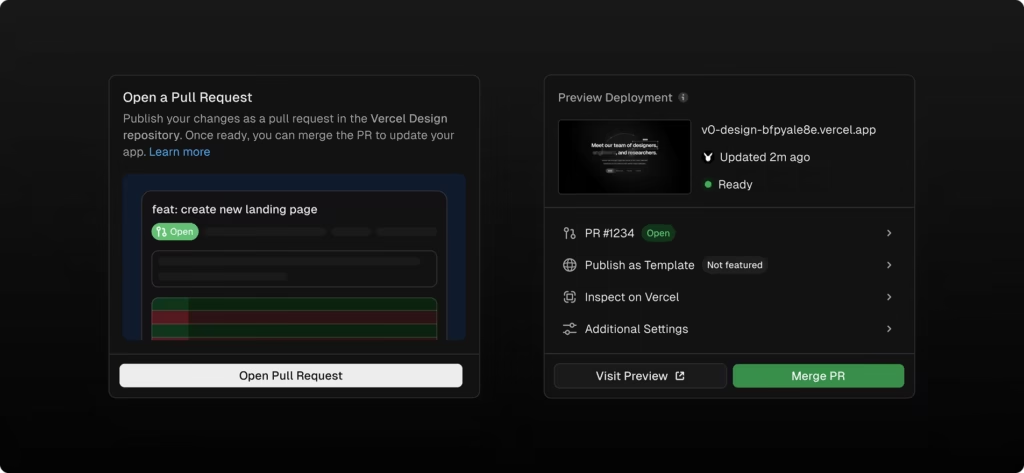
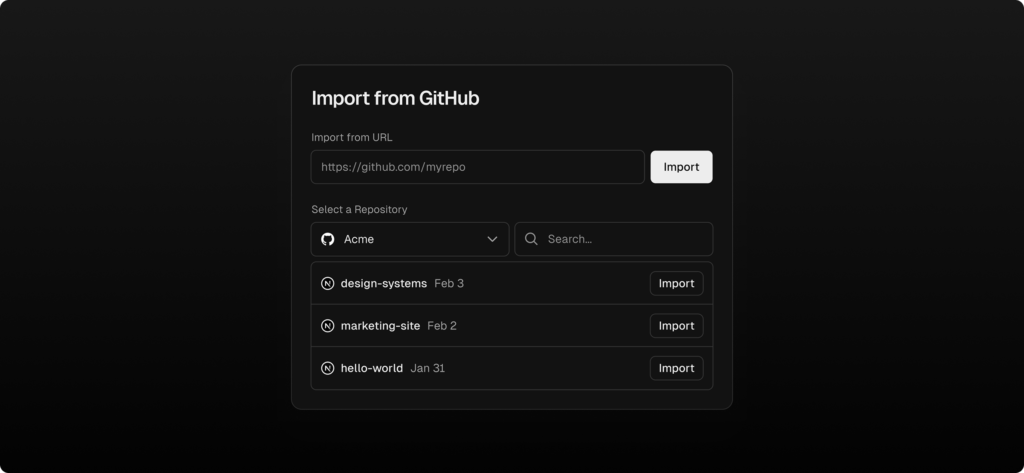
- Repository work: GitHub import, working branches, commits, pull requests, and code review through the integrated editor.
- Executable previews: a real Node.js environment supporting server code, API routes, dependencies, and database connections.
- Visual iteration: selecting interface elements, changing their presentation, and applying those changes to code.
- Development checks: shell commands, unit tests, browser interaction, and error investigation.
- External tools: integrations and Model Context Protocol, or MCP, connections that give the agent access to additional services.
Vercel covers repository and editor features in its workflow guidance, the Node.js environment in its sandbox documentation, and shell, browser, and MCP capabilities in its agent documentation. These capabilities help with implementation. However, their availability does not guarantee that every generated application receives complete testing.
What our hands-on findings mean
Our experience points to four tasks v0 handles particularly consistently: translating instructions into code, iterating toward a usable result, understanding repository context, and working within a design-system path. Those findings explain its 9.2/10 scores in AI Intelligence, Speed, and Prompt Accuracy. That combination matters when your brief has boundaries. A frontend team might need a new account page that keeps the existing navigation, uses established components, and changes only a defined part of the application. Our findings favour v0 for that kind of controlled implementation work.
The design controls make refinement more direct. You can select an element in the preview and adjust typography, spacing, colours, borders, or content. Applying those edits generates a new code version. Design Mode requires a supported preview runtime and the latest chat version, and it is unavailable on mobile viewports. When you already have a visual reference, v0’s screenshot support can interpret the layout and generate an implementation. Its paid Figma integration can read frames, assets, layout information, styles, and tokens. Figma account permissions and rate limits still apply. A screenshot also leaves behaviour unspecified, so explicit instructions for flows and edge cases remain important.
The documented design systems functionality lets teams supply their own components, tokens, and conventions. Together with repository access, that gives a design a route into an existing implementation and helps teams avoid treating every generated screen as an isolated deliverable. Our strongest use-case recommendation is a frontend or product team seeking a polished React/Next.js result, design-system control, and a path into an existing GitHub repository or Vercel workflow.
The main limitation follows from that fit: v0 has a strong React, Next.js, and Vercel orientation. Vercel’s application guide identifies Next.js as the default framework and its most reliable route, though it supports other frameworks. Editing also remains relatively code-oriented. If you want a primarily visual design environment, consider how comfortable you are reviewing an implementation. Our team also found that the visual first draft is not always as distinctive as the output of a specialist design tool. We score v0 at 8.7/10 for UI/UX and web-design quality, below Lovable’s 9.0 and Figma Make’s 9.6. Your plan, model, and credit choices can also materially affect the experience, including speed and output.
What external testing adds
In his July 1, 2026 hands-on review for TechRadar, Christian Cawley used a cryptocurrency-calculator brief that the publication had also used with other builders. He reports that the generated tool satisfied the specified requirements. The review records a creation time of 1 minute 44 seconds, described as v0’s timing. That result is consistent with our Speed and Prompt Accuracy findings. Its scope is still one task, and the reported timing is not an independently established average across workloads. It does not show that a complex application will finish in the same time or that users have validated the resulting experience.
Visual-design research offers a more critical view. AfterQuery’s UI-Bench study, revised September 3, 2025, compared ten tools across thirty prompts using expert pairwise judgments with hidden tool identities. Its reported ordering placed v0 ninth, with Figma Make second and Lovable third. Bolt and Base44 also appeared above v0. Those findings give buyers a reason to consider visual alternatives. The study agrees with our preference for Figma Make and Lovable on design quality, while its ordering of v0 against Bolt and Base44 differs from ours. It evaluates a dated set of visual outputs using a different method and does not cover our full repository, instruction-following, or usability framework.
A good-looking interface still needs review. Visual polish does not establish that navigation is intuitive, keyboard interaction works, screen-reader labels are appropriate, or authentication and data permissions are correct. Vercel’s usage guidance acknowledges that generated output can be incomplete or contain bugs. Human inspection, interaction testing, and UX validation remain part of the job.
These three illustrative scenarios, rather than additional experiments from our team, show what that means in practice:
- A marketer creating a campaign page: v0 can help produce an editable implementation. Review should cover brand consistency, long headlines, mobile layout, and the clarity of the main action.
- A founder prototyping a dashboard: the interface can support discussion, but realistic loading, empty, and error states are needed before judging usability.
- A product team extending a Next.js application: repository and design-system support fit the workflow, while developers still need to inspect changes for regressions and maintainability.
Our seven evaluation factors
All factors and overall scores use a 10-point scale. The names, measurements, and weights below come directly from our evaluation framework.
| Evaluation Factor | What It Measures | Weight |
|---|---|---|
| AI Intelligence | Architectural reasoning; repository and design-system understanding; context retention; debugging; tool selection; multi-step planning; recovery after failed approaches. | 15% |
| Speed | Time and consistency from request to an accepted runnable result, including latency, retries, tool efficiency, tests, and revision time. | 10% |
| UI/UX and Web-Design Quality | Visual hierarchy; typography; spacing; colour; responsive behaviour; interaction states; accessibility/semantics; design-system fidelity; information architecture; originality and polish. | 25% |
| Prompt Accuracy | Requirement coverage; literal adherence; scope discipline; handling of ambiguity; preservation of existing behaviour; quality of follow-up revisions. | 20% |
| User Rating | Weighted public satisfaction from credible review platforms | 10% |
| Review Confidence | Authenticity/verification; sample size; relevance to the current product/version; recency; source diversity; agreement or divergence between platforms. | 5% |
| Features & Usability | Onboarding; visual editing; code/repository control; design-system and Figma import; backend/integrations; testing; deployment; collaboration; accessibility; plan limits and portability. | 15% |
Our research summary supplies these weights and published scores. It does not include a complete task-by-task protocol, measured response-time distribution, or platform-level User Rating calculation. We preserve the findings without inventing the missing methodology.
Comparisons Before You Buy
The tables below reproduce our published scorecard. All scores are out of ten, and rank follows the supplied ordering.
| Product | Overall Score | AI Intelligence | Speed | UI/UX & Web Design Quality | Prompt Accuracy | User Rating | Review Confidence | Features & Usability | Best For |
|---|---|---|---|---|---|---|---|---|---|
| v0 by Vercel | 8.95 | 9.2 | 9.2 | 8.7 | 9.2 | 9.8 | 6.0 | 9.0 | Frontend teams shipping polished Next.js products |
| Lovable | 8.79 | 8.8 | 8.4 | 9.0 | 8.5 | 9.4 | 7.5 | 9.1 | Teams building polished managed-backend SaaS products |
| Figma Make | 8.55 | 7.6 | 7.8 | 9.6 | 8.8 | 9.5* | 4.5 | 8.6 | Figma-driven product prototyping teams |
| Replit Agent | 7.96 | 8.7 | 7.6 | 7.2 | 7.4 | 9.2 | 7.5 | 8.8 | Engineers, students, and teams that want a browser-based repository |
| Base44 | 7.91 | 7.7 | 8.3 | 7.7 | 7.8 | 8.8 | 6.0 | 8.4 | A solo founder, small business, or internal team building a workflow application |
| Bolt.New | 7.65 | 7.8 | 6.5 | 7.8 | 7.0 | 8.8 | 6.5 | 8.5 | JavaScript teams building fast hosted prototypes |
*Figma Make’s User Rating is a parent-product proxy for Figma, not a standalone Make rating. Its Review Confidence score is intentionally reduced for that reason.
Where v0 leads and where alternatives fit better
v0 leads this group in AI Intelligence, Speed, and Prompt Accuracy, scoring 9.2 on each. Those implementation strengths matter in the weighted total: Prompt Accuracy carries 20%, AI Intelligence 15%, Features & Usability 15%, and Speed 10%. Its design-system path and repository workflow help explain why our team prefers it for frontend delivery. The rest of the scorecard adds useful perspective. v0’s 8.7 design score trails Figma Make and Lovable. Its 9.0 Features & Usability score sits just below Lovable’s 9.1. Its 9.8 User Rating is our published public-satisfaction component. Its 6.0 Review Confidence ties Base44, trails Lovable and Replit Agent at 7.5 and Bolt.New at 6.5, and exceeds Figma Make’s 4.5.
The 0.16-point overall lead over Lovable is not decisive evidence that everyone should buy v0. Our research summary does not provide uncertainty bounds, and a better workflow fit can matter more than a small numerical difference. Lovable is the closest alternative for teams building polished, managed-backend SaaS products. It scores higher than v0 on design quality, Features & Usability, and Review Confidence, while trailing on reasoning, speed, and prompt accuracy. We would compare it closely when the application workflow and visual result matter more than v0’s repository-oriented strengths.
Figma Make leads our design-quality assessment at 9.6. Its 8.8 Prompt Accuracy score is also relatively strong, although its reasoning and speed scores are lower. It is especially suitable for Figma-driven product prototyping teams. The Figma parent-product rating adds context, but it cannot establish Make-specific customer satisfaction. Replit Agent suits engineers, students, and teams looking for a browser-based repository and development environment. Its AI Intelligence score of 8.7 and Features & Usability score of 8.8 are stronger than its design quality of 7.2 and Prompt Accuracy of 7.4. We would prioritise it when the broader coding environment matters more than the initial interface.
Base44 fits solo founders, small businesses, and internal teams building workflow applications. Its Speed score of 8.3 is comparatively stronger than its 7.7 scores for reasoning and design quality. Its overall score of 7.91 is only 0.05 below Replit Agent’s. That narrow gap offers little help when choosing between two different workflows. Bolt.New remains relevant to JavaScript teams building hosted prototypes. However, its Speed score of 6.5 and Prompt Accuracy score of 7.0 are the lowest in our comparison. The supplied best-fit description identifies a workflow opportunity. Buyers should still assess the full revision process needed to reach an accepted result.
Your preferred tool can reasonably depend on your work. A design-first buyer may choose Figma Make. A managed-backend SaaS team may prefer Lovable. A frontend team already working with Next.js may find v0 more useful. None of those purchasing preferences requires changing our published ranking.
Customer Review
Public feedback on v0 varies substantially across platforms. The table below preserves our October 1, 2026 research study, sorted from low to high. All ratings here use their original five-point scales.
| Product | Source used | Public Rating | Votes & Reviews |
|---|---|---|---|
| v0 by Vercel | Product Hunt | 4.9/5 | 60+ reviews |
| Lovable | G2 | 4.6/5 | 433+ reviews |
| Figma Make | Trustradius | 4.4/5 | 1.7k+ reviews |
| Replit Agent | G2 | 4.4/5 | 413+ reviews |
| Base44 | Product Hunt | 4.4/5 | 41+ reviews |
| Bolt.New | G2 | 4.3/5 | 96+ reviews |
We found many platforms where customers rate v0 for Vercel. During our October 1 verification, the US App Store page displayed 4.8/5 from 845 ratings. The table preserves our supplied snapshot’s 844 ratings, with the newly observed count reported here separately. G2’s indexed Vercel-associated product listing shows 4.5/5, and its product directory identifies 28 v0 reviews. We could not retrieve the full product page. apps.apple.com
Our team chose Product Hunt as the primary public-review reference because of its review volume, our trust in the source, and the relevance of its product-specific feedback to UI generation and prototyping. Its 60-review sample is larger than the 28-review G2 listing. Volume alone, though, does not establish trustworthiness. We prefer editorial judgment, not a guarantee that every reviewer represents the wider customer base. G2 remains a useful cross-check. Its documented review moderation process examines reviewer identity and relevant professional experience. A smaller sample can still contain feedback worth reading.
Trustpilot’s 1.9/5 from 30 reviews also deserves attention before you purchase. Reviewers describe concerns about costs, credit consumption, unsuccessful revisions, and the overall customer experience. These are reported experiences, not independently verified facts about every account. Trustpilot explicitly warns that the profile’s reviews may not represent all customers because the company has not invited customers to review. That limits generalisation while leaving the criticism relevant to a buying decision. Product Hunt’s explicitly labelled AI-generated review summary highlights useful first iterations, clean React/Tailwind interfaces, and Next.js compatibility. It also identifies concerns about backend and state handling, inconsistent output, prompt sensitivity, and price. The favourable themes align with our implementation findings. The criticism strengthens the case for human review and a realistic credit budget.
Our original Figma snapshot recorded 4.4/5 after our team converted TrustRadius’s ten-point scale, with “1.7k+ reviews.” The verified TrustRadius listing reports the native 8.9/10 observation shown above and separately identifies 209 written reviews within the combined total. Our internal Figma Make score remains 9.5*, with the parent-product proxy explanation intact. The verified Base44 reviews show 41 reviews; our original attachment records “41+.” We could not fully retrieve the competitor G2 product pages, so their supplied figures remain snapshots rather than freshly confirmed totals.
We do not average these platforms together. They cover different products, interfaces, user populations, dates, and potentially overlapping reviewers. The expanded feedback also does not prompt an invented recalculation of our published User Rating scores. v0’s 6.0/10 Review Confidence is a useful reminder to read the favourable rating alongside the uneven public evidence.
Pricing
Our experience with different subscriptions leads to a clear default: buy Plus if you expect to use v0 regularly and will actually use its included credits. The verified subscription documentation and pricing page list the following terms as of October 1, 2026. Prices are in USD and exclude applicable taxes, which depend on your billing address. Plus and Business also advertise $2 in daily credits on login per user. These are conditional daily allowances, not a guaranteed accumulated monthly balance. Included credits give you a spending allowance rather than unlimited generation.
The documented credit rules say unused monthly credits roll over and expire after 65 days. Purchased credits expire one year after purchase and require an active paid plan to use. Individual monthly allowances are separate from purchased shared-pool credits. Generation pauses when credits are exhausted. How far those credits go depends on the selected model, input and output, and relevant context such as project files and chat history. The number of useful iterations a subscription buys will vary. Our recommendation does not assume that $30 of credits will complete a particular number of applications.
Here is how we would choose:
- Choose Plus for regular frontend or product work. The $30 fee includes $30 of monthly credits per user, unlocks all models, supports collaboration, and permits shared extra-credit purchases. The value comes from using the allowance and benefiting from the workflow.
- Choose Free for experimentation or light use within seven messages per day and the applicable credit allowance.
- Choose Business when privacy by default is the deciding factor. It costs $70 more per user per month than Plus, with the same $30 monthly credit allowance. The additional fee primarily pays for the privacy position and default training opt-out.
- Choose Enterprise when you need SSO, role-based access control, priority access, SLAs, or contractual no-training commitments. Confirm contractual requirements in the agreed terms.
- Do not choose Premium as a new customer. Vercel says it is being retired and is unavailable to new users.
Before paying, eligible students should check the student program. It offers one year of complimentary v0 access after verification at a participating school. Eligibility depends on the active school list; the public offer should not be read as a benefit available to every student. v0.app. Existing ChatGPT Plus and Pro subscribers should also examine the subscription connection. Eligible responses from supported OpenAI models can use the connected ChatGPT allowance. Image generation, delegated subagents, and supporting agent work may still consume v0 credits, and the connected plan’s usage limits remain applicable.
v0 billing and Vercel hosting billing are separate. Vercel’s published hosting pricing lists Hobby at $0 per month, Pro at $20 per month, and Enterprise at a custom price, with additional resource and seat terms. Those are hosting plans, not alternative names for v0 Free, Plus, or Business. The documented hosting relationship explains that Vercel Pro does not unlock extra v0 features, while Vercel limits still affect connected projects. As you move beyond a prototype, estimate deployment, database, and other service costs separately.
We could not verify a standard annual v0 subscription price or annual discount in the official public materials. We therefore recommend monthly billing. It gives you flexibility while you establish your workload and credit consumption. There is no verified annual savings figure to justify a longer commitment. An existing subscription can also change the value calculation. Figma pricing includes Make access within eligible Full seats, subject to AI allowances. A design-focused team already paying for those seats should try that entitlement before adding v0, particularly given Figma Make’s higher design-quality score in our evaluation.
Conclusion
v0 by Vercel is our strongest overall choice for frontend and product teams that want faithful prompt-to-code results, fast iteration, design-system control, and a practical route into an existing React/Next.js application. Its repository workflow and development tools give those teams useful control over the implementation. The limitations belong in the buying decision, too: a React/Next.js/Vercel bias, a relatively code-oriented editing experience, variable credit consumption, and visual first drafts that do not consistently match specialist design tools. Public feedback also includes material pricing and customer-experience concerns worth reading alongside Product Hunt’s favourable rating.
We recommend Plus at $30 per user per month, billed monthly, for regular users who expect to use the included credits and can review the resulting implementation. Start with Free for experimentation, check student eligibility before paying, and choose Business or Enterprise for the specific privacy or organisational requirements they address. Figma Make may better serve design-focused prototyping teams. Lovable remains a strong alternative for polished managed-backend SaaS work. v0’s first-place result is most useful when its implementation strengths match the work you need to finish.
FAQ
Why did v0 rank first when Figma Make and Lovable scored higher for design quality?
Our ranking considers seven factors, so visual quality is one part of the result. Figma Make scored 9.6/10 for UI/UX and web-design quality, Lovable scored 9.0/10, and v0 scored 8.7/10. But v0’s consistency in prompt accuracy, reasoning, iteration speed, and repository-aware work helped it finish first overall at 8.95/10. That makes it the winner under our evaluation framework; teams that prioritise visual polish above everything else may prefer a different tool.
Which v0 subscription do we recommend for regular use?
We recommend Plus at $30 per user per month, provided you expect to use its included $30 of monthly credits. It unlocks all models, supports collaboration, and allows shared extra-credit purchases. Business costs $100 per user per month but includes the same $30 in monthly credits. Its additional $70 primarily buys privacy controls and default training opt-out. Choose it because those protections matter to your team, rather than expecting a larger generation budget. We do not recommend Premium for new customers because it is being retired.
Does the Plus subscription cover production hosting and unlimited AI generation?
No. v0 billing and Vercel hosting billing are separate. Plus includes a credit allowance; generation costs depend on the selected model, token usage, and project context. Generation pauses when your credits run out unless you purchase more. Vercel separately lists Hobby at $0/month, Pro at $20/month, and custom Enterprise pricing, with applicable usage and seat charges. When estimating a project’s cost, account for both AI generation and the hosting resources your deployed application needs.
Why do we use Product Hunt’s rating when Trustpilot scores v0 much lower?
We chose Product Hunt’s 4.9/5 from 60 reviews as our primary public-rating reference because we considered its volume and product-focused feedback appropriate for evaluating UI generation and prototyping. However, Trustpilot’s v0.dev profile scored 1.9/5 from 30 reviews and raised pricing, credit-consumption, and customer-experience concerns that buyers should examine. G2’s Vercel-associated listing scored 4.5/5 from 28 reviews, providing another useful cross-check. These platforms capture different experiences, so we do not average their ratings or use public satisfaction alone to determine our performance ranking.
When should a team choose Figma Make or Lovable instead of v0?
Choose Figma Make when Figma-centred prototyping and visual polish are your main priorities. Its 9.6/10 design-quality score exceeded v0’s 8.7/10. If you already pay for a Figma Full seat, try its included Make allowance before adding another subscription. Choose Lovable when your priority is a polished SaaS product with a managed backend; it scored 9.0/10 for design quality and 8.79/10 overall. Our strongest fit for v0 remains a frontend or product team seeking polished React/Next.js output, design-system control, and a path into an existing GitHub repository or Vercel workflow.