

Introduction
Google Gemini is both a family of multimodal AI models and the consumer assistant that exposes those models. That distinction matters. The Gemini assistant can plan, search, reason, and discuss an image request; the image model actually renders or edits the pixels. As of our August 31, 2026 cutoff, the fast default image system is Nano Banana 2, formerly Gemini 3.1 Flash Image. Paid users can also regenerate demanding work with Nano Banana Pro, formerly Gemini 3 Pro Image. We therefore evaluate the complete Gemini image experience, not an isolated text-to-image endpoint.
The product sits on a long research and distribution history. Larry Page and Sergey Brin built Google around a search engine and a mission to organize the world’s information; Google dates that story to 1998 in its 25th-anniversary account. In August 2015, Page announced Alphabet as a new parent company, with Google as its largest subsidiary and Sundar Pichai as Google’s CEO. Pichai now leads both Google and Alphabet. Page and Brin are no longer operating executives, but both remained directors on Alphabet’s board at the cutoff.
Google’s AI lineage is just as relevant. DeepMind began in 2010; Google Brain began in 2011 and later produced foundational work including the Transformer architecture and Imagen. The two labs became one Google DeepMind team in 2023 under co-founder and CEO Demis Hassabis, according to Google DeepMind’s institutional history. This helps explain Gemini’s differentiator: image generation is connected to a broad multimodal system, Google’s knowledge infrastructure, and products such as Search, Lens, Flow, AI Studio, and Vertex AI.
The launch timeline has several distinct dates. Google announced Bard to trusted testers on February 6, 2023, then opened limited U.S. and U.K. early access on March 21. It introduced the Gemini model family on December 6, 2023, in Ultra, Pro, and Nano sizes, describing it as natively multimodal in the original Gemini announcement. On February 8, 2024, Google renamed the Bard consumer service Gemini, launched Gemini Advanced and mobile access, and said image generation was already available. Those are model, assistant, subscription, and app launches not one interchangeable “Gemini launch.”
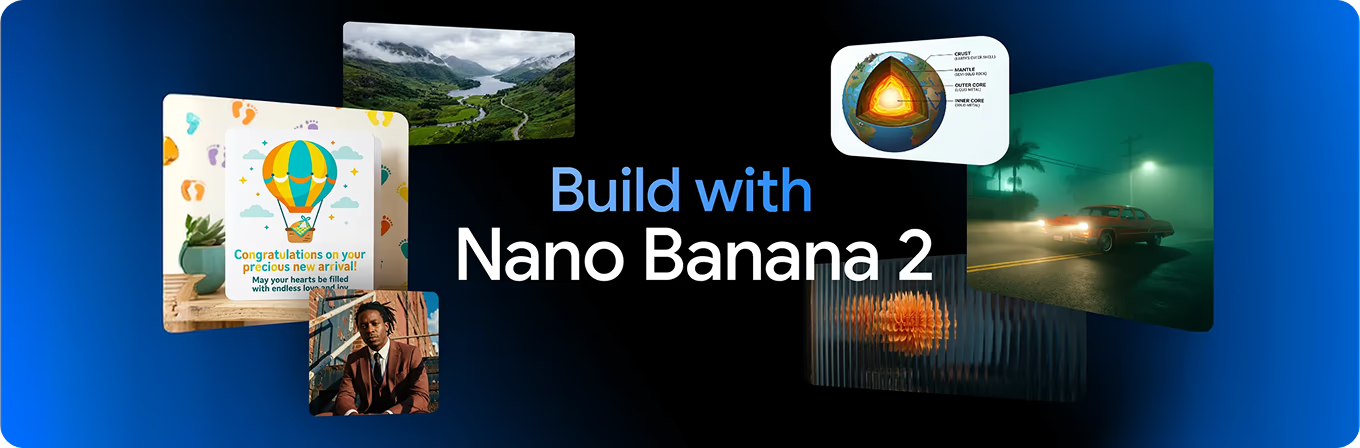
Image generation also evolved separately. Imagen established Google’s text-to-image foundation. Gemini 2.5 Flash Image popularly Nano Banana brought conversational editing and stronger subject consistency in 2025. Nano Banana Pro added higher-resolution, knowledge-heavy design work in November 2025. On February 26, 2026, Google launched Nano Banana 2, combining Flash-class latency with stronger instruction following, text rendering, world knowledge, reference consistency, multiple aspect ratios, and outputs from 512 pixels through 4K.
Gemini’s reach is enormous, although reach is not image quality. Alphabet reported 950 million monthly active users for the Gemini app in its July 2026 earnings call, plus more than nine million monthly developers across its AI APIs and key developer products. Reuters reported that the first Nano Banana attracted 13 million first-time Gemini users in four days and had generated more than five billion images by mid-October 2025; its Nano Banana 2 launch report also noted 750 million Gemini monthly users at the end of 2025. Google has not disclosed a comparable paying-consumer count, and none of these figures proves that a given image will be good.
How Find Premium AI Evaluated Google Gemini
We evaluated Google Gemini through seven weighted factors designed to measure both the quality of its images and the complete experience of creating and refining them. Each factor contributed a defined share of our assessment.
The weights total 100%. Image Quality and Prompt Accuracy carry the greatest combined influence because an attractive image has limited value if it does not follow the brief. AI Intelligence and Features & Usability account for how well Gemini understands a creative task and how effectively users can turn that understanding into a finished result. Speed, public satisfaction, and the strength of the review evidence provide the remaining practical and confidence checks.
After establishing this framework, our team researched, tested, and analyzed Google Gemini alongside ChatGPT, Midjourney, Recraft AI, Adobe Firefly, and Ideogram. Our hands-on evaluation focused on the behaviors covered by the seven factors: how each system interpreted creative intent, handled constraints and references, produced images, responded to revisions, and supported a practical creative workflow.
| Evaluation Factor | What It Measures | Weight |
|---|---|---|
| AI Intelligence | Creative intent, context, complex instructions, references, and multi-turn reasoning | 15% |
| Speed | Time and consistency from request to usable image or revision | 10% |
| Image Quality | Realism, aesthetics, anatomy, composition, detail, typography, and style | 25% |
| Prompt Accuracy | Fidelity to subjects, placement, colors, text, exclusions, and other constraints | 20% |
| User Rating | Weighted public satisfaction from credible review platforms | 10% |
| Review Confidence | Authenticity, volume, relevance, recency, and source diversity | 5% |
| Features & Usability | Editing, controls, resolution, consistency, workflow, access, and learning curve | 15% |
We then reviewed documentation available by August 31, 2026, along with vendor release notes, academic preprints, independent comparisons, distribution data, and the designated public-rating pages. We treated vendor demonstrations as capability claims rather than independent proof, kept every piece of evidence tied to the model version actually examined, and credited outside researchers whenever their testing informed our analysis.
Together, our testing, weighted framework, and version-specific research formed the basis of our final conclusion. The resulting scores represent our assessment of the tools at the cutoff date; they are not universal or permanent measurements. Results can vary with prompt quality, subject, style, task complexity, model access, settings, revision strategy, and personal expectations. Another user can reasonably reach a different score, so our ratings should be read as comparative guidance rather than absolute fact.
Performance
AI Intelligence
What it measures. AI Intelligence is the system’s ability to reason about a visual task before rendering: understanding context, using world knowledge, decomposing a layout, connecting text and images, and making sensible revisions. It is not a claim that an attractive picture is factually true.
Gemini’s case is unusually strong because Nano Banana 2 is built on Gemini 3.1 Flash Image rather than operating as a detached art model. Google says it can use real-time information through Search grounding, translate and render text, and reason about diagrams, infographics, and unfamiliar subjects. Nano Banana Pro adds a more compute-intensive route for specialized outputs. The architecture creates a useful workflow: ask Gemini to research or structure an idea, generate the image, then revise it in the same conversation.
Our research found credible signals but no universal intelligence test for image generators. A 2026 preprint evaluating hard, composition-heavy prompts placed Gemini 3 Pro Image first at 84.8/100, ahead of FLUX.2, Ideogram 3.0, and Hunyuan 3.0 in 48 selected prompts. That supports the reasoning-plus-rendering thesis, but it assessed Nano Banana Pro, used AI-authored rubrics and an AI judge, and did not include four products in our full field. Search grounding can also import source errors, while the final picture can invent details even when the underlying facts are sound.
Within the six-product field, Gemini ranks second behind ChatGPT’s 9.6. Its advantage over Midjourney is contextual reasoning; over specialized design tools, it can research, explain, and revise around the image. ChatGPT retains the lead for the most fluid conversational creation and problem decomposition.
Our score: 9.3/10 – second of six. Strength: knowledge-aware visual planning. Limitation: grounded context does not make pixels factual. Evidence basis: our testing and analysis, Google’s model documentation, and a narrow, version-specific academic preprint; no standardized six-way intelligence benchmark was available.
Speed
What it measures. Speed covers time to a usable result, including generation latency, the friction of issuing a revision, and whether plan limits or queues interrupt iteration. It is broader than a vendor’s best-case render time.
Speed is central to Nano Banana 2’s positioning. Google moved its default image experience onto a Flash model and described it as bringing Pro-level capabilities to a faster system. The Vertex AI release notes identify Gemini 3.1 Flash Image as a February 26, 2026 public preview with improved pricing and latency, while Reuters independently reported the launch as a faster successor. Gemini’s conversational interface also removes workflow steps: users can request a change in ordinary language instead of reconfiguring a canvas or starting over.
The evidence is directional, not laboratory-grade. No published dataset measured identical prompts, account tiers, regions, server load, batch sizes, and retry rates across all six products. A seven-prompt Tom’s Guide comparison called Nano Banana 2 a speed-and-search competitor; an August TechRadar comparison found Gemini faster than ChatGPT in its small sample. Conversely, Google warns that usage limits can change with capacity in its Gemini limits documentation, so a fast model can still produce a slow session when access is constrained.
In our comparison, ChatGPT places first at 9.6 and Gemini second at 9.3, with Recraft next at 8.5. Because some of the available evidence favors Gemini on raw latency, the three-tenths gap should not be read as a stopwatch result; it reflects our assessment of the complete workflow.
Our score: 9.3/10 – second of six. Strength: rapid conversational iteration on a Flash-class model. Limitation: no controlled cross-product latency study, and limits are capacity-dependent. Evidence basis: our workflow evaluation, official latency positioning, release notes, and small independent comparisons.
Image Quality
What it measures. Image Quality covers visual coherence, detail, anatomy, lighting, material realism, composition, typography, and consistency across edits. It deliberately separates “looks impressive” from “followed every instruction.”
Gemini can produce excellent work. Google documents control over camera angle, focus, color grading, lighting, aspect ratio, and resolution, plus consistency for as many as five people and 14 objects in Nano Banana 2. Independent evidence is mixed in a useful way. Tom’s Guide gave Gemini three of seven rounds against ChatGPT Images 2.0, specifically material-and-light rendering, anatomy under stress, and narrative storytelling. An earlier Washington Post five-system comparison found Nano Banana Pro strongest overall for realistic editing and difficult hands, though it tested the Pro model rather than today’s fast default. In August, TechRadar preferred ChatGPT’s more natural results in three fresh prompts and found some Gemini outputs flatter or more synthetic.
Two restoration studies add narrower technical support. One systematic Nano Banana 2 evaluation reported strong full-reference metrics and difficult-scene generalization, but also prompt sensitivity and a need for iteration. A nine-model restoration-target study selected Nano Banana 2 as its best content-faithful generator for that task. Restoration is not the same as open-ended art direction, so neither result settles portraits, posters, logos, or stylized illustration.

Quality also depends on taste. Research based on 70,000 ratings across 5,000 images found substantial personal variation in aesthetic preference in the PAMELA study. Our field therefore puts Gemini fourth at 9.0: behind ChatGPT’s 9.5, Midjourney’s 9.4, and Recraft’s 9.1, but ahead of Ideogram and Firefly. It is a high floor for general work, not the automatic aesthetic winner.
Our score: 9.0/10 – fourth of six. Strength: realism, editing fidelity, and detailed multi-subject scenes. Limitation: visual character can be inconsistent and preference is task-specific. Evidence basis: our image evaluation, official capability limits, two narrow preprints, and independent comparisons with differing winners.
Prompt Accuracy
What it measures. Prompt Accuracy asks whether the output includes the requested objects, counts, relationships, text, exclusions, style, and revision without adding or dropping important elements. It is distinct from beauty.
Nano Banana 2 improves on exactly these failure modes. Google claims stronger complex-instruction adherence, sharper small text, multilingual rendering, and continuity across multiple references and revisions. The most detailed external figure we found comes from SCHEMA, a 2026 practitioner preprint that evaluated Gemini 3 Pro Image across professional visual tasks. It reports 91% compliance with mandatory constraints and 94% compliance with prohibitions in 621 structured prompts. Those numbers are encouraging, but the study is a single-author framework, not a blinded industry benchmark, and it evaluates Pro rather than Nano Banana 2.
The 48-prompt frontier-model preprint also favored Gemini 3 Pro Image, while still identifying object counts and geometry as failure sources. Tom’s Guide found Nano Banana 2 especially literal in some realism tasks but gave ChatGPT the rounds for text-and-layout and spatial relationships. The restoration study’s finding that concise prompts with explicit fidelity constraints worked best is another warning: Gemini is steerable, yet wording still changes outcomes.
Our placement is a tie for third: ChatGPT leads at 9.5, Ideogram follows at 9.2, and Gemini and Recraft both score 9.0. Ideogram remains the specialist choice when exact display text and typography dominate. Gemini is more versatile when the prompt needs discussion, research, or successive natural-language edits.
Our score: 9.0/10 – tied for third of six. Strength: complex instructions and multi-turn revisions. Limitation: counting, geometry, and exact layout can still fail; the strongest published statistics are Pro-specific. Evidence basis: our prompt and revision evaluation, two preprints, official documentation, and small head-to-head reviews.
User Rating
What it measures. User Rating summarizes broad public satisfaction signals from the designated listing for each product. It is not a normalized measure of image-generation quality, because the listings cover different products, platforms, audiences, countries, and time windows.
| Product | Source used | Public Rating | Votes & Reviews |
|---|---|---|---|
| Google Gemini | Google Play Store | 4.6/5 | 43.4M reviews |
| ChatGPT | Google Play Store | 4.8/5 | 56.2M reviews |
| Midjourney | G2 | 4.4/5 | 88 reviews |
| Recraft AI | G2 | 4.7/5 | 450+ reviews |
| Adobe Firefly | G2 | 4.4/5 | 358 reviews |
| Ideogram | App Store | 4.8/5 | 2.6K reviews |
The official Gemini Google Play listing displayed 4.5/5 when checked after the cutoff and was dated August 31, 2026. It also showed inconsistent dynamic counts on the same page – 44.7 million reviews in the header and 43.2 million in the ratings panel. More importantly, people rate the whole Gemini Android assistant: chat, reliability, voice, connected apps, and device behavior as well as image creation. A huge sample reduces random noise but does not isolate Nano Banana 2.
Cross-product comparison is weaker still. ChatGPT and Gemini use Google Play, Ideogram uses Apple’s U.S. App Store, and Midjourney, Recraft, and Firefly use G2. The three G2 pages presented a human-verification challenge during our research, so we mark their raw listings as unverified rather than substituting another source. The Ideogram App Store listing displayed 4.8/5 from 2.6K ratings after the cutoff. ChatGPT’s Google Play listing was updated on September 3, after our cutoff, so its August 31 raw value cannot be reconstructed from the live page.
Our scorecard puts Gemini fourth at 9.2, behind ChatGPT and Ideogram at 9.6 and Recraft at 9.4. This is our comparative assessment of public satisfaction, not Gemini’s 4.5-star rating multiplied by two. We considered the rating level together with review volume, relevance, recency, source quality, platform context, and the limits of comparing different listings.
Our score: 9.2/10 – fourth of six. Strength: exceptionally broad consumer adoption and a large public feedback pool. Limitation: app-wide, dynamic, regional ratings are not directly comparable image benchmarks. Evidence basis: our analysis of the designated public-rating sources; three G2 raw values and some cutoff snapshots remain unverified.
Review Confidence
What it measures. Review Confidence reflects how well a score is supported by current, independent, reproducible evidence. It rewards version clarity, transparent methods, adequate samples, and convergence across sources; it is not confidence in Google as a company.
Gemini has more evidence than most image generators. Google publishes model identities, release dates, resolution ranges, reference limits, provenance measures, and deployment surfaces. Reuters provides adoption context. Multiple journalists have run disclosed prompt comparisons, and several 2026 preprints address instruction compliance or restoration. Their disagreement is informative: Gemini can lead in realism or editing while losing on typography, spatial logic, or aesthetic naturalness.
Confidence stops short of excellent for four reasons. First, no one independently evaluated the cutoff-date versions of all six products with the same prompts. Second, studies frequently test Nano Banana Pro while the default consumer experience uses Nano Banana 2. Third, academic work is mostly preprint-stage, narrow, and sometimes AI-judged. Fourth, products and limits change faster than conventional reviews, while public ratings are dynamic and platform-specific. Google’s own 2024 pause and later restart of people generation, reported by Reuters, is a reminder that safety configuration can materially change output behavior without a new model name.
Gemini ranks second at 8.4, just behind ChatGPT’s 8.5. Ideogram follows at 7.9; Recraft, Firefly, and Midjourney have thinner or less accessible independent evidence under this method. An 8.4 should be read as “well supported with material caveats,” not certainty to one decimal place.
Our score: 8.4/10 – second of six. Strength: unusually broad triangulation across official, journalistic, and academic sources. Limitation: version mismatch and no standardized six-way test. Evidence basis: our source review across multiple evidence classes, with appropriate caution for vendor claims, small samples, preprints, and inaccessible rating pages.
Features & Usability
What it measures. Features & Usability covers access, interface clarity, editing, references, output controls, platform reach, safety/provenance, and how easily a user moves from idea to reusable asset.
Gemini’s strongest usability feature is conversation. Users can upload images, combine references, ask for localized changes, resize, translate text, or request another version without learning parameter syntax. Nano Banana 2 supports common aspect ratios and 512px, 1K, 2K, and 4K output; Google says it can preserve up to five characters and work across as many as 14 objects. It is distributed through the Gemini web and mobile apps, Search AI Mode and Lens, Flow, the Gemini API and AI Studio, and Vertex AI. This is a broader reach than most standalone generators.
Google also applies invisible SynthID watermarking and C2PA metadata, and offers a verification flow for checking whether media was generated or edited by Google AI. Those measures improve provenance, not truth: metadata can be stripped, and a marked image can still mislead. Access is another caveat. Nano Banana 2 is available without a paid plan, but quotas vary; Google AI Plus, Pro, and Ultra raise limits, and paid tiers can regenerate with Nano Banana Pro. The Google AI plans page listed AI Pro at $19.99 per month in the United States at the cutoff, while feature availability depends on region and account type.
Gemini ranks third here at 9.3, behind Adobe Firefly’s 9.6 and Recraft’s 9.4. Firefly offers the deeper Adobe production chain; Recraft offers native vector and brand-asset tooling. Gemini is easier for broad, conversational creation but lacks their specialist control. It edges ChatGPT and Ideogram at 9.2 and Midjourney at 8.8.
Our score: 9.3/10 – third of six. Strength: the widest general-purpose distribution with natural-language editing and strong provenance support. Limitation: shifting quotas, regional availability, and fewer specialist vector or production controls. Evidence basis: our workflow evaluation, official feature documentation, and release notes, with usability findings moderated by access constraints.
Comparison Before You Buy
The scores below are our August 2026 assessment, developed through the seven-factor testing and research framework described above. The percentages guided the relative importance of each factor, while the Overall score reflects our final evaluation of the complete product experience. These are informed comparative judgments, not objective constants: prompt technique, use case, preferred style, workflow, account tier, and model version can all change the result. Because the displayed factor scores are rounded and the final rating includes our cross-product review, simple arithmetic may not reproduce every Overall score exactly.
| Product | Overall Score | AI Intelligence | Speed | Image Quality | Prompt Accuracy | User Rating | Review Confidence | Features & Usability | Best For |
|---|---|---|---|---|---|---|---|---|---|
| ChatGPT | 9.1 | 9.6 | 9.6 | 9.5 | 9.5 | 9.6 | 8.5 | 9.2 | Conversational creation |
| Google Gemini | 9.0 | 9.3 | 9.3 | 9.0 | 9.0 | 9.2 | 8.4 | 9.3 | Fast, general-purpose images |
| Midjourney | 8.9 | 8.0 | 8.0 | 9.4 | 8.2 | 8.8 | 7.2 | 8.8 | Aesthetic art direction |
| Recraft AI | 8.8 | 8.5 | 8.5 | 9.1 | 9.0 | 9.4 | 7.7 | 9.4 | Vectors and brand assets |
| Adobe Firefly | 8.7 | 8.1 | 8.1 | 8.6 | 8.5 | 8.8 | 7.6 | 9.6 | Adobe production workflows |
| Ideogram | 8.6 | 8.4 | 8.4 | 8.9 | 9.2 | 9.6 | 7.9 | 9.2 | Typography and open deployment |
The 0.1-point steps make this look more settled than the evidence permits. In practice, use case matters more than rank:
- Choose ChatGPT if the image is part of a longer collaborative conversation and you value reasoning, layout planning, and repeated edits. OpenAI describes GPT Image 2 as its cutoff-date state-of-the-art model for fast generation and editing. Its 9.1 lead is narrow, and some independent comparisons found Gemini faster or more realistic.
- Choose Google Gemini if you want fast everyday creation, image-aware discussion, optional Search context, mobile access, and a path from a quick draft to a Pro regeneration. It is the most balanced alternative to ChatGPT and the easiest recommendation for people already using Google products.
- Choose Midjourney if a distinctive, art-directed first impression matters more than literal compliance or a conventional editor. Midjourney V8.2 became the default on July 24, 2026, emphasizing aesthetics and personalization; its new Edit Model supports written edits and up to four references. All plans are paid, starting at $10 monthly in the official plan comparison.
- Choose Recraft AI for logos, icons, brand systems, scalable vectors, mockups, and editable production assets. Recraft’s own feature overview highlights native vector graphics, typography, image editing, vectorization, upscaling, erasing, and mockups. Its specialized canvas is more purposeful than a chatbot for design-system work.
- Choose Adobe Firefly if generated assets must continue into Photoshop, Illustrator, Express, or a controlled enterprise workflow. Adobe’s official Android listing documents image generation, Generative Fill, background removal, cross-device history, and access to Adobe and partner models. Firefly’s advantage is workflow integration, not the highest standalone image-quality score.
- Choose Ideogram when legible type, posters, merchandising, or local deployment is central. Ideogram 4.0 is a 2026 open-weight model positioned around prompt fidelity, clear typography, and reliable edits, with both a creative workspace and API. That makes it the most differentiated option here for typography and deployment control.
Gemini’s second-place result is therefore not a claim that it wins every prompt. It means it has the fewest consequential weaknesses for a general buyer: excellent speed and intelligence, strong quality and adherence, high usability, and better evidence coverage than most specialists.
Conclusion
Google Gemini earns 9.0/10 overall and second place in Find Premium AI’s August 2026 scorecard. Its defining advantage is not one photorealistic sample. It is the combination of a capable image model, conversational revision, world knowledge, Search-aware planning, wide distribution, and a faster default that can handle demanding work to Nano Banana Pro.
For most non-specialist users, Gemini is an easy shortlist choice. It suits marketers drafting campaign concepts, educators building diagrams, small businesses making social graphics, researchers visualizing grounded ideas, and anyone who wants to edit by saying what should change. The free route makes evaluation simple, while Google AI subscriptions raise limits and add a Pro-quality fallback.
The tradeoffs are equally clear. ChatGPT remains first in our scorecard and won more rounds in one 2026 head-to-head. Midjourney has a stronger aesthetic ceiling. Recraft produces more useful vector and brand assets. Adobe Firefly fits professional Adobe pipelines better. Ideogram is the sharper specialist for typography and open deployment. Gemini can also render plausible but false details, access limits can change, and the public rating for the whole assistant should not be mistaken for an image-only score.
Gemini’s 9.0/10 is therefore our evidence-based assessment, not a promise that every user will get a 9.0 experience. A different prompt, subject, reference image, account tier, model version, or revision approach can produce a different outcome, and someone with a specialized workflow may reasonably rank another tool higher.
Our verdict is consequently specific: buy or subscribe to Gemini for fast, versatile, conversation-led image work; choose a specialist when the output format or production pipeline matters more than breadth. Because models change quickly and the closest scores are separated by tenths, recheck the model name, plan limits, and required export format before committing a recurring workflow.
FAQ
Why did Google Gemini rank second if it did not receive the highest Image Quality score?
Gemini’s ranking reflects its complete performance rather than image quality alone. Although it placed fourth for Image Quality in our evaluation, it performed exceptionally well in AI Intelligence, Speed, Prompt Accuracy, and Features & Usability. This balance gave Gemini fewer serious weaknesses than most specialized generators, making it one of the strongest options for people who need dependable results across many types of visual work.
When should you use Nano Banana 2 instead of Nano Banana Pro?
Use Nano Banana 2 for fast drafts, everyday images, experimentation, and repeated conversational revisions. Choose Nano Banana Pro when the request involves dense typography, detailed infographics, higher-resolution output, complex layouts, or knowledge-heavy visual content. A practical workflow is to develop the concept quickly with Nano Banana 2 and then use Nano Banana Pro for the more demanding final version.
Can Gemini be trusted to create accurate infographics, diagrams, and fact-based images?
Gemini’s reasoning and Search grounding can help it plan fact-based visuals, but they do not guarantee that every rendered label, number, date, or relationship will be correct. The image model can still create convincing but inaccurate details. For educational, medical, financial, or research content, verify all information separately and treat Gemini as a visual-production assistant rather than the final factual authority.
How consistent is Gemini when the same person, character, or product must appear across several images?
Gemini is stronger than many general-purpose generators at preserving subjects through references and conversational edits, but consistency is not perfect. Facial details, clothing, proportions, branding, or product geometry can drift when the pose, camera angle, lighting, or environment changes significantly. For better results, provide a clear reference, identify the features that must remain unchanged, and revise one major element at a time.
Could Gemini still be the best choice for you even though it ranked second overall?
Yes. Our ranking measures broad, general-purpose performance, while your ideal tool depends on what you create. Gemini may be your best option if you value speed, natural-language editing, Google integration, reference-based revisions, and the ability to move from a quick draft to a more advanced result. Someone focused on artistic style, vectors, typography, or Adobe production may prefer Midjourney, Recraft, Ideogram, or Firefly instead.