



Introduction
A voice that sounds human is impressive. But making audio that people actually want to listen to? That’s a much bigger challenge.
Think about what different creators need. A songwriter wants a melody that sticks and vocals that carry real emotion. A podcaster needs narration that sounds natural, without spending hours fixing awkward pronunciations. A video producer might need all of that plus background music, sound effects, and voiceovers in several languages.
And ideally, they’d like to accomplish those things without juggling five different platforms. That’s where ElevenLabs makes an interesting case for itself. Founded in 2022 by Polish entrepreneurs Mati Staniszewski and Piotr Dąbkowski, ElevenLabs began with a deceptively simple ambition: make artificial speech sound more human.
The idea came from something both founders knew well. Growing up in Poland, they had experienced foreign films dubbed with voices that often stripped away the emotion and personality of the original performances. They believed AI could do better.
Staniszewski brought experience from Palantir, while Dąbkowski had worked in machine learning at Google. Together, they began developing speech technology in 2022 and launched ElevenLabs’ public beta in January 2023.
The company moved quickly. By June 2023, ElevenLabs reported more than one million registered users and had begun expanding beyond basic speech synthesis into voice cloning, audiobook production, and localization. Its early company announcement tells that story. The business has grown considerably since those early days.
In May 2026, ElevenLabs reported surpassing $500 million in annual recurring revenue. In September, the company announced a $22 billion valuation following a $300 million employee tender offer, reflecting growing enterprise interest in its voice and conversational AI products. One number, however, remains unclear: paying subscribers.
As of October 8, 2026, we could not establish a sufficiently recent, independently verifiable count of ElevenLabs’ individual paying subscribers. Registered users, enterprise adoption, and company revenue tell us something about its growth. They don’t tell us how many individuals currently pay for a subscription. We won’t pretend otherwise.
Today, ElevenLabs is much more than a text-to-speech tool. Its growing product family covers expressive speech, voice cloning, multilingual dubbing, transcription, sound effects, editing, and original music generation.
That’s an impressive collection of capabilities. But an extensive feature list isn’t the same as an excellent product. And it certainly isn’t a reason to recommend a subscription without examining what buyers actually get.
Our research team has spent time experimenting hands-on with AI audio tools, testing different models at different stages of their development and putting them to work on a wide variety of songs, music, audio, and voice tasks.
We also tried ElevenLabs’ available subscription tiers across different usage situations to understand which plans make practical and financial sense. Those experiences informed our seven-factor comparison, finalized on October 6, 2026. We evaluated ElevenLabs alongside all the AI tools related to songs, music, audio & voice. And here we are showing comparisons between the top 6 of them.
Our aim wasn’t to crown a familiar name or reward the product with the longest feature list. It was to find out which tools delivered the strongest results across the category—and where a more specialized alternative might actually serve a buyer better.
Performance
Eleven v4: When a voice needs to do more than read words
Text-to-speech has come a long way from the robotic voices many of us remember. Yet even a technically clear AI voice can fall flat. The words might be correct, but the emphasis feels wrong. A supposedly emotional sentence sounds indifferent. A character meant to sound nervous delivers a line with the confidence of a weather presenter.
That gap between saying words and communicating meaning is exactly what ElevenLabs has been working to close. Its latest verified speech-generation family is Eleven v4 and Eleven v4 Turbo, released September 28, 2026. The two variants address related but different needs. Eleven v4 emphasizes expressive, high-quality speech generation. Eleven v4 Turbo is designed for situations where faster responses matter.
Eleven v4 aims to interpret the context behind a script, not simply pronounce each word. It can respond to emotional direction, pacing, character, and performance instructions. That opens up useful possibilities for audiobook producers, documentary creators, podcasters, advertisers, and developers creating dialogue-driven experiences.
Consider a single sentence: “I didn’t expect you to come back.” In an audiobook, it might need to communicate relief. In a suspense scene, suspicion. In a customer-service recording, perhaps gentle surprise. The words haven’t changed. The performance needs to. Eleven v4 gives creators more ways to guide that performance through natural-language instructions, audio tags, multi-speaker dialogue, and controls intended to maintain a consistent vocal identity. The model family also supports Professional Voice Clones, allowing eligible creators to use verified voices while benefiting from more expressive speech generation.
According to ElevenLabs’ model documentation, Eleven v4 supports more than 90 languages. That’s particularly useful for multilingual publishing, localization, and international content production. Still, supporting a language is not the same as delivering equally convincing accents, pronunciation, and cultural nuance in every language.
Those qualities need to be judged in the finished recording. Independent listening comparisons provide encouraging evidence for ElevenLabs’ speech technology. On the Artificial Analysis provider-voice leaderboard, Eleven v4 Turbo and Eleven v4 occupied the top two positions in the results we examined. The leaderboard compares listener preferences for speech generated using each provider’s native voices. There’s an important qualification: the confidence intervals of the two ElevenLabs models overlap. Their positions shouldn’t be interpreted as proof that one decisively outperforms the other.
Nor should the results be stretched beyond what they measure. A text-to-speech leaderboard tells us about speech preferences under particular testing conditions. It doesn’t tell us who writes the best melodies, generates the strongest singing performances, or produces the most compelling complete songs. Those are different creative challenges.
Eleven v4 Turbo: Sometimes speed changes the experience
Imagine talking to an AI assistant and waiting several seconds after every question. Even if its voice sounds wonderful, the conversation doesn’t feel natural. For interactive voice applications, responsiveness can matter nearly as much as sound quality. That’s the problem Eleven v4 Turbo is designed to address.
ElevenLabs reports approximately 100 milliseconds of median model inference latency under its stated testing conditions. The model supports low-latency workflows through streaming, developer APIs, and ElevenAgents. For conversational assistants, customer-service agents, interactive characters, and voice-driven applications, those capabilities can make a meaningful difference.
The Eleven v4 announcement also describes improvements in emotional expression and consistency during longer speech generation. Of course, model latency isn’t the whole story. A finished voice application may also need to recognize speech, process a request, generate an answer, and transmit audio over a network. Each stage can introduce additional delay. So the reported latency is useful technical information, not a promise that every conversation will respond in precisely 100 milliseconds.
And speed isn’t equally important to every buyer. An audiobook producer might happily wait longer for a more convincing narration. Someone developing a real-time conversational assistant may consider responsiveness essential. That difference is worth remembering throughout this review: a feature can be technically impressive without being equally valuable to everyone.
Eleven Music v2.5: Creating songs, not just speaking words
Now comes a different challenge. Can ElevenLabs make music? Yes. But its music-generation capabilities deserve to be evaluated separately from its speech technology. The latest verified model is Music v2.5, released September 11, 2026. It builds on Music v2, introduced earlier that year, and became the default model for prompted and audio-reference generation in ElevenMusic.
Where Eleven v4 focuses on speech, Music v2.5 generates musical compositions—including instrumentals and complete songs with vocals. A creator can describe the genre, mood, instrumentation, lyrical direction, and arrangement they want. ElevenMusic then generates a composition based on those instructions. It also supports more structured creative workflows, allowing users to develop and revise music rather than relying entirely on a single prompt.
ElevenLabs’ Music v2.5 announcement describes improvements in instrumental realism, layered arrangements, and consistency across longer compositions. The company also reported an internal listening comparison involving 47,885 paired generations, in which listeners preferred Music v2.5 over Music v2. That’s useful evidence of progress between ElevenLabs’ own music models.
But it isn’t independent proof that Music v2.5 makes better songs than every competitor. And buyers deserve to understand the difference. For that, external music comparisons offer another perspective. In the Artificial Analysis vocal-music leaderboard we examined, Suno performed ahead of ElevenMusic. The instrumental music leaderboard also favored Suno’s leading models over the ElevenMusic versions represented.
That doesn’t make ElevenMusic irrelevant. Far from it. It simply tells us something important about the market: the company that performs exceptionally well at generating voices isn’t necessarily the company that generates the best songs. Speech and music demand different kinds of excellence. A convincing song needs melody, harmony, rhythm, structure, instrumentation, lyrics, and vocal phrasing to work together. A technically realistic singer can still deliver a musically disappointing performance.
For songwriters, the important questions are practical ones. Does the chorus work? Is the arrangement coherent? Do the lyrics sound natural when sung? Can the generated music be refined without rebuilding the entire song? Those questions matter more than the novelty of hearing AI sing.
Creative control: Getting closer to the track you actually want
Generating an impressive first draft is useful. Being able to improve it is often more useful. ElevenLabs has expanded ElevenMusic with tools intended to give creators greater control over the development process. Its music documentation describes several approaches to composing and refining generated tracks. Audio Reference allows users to upload a short musical reference to help guide a new composition, subject to copyright screening.
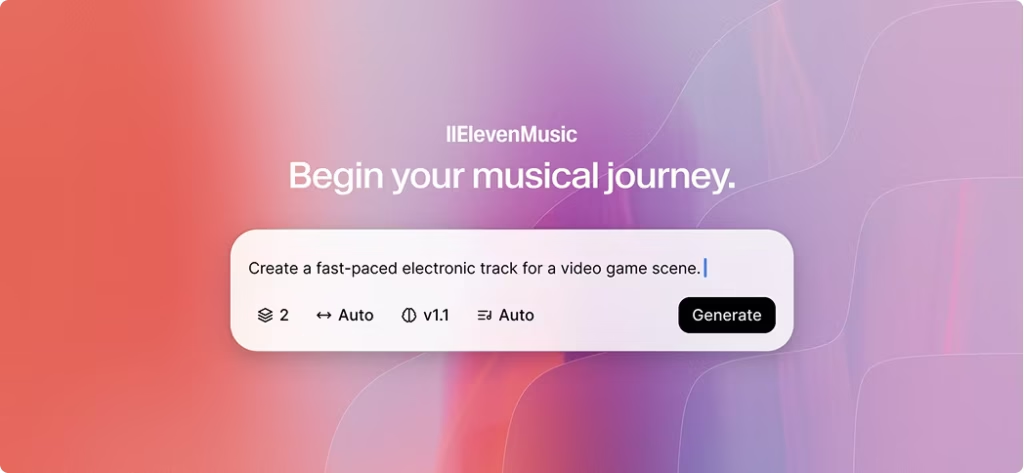
Section editing and inpainting make it possible to work on individual parts of a track. Composition controls allow creators to shape song structure, lyrics, musical style, and transitions. Why does this matter? Because creative work rarely proceeds in a straight line. A songwriter might love the chorus but dislike the introduction. A producer might want to keep the melody while changing the instrumental feel. A video editor might need the music to build more gradually toward a particular scene.
Starting from scratch every time would be frustrating. Section-level controls make those revisions more manageable. Stem functionality provides another layer of flexibility by separating musical elements for further production work. The available stems and workflows depend on the plan and feature being used.
ElevenLabs also introduced reusable singing identities in 2026. Its Vocals feature includes Voice-to-Song creation and tools intended to maintain a more consistent vocal identity across multiple tracks. That’s an important distinction for artists developing a collection of songs. A recognizable singing voice can help tie a project together.
Of course, these controls don’t turn AI music generation into a traditional digital audio workstation. Section editing and stems improve flexibility, but they don’t necessarily give creators complete manual control over every instrument or note. For experienced producers, that difference can influence how ElevenMusic fits into an existing workflow.
One platform, several audio jobs
Here’s where ElevenLabs starts to distinguish itself. Consider a documentary creator working on a new film. First comes the narration. Then perhaps a translated version for another audience. Next, a few atmospheric sound effects. Finally, an original music track to support the story. Each task is different. And ElevenLabs offers tools for all of them within its broader creative environment.
Its Studio environment supports longer spoken-content projects. Other tools cover dubbing, transcription, voice conversion, music creation, and sound effects. That range doesn’t mean every operation happens in one click. Nor does it mean all the tools use the same underlying model. Speech synthesis, music generation, sound effects, and editing involve separate capabilities, with different usage requirements and potentially different credit charges.
Still, having those capabilities within one broader platform can be valuable for someone who produces several types of audio. There are trade-offs. Generated narration may need corrections to pacing, pronunciation, or emphasis. Music may take multiple attempts to follow a demanding creative brief. Advanced editing controls introduce additional decisions, and repeated generations can consume credits.
Voice cloning also requires attention to consent and identity rights. Commercial music brings its own licensing and distribution conditions. These aren’t minor details for professional creators. They determine whether an output is merely interesting or suitable for delivery to a client, publisher, audience, or streaming platform.
Our team has experimented with different ElevenLabs models and production workflows over several years. Those experiences informed our evaluation, but our supplied research record contains consolidated scores rather than detailed public logs of every prompt, audio sample, or individual generation. We therefore use our recorded results to explain comparative performance without attributing specific undocumented experiments to our testers.
The seven factors we used to evaluate performance
We didn’t want to judge these tools on one beautiful demo or one disappointing generation. Our evaluation considered seven factors, each addressing a different part of the creative and purchasing experience.
| Evaluation Factor | What It Measures | Weight |
|---|---|---|
| AI Intelligence | Understanding creative intent, interpreting musical and audio references, developing original ideas, choosing suitable vocal expression, and responding intelligently to revisions | 15% |
| Speed | Time and consistency from request to usable songs, instrumentals, audio, or speech including generation, revisions, retries, and exports; response latency for real-time voice | 10% |
| Music, Audio & Voice Quality | Songs and music: melody, harmony, rhythm, arrangement, structure, lyrical quality, and natural singing. Audio: clarity, sound realism, production quality, and freedom from noise or artifacts. Voice: intelligibility, naturalness, pronunciation, pacing, intonation, emotional expression, and speaker consistency | 25% |
| Prompt Accuracy | Adherence to requested genre, mood, tempo, instruments, lyrics or script, language, accent, pronunciation, vocal style, emotion, duration, timing, and exclusions | 20% |
| User Rating | Public satisfaction from credible, product-specific reviews, prioritizing people who actually use the relevant song, music, audio, or voice features | 10% |
| Review Confidence | Authenticity, volume, recency, relevance, diversity of independent review sources, and whether reviews match the evaluated features and current product or model | 5% |
| Features & Usability | Lyric and script controls, section editing, track extension, stems, audio editing, voice libraries, voice cloning and conversion, pronunciation controls, dubbing, export quality, integrations, workflow, learning curve, pricing value, and clarity of commercial-use terms | 15% |
Notice where we placed the greatest emphasis. Music, Audio & Voice Quality and Prompt Accuracy account for 45% of the overall evaluation. That’s deliberate. A tool can be fast, beautifully designed, and packed with features. But if its output sounds poor or consistently misses the brief those advantages lose much of their value. At the same time, Features & Usability carries 15%. That recognizes something professional creators know well: producing a good sample isn’t the same as finishing a project.
Our criteria reflect years of experimentation across models and tasks, with the final comparative scores recorded on October 6, 2026. These scores represent our team’s research judgments. They aren’t universal laboratory measurements or independently certified benchmarks. With that distinction established, let’s look at how ElevenLabs compares with the alternatives.
Comparisons Before You Buy
Six products. Seven evaluation factors. One important question: Which tool gives buyers the strongest overall experience across songs, music, audio, and voice? In our October 6, 2026 hands-on evaluation, ElevenLabs ranked first with an overall score of 8.58. Suno followed at 8.14, with Mureka AI in third place at 7.65. That ranking reflects our team’s years of experimentation and the seven-factor framework described above. It wasn’t determined by public star ratings, a single listening test, or one external benchmark.
Our six-company performance scorecard
The table below preserves our finalized scores, including the individual factor results and overall rankings.
| Product | Overall Score | AI Intelligence | Speed | Music, Audio & Voice Quality | Prompt Accuracy | User Rating | Review Confidence | Features & Usability | Best For |
|---|---|---|---|---|---|---|---|---|---|
| ElevenLabs | 8.58 | 8.9 | 8.6 | 8.5 | 8.6 | 7.6 | 7.0 | 9.5 | Projects combining narration, songs, sound effects and voice production |
| Suno | 8.14 | 8.4 | 8.3 | 8.6 | 8.0 | 6.5 | 6.5 | 8.8 | Complete vocal songs and substantial music-production revisions |
| Mureka AI | 7.65 | 7.8 | 8.0 | 7.9 | 7.5 | 6.0 | 6.0 | 8.7 | Song drafts developed with references, remixing, stems and production exports |
| Descript | 6.99 | 6.6 | 6.5 | 6.6 | 6.5 | 7.2 | 6.5 | 9.0 | Podcasts, recorded dialogue, narration and editing audio inside a project |
| Adobe Firefly | 6.82 | 6.5 | 6.8 | 6.3 | 6.3 | 8.8* | 4.0 | 8.3 | Video soundtracks, instrumental backing, voiceovers and sound effects |
| MiniMax Audio | 6.07 | 6.0 | 6.5 | 6.1 | 6.1 | 5.0† | 3.0 | 7.5 | Speech, voice cloning and music experiments with web/API options |
* Adobe Firefly, 8.8/10: Based on one G2 rating for the overall Firefly product. It does not specifically measure its music, audio or voice features. † MiniMax Audio, 5.0/10: A neutral placeholder because a reliable, comparable customer-rating average was not verified. It is not an actual customer rating.
Why ElevenLabs came out on top
Let’s begin with something the overall ranking doesn’t immediately reveal. ElevenLabs didn’t win every category. Suno actually earned the highest Music, Audio & Voice Quality score. So why did ElevenLabs finish first? Because our research wasn’t designed to identify only the best AI song generator. It examined a broader set of creative needs, including music composition, realistic speech, sound effects, voice tools, and the workflows connecting them. Across that combined category, ElevenLabs demonstrated the strongest overall balance. The factor-level results explain why.
AI Intelligence: ElevenLabs scored 8.9
This was the highest AI Intelligence score in our comparison, ahead of Suno’s 8.4 and Mureka AI’s 7.8. Here, AI Intelligence doesn’t mean general-purpose reasoning. It means understanding creative direction, interpreting audio references, making suitable expressive choices, and responding intelligently when a user requests changes.
That matters when a task involves more than one straightforward instruction. A creator might need narration with a particular emotional tone, music matching a specific atmosphere, and subsequent revisions that preserve the original creative direction. The more complicated the brief, the more valuable accurate interpretation becomes. Our scores show ElevenLabs performed particularly strongly under that criterion.
Speed: ElevenLabs scored 8.6
ElevenLabs also earned the highest Speed score, ahead of Suno at 8.3 and Mureka AI at 8.0. We weren’t looking only at how fast a tool produces its first sample. Our Speed factor also considers revisions, retries, exports, and the time required to reach a usable result. That distinction is practical.
A tool that creates audio quickly but requires repeated fixes may not save as much time as its advertised generation speed suggests. For recurring production work, the time to a finished deliverable is what ultimately matters.
Music, Audio & Voice Quality: ElevenLabs scored 8.5
Here’s the close contest. Suno scored 8.6, giving it a narrow advantage over ElevenLabs’ 8.5. Because quality carries a 25% weighting—the largest single allocation in our evaluation that result deserves attention. It also fits the broader pattern in independent listening comparisons. ElevenLabs’ latest speech models performed strongly on the Artificial Analysis provider-voice leaderboard.
Meanwhile, Suno performed better than the represented ElevenMusic models on the music-generation leaderboards we examined. Those external results aren’t measurements from our own experiments, and their methods and model coverage differ from ours. But they reinforce a useful distinction: ElevenLabs can be the strongest all-around choice without being the best-performing option for every individual music task. For creators focused almost entirely on songs, that distinction could change the buying decision.
Prompt Accuracy: ElevenLabs scored 8.6
ElevenLabs led again here, compared with Suno’s 8.0 and Mureka AI’s 7.5. Prompt Accuracy makes up 20% of our evaluation, so its contribution to the overall result is substantial. And the reason is simple: creative quality without instruction-following can be frustrating.
A beautiful song in the wrong style may be useless for the project. A natural-sounding voiceover with the wrong pronunciation may need to be regenerated. An otherwise impressive audio clip that ignores timing requirements may not fit the final video. Our results indicate that ElevenLabs delivered a particularly strong balance of creative output and adherence to requested direction.
Features & Usability: ElevenLabs scored 9.5
This was ElevenLabs’ standout result. Its 9.5 was the highest Features & Usability score in the study. Descript followed at 9.0, with Suno at 8.8 and Mureka AI at 8.7. This factor considers much more than the number of tools in a product menu. It includes editing capabilities, production controls, exports, integrations, ease of use, pricing value, and commercial-use clarity.
ElevenLabs benefits from offering several connected audio-production capabilities. For someone who produces narration on Monday, music on Wednesday, and localized video content on Friday, that breadth can be genuinely useful. Taken together, ElevenLabs’ advantages in AI Intelligence, Speed, Prompt Accuracy, Features & Usability, and Review Confidence helped it finish 0.44 points ahead of Suno overall. That’s the reason for its first-place position, not an assumption that every ElevenLabs output is better than every competitor’s.
Where another product might be the smarter choice
Overall rankings are helpful. But they can’t tell every buyer what to purchase. The best option depends on the job.
Suno: A compelling choice for complete songs
Suno finished second overall with 8.14. But it earned our highest Music, Audio & Voice Quality score at 8.6. Its strongest fit in our evaluation was creating complete vocal songs and making substantial music-production revisions.
For independent musicians who primarily want to produce original songs, Suno is an obvious alternative to examine. ElevenLabs offers broader audio capabilities. Suno’s particular appeal lies in music creation. If you rarely need narration, dubbing, speech generation, or sound effects, the extra breadth of ElevenLabs might not matter enough to outweigh Suno’s strengths.
Mureka AI: Worth considering for reference-led music production
Mureka AI ranked third at 7.65 overall. It earned 7.9 in Music, Audio & Voice Quality and 8.7 in Features & Usability. Our research identified song drafting, audio references, remixing, stems, and production exports as particularly relevant workflows.
That makes Mureka AI interesting for musicians who use generated audio as a starting point for further production. Its lower AI Intelligence and Prompt Accuracy scores indicate that it didn’t match ElevenLabs as strongly across our broader criteria. Still, creators who value its particular music-development workflow may find it worth exploring.
Descript: A specialist for podcasts and recorded dialogue
Descript earned 6.99 overall, placing fourth. But one score deserves a second look: 9.0 in Features & Usability. That was the second-highest usability result in our study. Descript is particularly relevant for editing podcasts, narration, interviews, and recorded dialogue within a larger production project.
That isn’t the same job as generating an original vocal song. Someone who regularly edits existing recordings might reasonably prefer Descript’s focused workflow over a broader creative-generation platform. This is why we don’t believe overall rankings should be treated as universal purchasing instructions.
Adobe Firefly: A fit for multimedia creators
Adobe Firefly received an overall score of 6.82, including 8.3 for Features & Usability. We identified video soundtracks, instrumental backing, voiceovers, and sound effects as its most relevant applications within this category. It also earned 8.8* in our User Rating factor, although its Review Confidence score was considerably lower at 4.0.
The asterisk appears in our original scorecard without further explanation, so we have preserved it rather than assigning it a meaning. Firefly may make particular sense for creators whose audio work is one part of a larger visual-production process. Its lower scores of 6.3 in both quality and prompt accuracy, however, limited its overall position in our audio-focused comparison.
MiniMax Audio: An option for technical experimentation
MiniMax Audio finished sixth, with an overall score of 6.07. Its most relevant applications in our research included speech generation, voice cloning, music experimentation, and web/API workflows. It earned 7.5 in Features & Usability, but 6.1 in both quality and prompt accuracy.
Its Review Confidence score of 3.0 was the lowest in our study. That result doesn’t prove MiniMax is unsuitable for every developer or experimental project. It indicates that our comparative results and available review evidence provided less support for recommending it as the best all-around choice.
The ranking is a guide, not a universal rule
Here’s the distinction we want buyers to remember. ElevenLabs ranked first for the combined category of Songs, Music, Audio & Voice not for every individual task within it. Its breadth of capability, creative interpretation, prompt adherence, speed, and usability helped it earn that position.
But a music-only evaluation could reasonably give Suno greater weight. A study focused on editing recorded podcasts might elevate Descript. Those outcomes wouldn’t automatically contradict our findings. They would reflect different priorities. Our scores capture the results of our seven-factor research framework as of October 6, 2026. The right purchase still begins with understanding what you need to produce.
Customer Review
Our team didn’t rely solely on its own experiments. Throughout the research process, we also collected ratings and customer experiences from independent review platforms, with our research snapshot finalized on October 6, 2026. Why look beyond our tests? Because product reviews can reveal what happens after the exciting first generation.
They can help buyers understand recurring problems with billing, customer support, usability, credit consumption, and reliability issues that may become more apparent over extended use. For ElevenLabs, we selected G2 as our principal source for detailed public feedback, particularly regarding voice quality, production workflows, and API use.
Its pool of 1,238 reviews offers a substantial body of professional software feedback. G2 also provides reviewer context and indicators relating to validation, current use, and incentivized submissions. That context matters.A review from someone regularly producing commercial voiceovers may answer different questions from a review by someone experimenting with a mobile app for the first time.
Still, a large review pool isn’t a guarantee that every reviewer has used the latest model or tested every feature. That’s an important limitation to acknowledge.
What the public ratings show
Here are the ElevenLabs ratings and counts our team collected through October 6, 2026.
| Review source | Public rating | Reviews or ratings in our snapshot |
|---|---|---|
| G2 | 4.5/5 | 1,238 reviews |
| Trustpilot | 3.1/5 | 1,173 reviews |
| SourceForge / Slashdot | 4.0/5 | 4 reviews, shared |
| Gartner Peer Insights | 4.5/5 | 17 ratings |
| Techjockey | 4.6/5 | 3 ratings and reviews |
| Capterra / GetApp / Software Advice | 4.7/5 | 25 reviews, shared |
| Google Play, official app | 4.7/5 | 239K reviews |
| TrustRadius | 9.5/10 | 17 reviews and ratings |
| Apple App Store, U.S. official app | 4.8/5 | 22K ratings |
| Product Hunt | 4.9/5 | 212 reviews |
Source: Public rating information collected by our team through October 6, 2026. Ratings retain their original scales. Platforms sharing a review pool are grouped rather than counted as separate sets of feedback.
At first glance, the figures look overwhelmingly positive. G2 reports 4.5/5. Capterra shows 4.7/5. Apple’s App Store records 4.8/5, and Product Hunt reaches 4.9/5. But a rating rarely tells the whole story. Start with audience differences. G2 and Gartner Peer Insights generally attract software users evaluating tools for business or professional applications. Google Play and Apple’s App Store reflect experiences with the official mobile application.
Those users may care about very different things. Someone reviewing a mobile voice generator could be judging the interface, convenience, and subscription experience. A production professional may be concerned with pronunciation consistency, API behavior, editing, or commercial output quality.
Neither perspective is automatically wrong. They simply answer different questions. Sample size matters, too. The 1,238-review G2 pool offers considerably more customer feedback than Techjockey’s three ratings or SourceForge’s four reviews.
Likewise, the 17 ratings on Gartner and the 17 reviews and ratings on TrustRadius provide useful perspectives, but they are relatively small samples. We also avoided counting identical review pools more than once. SourceForge and Slashdot share four reviews. Capterra, GetApp, and Software Advice share the same 25-review collection.
Treating these as separate bodies of evidence would exaggerate the amount of independent customer feedback available. TrustRadius uses a different scale, reporting 9.5/10. We’ve preserved that original score rather than converting it and combining it with five-point averages. And while Product Hunt’s 4.9/5 is striking, its maker and early-adopter audience may have different expectations from long-term production customers.
In short, all these sources can be useful. None should be mistaken for a controlled, product-wide performance test.
What customers like about ElevenLabs
One theme appears repeatedly in favorable reviews: natural-sounding voices. On G2, customers discuss realistic narration, voice customization, production convenience, and the ability to create polished spoken content without arranging conventional recording sessions. For creators making educational videos, marketing materials, and narrated content, that convenience can be significant.
Positive Capterra reviews similarly describe accessible tools and convincing voice generation. These experiences support the broader picture of ElevenLabs as a capable speech-production platform. But they remain individual customer reports. They don’t establish that every voice, language, model, or generation performs equally well.
Where the reviews are less enthusiastic
The biggest contrast comes from Trustpilot. Our research snapshot recorded 3.1/5 from 1,173 reviews considerably lower than the scores on G2 or the mobile app stores. That difference deserves attention. The Trustpilot reviews include complaints about billing, credit consumption, inconsistent generation, account restrictions, and access to customer support.
Positive experiences appear there as well, including praise for the technology and examples of helpful support. So what should buyers conclude? Not that one website must be right and another wrong. Instead, the different ratings suggest that customers may feel very differently about different parts of the ElevenLabs experience.
A creator can love the quality of a generated voice and still be frustrated by the cost of repeated revisions. A business might value the API while finding subscription management inconvenient. Both reactions can be genuine. Our research also distinguished the October 6 snapshot from subsequently changing public numbers. During verification on October 8, 2026, Trustpilot displayed 1,177 reviews, Gartner showed 19 ratings, Google Play showed approximately 242K reviews, and Product Hunt showed 215 reviews.
We have retained our original research figures rather than silently substituting later counts. One final distinction matters. Our scorecard gave ElevenLabs 7.6 for User Rating and 7.0 for Review Confidence. Those are our team’s factor scores. They aren’t direct conversions of G2’s 4.5/5, nor are they averages of the public platforms.
The customer evidence reinforces a balanced conclusion: ElevenLabs receives substantial praise for its voice technology and convenience, but billing, usage costs, support, and consistency are legitimate concerns to examine before paying.
| Product | Source used | Public Rating | Votes & Reviews |
|---|---|---|---|
| ElevenLabs | G2 | 4.5/5 | 1.2K+ reviews |
| Suno | Google Play Store | 4.5/5 | 2.47M+ reviews |
| Mureka AI | Google Play Store | 4.2/5 | 159K+ reviews |
| Descript | G2 | 4.6/5 | 927+ reviews |
| Adobe Firefly | G2 | 4.4/5 | 371+ reviews |
| MiniMax Audio | Not Enough Solid Report | – | – |
Pricing
ElevenLabs gives buyers plenty of options. That’s helpful until the number of plans, credits, features, and licensing conditions makes choosing one feel like a research project of its own. Our team tested the available subscription tiers across different usage situations through October 6, 2026, to understand which plans offer the most practical value.
The goal wasn’t to identify the most expensive option. It was to answer a more useful question: How much ElevenLabs do you actually need? We verified the published prices against the official pricing page on October 8, 2026.
ElevenLabs plans and prices
| Plan | Regular monthly price | Annual total | Annual monthly equivalent | Monthly credits | Main advantage |
|---|---|---|---|---|---|
| Free | $0 | $0 | $0 | 10,000 | Explore speech, music, sound effects, and Studio |
| Starter | $6 | $60 | $5 | 30,000 | Commercial license, Instant Voice Cloning, Dubbing Studio |
| Creator | $22 | $220 | $18.33 | 121,000 | Professional Voice Cloning and additional usage |
| Pro | $99 | $990 | $82.50 | 600,000 | Higher-volume generation and 44.1 kHz PCM API output |
| Scale | $299 | $2,990 | $249.17 | 1,800,000 | Team collaboration, three seats and three Professional Voice Clones |
| Business | $990 | $9,900 | $825 | 6,000,000 | Ten seats and ten Professional Voice Clones |
| Enterprise | Custom quote | Custom quote | — | Custom | SSO, custom agreements, elevated limits, priority support |
All prices are in USD and exclude applicable taxes, duties, and levies. Annual plans are paid upfront. The annual monthly equivalents are provided for comparison; they are not separate monthly payment options.
Annual subscriptions cost the equivalent of ten regular monthly payments for 12 months of access. For Creator, that means paying $220 annually instead of $264 across 12 regular monthly payments a $44 saving. But there’s something important to understand before comparing the credit totals. ElevenLabs uses a shared credit pool across its products. Credits spent generating music are credits you can’t also spend on narration or another supported workflow.
And not every task consumes credits at the same rate. According to the published pricing information, text-to-speech commonly uses one credit per character. Eleven Music uses approximately 900 credits per generated minute, while dubbing may require several thousand credits per minute depending on the workflow.
Actual usage varies by model and operation. So 121,000 credits shouldn’t be treated as a guaranteed number of completed songs, finished podcast episodes, or usable voiceovers. Those outcomes depend on what you’re making and how many attempts it takes to get there.
Which plan makes the most sense?
Different users need different amounts of capacity. A hobbyist experimenting with AI voices has little reason to pay for an enterprise account. A production team generating large volumes of audio may find a low-tier subscription limiting within days. Based on our plan testing and ElevenLabs’ published allowances, these are our recommendations.
Based on our plan testing and ElevenLabs’ published allowances, these are our recommendations.
| Your use | Recommended plan | Why |
|---|---|---|
| Learning or occasional personal experiments | Free | Test the models and tools before spending |
| A few commercial clips each month | Starter | Lowest regular paid entry point |
| Regular individual audio production | Creator | Better allowance for revisions and professional voice cloning |
| Long narration or frequent large projects | Pro | More capacity when Creator becomes restrictive |
| Small production team | Scale | Three workspace seats and team collaboration |
| Larger team producing substantial audio | Business | Ten seats and a larger shared allowance |
| Custom security, contracts, or deployment requirements | Enterprise | Tailored terms, support, and technical limits |
These recommendations reflect practical use cases, not a claim that the highest-priced tier always generates the best audio. More credits are useful only when you need them. More features are valuable only when they improve your work.
Why we recommend Creator for regular audio production
For most people producing audio on a recurring basis, Creator at $22 per month is our preferred plan. Here’s why. Starter provides 30,000 monthly credits. Creator provides 121,000 slightly more than four times as many. Creator also introduces Professional Voice Cloning. For someone making regular voiceovers, podcast content, educational narration, or mixed audio projects, that additional capacity creates more room for experimentation and revisions.
Here’s why. Starter provides 30,000 monthly credits. Creator provides 121,000 slightly more than four times as many. Creator also introduces Professional Voice Cloning. For someone making regular voiceovers, podcast content, educational narration, or mixed audio projects, that additional capacity creates more room for experimentation and revisions.
And revisions matter. Your first narration might sound good but miss the emphasis on an important sentence. A music track might need a different introduction. A client might request another version. You need enough capacity to make those changes without treating every adjustment as a budget emergency.
Creator strikes a useful balance for an individual with recurring production needs. That doesn’t make it necessary for everyone. Someone generating two short commercial clips each month may be perfectly well served by Starter. At the other end, creators producing long audiobooks or frequent large client projects may find Creator’s allowance too restrictive. Pro offers 600,000 monthly credits, providing substantially more capacity.
Our recommendation is therefore specific: Creator is the best starting point for an individual regularly producing commercial audio, but not yet working at enterprise-scale volume. Music creators need to read the licensing terms. Here’s where choosing a plan becomes more complicated. Having enough credits to generate a song doesn’t necessarily mean you have permission to distribute it in every way you want.
ElevenLabs’ music model-specific terms make Creator the minimum eligible self-service tier for distributing generated music through third-party streaming services. Starter allows certain commercial uses but prohibits that type of streaming distribution. For a creator making occasional background music for an eligible online project, Starter may be sufficient.
For an independent artist planning to release music through Spotify or Apple Music, Creator or another eligible higher tier is the appropriate place to begin evaluating licensing. Other projects require even more care. The published terms exclude film, television, radio, and certain commercial studio games from standard self-service media rights. Those uses generally require broader permissions under an appropriate Enterprise Music agreement.
And there’s a documentation issue we don’t want to overlook. ElevenLabs’ September 2026 Music v2.5 announcement states that Free users can make five lossless downloads daily and use qualifying music commercially with attribution. But the older May 2026 model-specific terms list no Free-plan downloads, while the current pricing comparison still describes Free music as personal use only.
Published music-generation minute allowances also differ between those older terms and the newer pricing presentation. We can’t responsibly treat those conflicting descriptions as identical. For anyone creating music that will be distributed, licensed, or monetized, our advice is to confirm the rights and limits applying to the specific model, subscription, and account before publication. That includes download allowances, streaming permissions, attribution requirements, and the scope of commercial use.
Originality deserves attention, too. ElevenLabs restricts certain artist-identifying references, and generated music isn’t necessarily exclusive to the customer. Permission to use an output commercially doesn’t automatically mean that the work has unique copyright protection in every jurisdiction. For professional artists, agencies, and production companies, those distinctions can matter as much as audio quality.
Limited-time offers available on October 8, 2026
ElevenLabs was advertising several introductory and temporary promotions when we verified pricing.
- Starter: $1 for the first month, followed by the regular $6 monthly price. The advertised offer runs until October 18, 2026.
- Creator: $11 for the first month, followed by the regular $22 monthly price.
- Eleven v4 promotion: Creator and higher plans temporarily receive additional qualifying v4 text-to-speech usage through October 12, 2026, within supported web and mobile workflows.
The official pricing page describes these promotions, although the v4 promotional banner and accompanying details use different multiplier descriptions. For that reason, we wouldn’t assume a particular bonus amount without checking the offer applicable to the individual account. The additional v4 usage is also temporary. It isn’t a permanent increase in the credit allowance across every ElevenLabs product.
A discounted first month can make testing easier. But a promotion shouldn’t determine the plan you keep for the next six months or a year. Regular pricing and actual usage matter far more. Pay As You Go: Extra credits without an immediate upgrade What happens if your projects occasionally need more capacity than your subscription provides? ElevenLabs offers Pay As You Go, with prepaid usage starting at a $5 top-up.
t’s available to users on self-service tiers, including Free. For creators with unpredictable workloads, this can be useful. A busy production week doesn’t automatically require committing to a substantially more expensive monthly subscription. But prepaid credits come with limitations. The Pay As You Go documentation explains that app and API rates differ, and purchasing additional credits doesn’t unlock every feature restricted to a higher subscription tier.
Top-ups also have their own expiration and refund conditions. Pay As You Go is therefore a capacity option, not a substitute for understanding the capabilities and rights included in each plan.
ElevenAgents: A different kind of usage
ElevenAgents serves a different purpose from ordinary audio production. It’s intended for conversational AI applications, where an agent listens, responds, and interacts with users. Although ElevenAgents uses the same named subscription tiers and standard monthly prices, its usage allowances are measured differently.
According to the agent pricing page, the included call minutes are:
| Plan | Included call minutes |
|---|---|
| Free | 15 |
| Starter | 75 |
| Creator | 275 |
| Pro | 1,238 |
| Scale | 3,738 |
| Business | 12,375 |
Additional call usage generally costs $0.08 per minute, with separate LLM and external carrier charges where applicable. Concurrency and burst conditions can also affect the effective cost. These aren’t interchangeable with ordinary text-to-speech or music-generation credit allowances. Someone building a conversational customer-support agent should evaluate ElevenAgents using call volume, interaction requirements, and associated operating costs not just the main creative subscription table.
ElevenReader: For listening, not audio production
ElevenReader is another product worth distinguishing from the main ElevenLabs creative platform. Its purpose is listening to written content, including articles, books, and documents. The separate Reader pricing page lists Free access and an Ultra subscription costing $11 per month or $99 annually. The annual price works out to $8.25 per month.
That may suit someone who wants written material read aloud for personal listening. But there’s a significant limitation for creators: ElevenReader doesn’t allow its audio to be exported from the app as standalone production files. For professional narration or downloadable voiceover work, the main ElevenLabs creative tools are the relevant products to consider.
Monthly or annual billing: Which should you choose?
Our recommendation is simple. Start monthly. Move to annual billing when you know your usage. There’s a good reason for that. AI audio production can be unpredictable. A creator may generate a perfect voiceover on the first attempt or need several rounds of corrections. A songwriter might produce a usable track quickly, then spend additional credits refining its structure and vocals.
Until you’ve experienced those workflows yourself, estimating your monthly credit needs can be difficult. Monthly billing gives you room to learn. Once you’ve established a predictable production routine, annual billing becomes more attractive. Creator, for example, costs $220 annually instead of $264 across 12 regular monthly payments. Saving $44 is worthwhile when you expect to use the service throughout the year. It’s less appealing when your next project might be several months away.
There are also rules around unused credits. Under ElevenLabs’ billing documentation, eligible subscription credits can roll over for up to two months’ allowance while the account remains on a qualifying active plan. However, cancelling or downgrading can cause unused subscription credits to expire when the current billing period ends.
Refunds are restricted as well. The refund policy generally requires requests within 14 days of payment and no use of the relevant credit quota. That’s another reason not to make a large upfront commitment before understanding the service.
For our default individual creator, the practical route is to experiment with Free, move to Creator monthly when recurring work and commercial rights justify it, and consider annual Creator only after confirming that the subscription consistently earns its place in the production workflow.

Conclusion
ElevenLabs earned first place with an overall score of 8.58 in our October 6, 2026 evaluation of AI products for Songs, Music, Audio & Voice. That result draws on years of hands-on experimentation by our 15-member team across different models, creative tasks, production scenarios, and subscription plans. Its strongest advantage isn’t that it produces the best result in every possible audio task. It’s that ElevenLabs does a remarkable range of audio jobs well within a broader production environment.
Expressive speech. Voice cloning. Original music. Sound effects. Editing. Dubbing. Tools that help creators move between different kinds of audio work. That breadth contributed to its leading scores of 8.9 in AI Intelligence, 8.6 in Prompt Accuracy, and 9.5 in Features & Usability. But the trade-offs are real. Suno slightly outperformed ElevenLabs in our Music, Audio & Voice Quality factor, making it a strong alternative for creators focused primarily on complete songs.
Descript deserves consideration for editing existing speech recordings. Mureka AI offers useful options for reference-driven music development. ElevenLabs also requires attention to the less exciting but essential parts of a purchasing decision: credits, licensing, billing, and commercial rights. Public reviews show genuine enthusiasm for its voice technology alongside concerns about costs, customer support, and consistency.
For individuals regularly creating narration, voiceovers, and mixed audio projects, Creator at $22 per month remains our preferred starting subscription. Begin with monthly billing. Learn how much capacity your work actually needs. Switch to annual billing only when the usage and savings justify the commitment. Occasional users should consider Free or Starter. High-volume creators and teams should examine Pro, Scale, Business, or an appropriate enterprise arrangement.
Our ranking reflects our documented research framework as of October 6, 2026. It isn’t a permanent judgment on every model or a promise that one product will suit every creator. Future releases, pricing changes, and different production priorities may change the picture. For now, the purchasing decision comes down to one question: Are you looking for an AI tool that does one audio job exceptionally well or a capable platform that brings several audio jobs together?
If complete song generation is the priority, compare Suno carefully. If your work spans narration, voice production, sound effects, and music, ElevenLabs has a strong case. And whichever product you choose, judge its value by the finished, legally usable audio it helps you produce not by the number of features on its pricing page.
FAQ
Is ElevenLabs worth paying for in 2026?
Yes, particularly if you regularly create different types of audio. In our October 6, 2026 evaluation, ElevenLabs ranked first among six AI tools, earning an overall score of 8.58 across seven weighted factors. Its strongest advantages were creative intelligence, prompt accuracy, and production usability. For podcasters, video creators, audiobook producers, and professionals who need speech, music, and sound effects, that versatility can justify a subscription. However, if you only need occasional voiceovers, the Free or Starter plan may be sufficient. And if your primary goal is producing complete songs, Suno deserves a closer look before you commit.
Is ElevenLabs better than Suno for AI music and song generation?
ElevenLabs is the stronger all-around audio platform in our evaluation, but Suno has a slight advantage in music quality. ElevenLabs ranked first overall with 8.58, ahead of Suno’s 8.14. However, Suno earned 8.6 in Music, Audio & Voice Quality, compared with ElevenLabs’ 8.5. Independent music-generation listening comparisons also favored Suno’s leading models over the ElevenMusic versions represented. The deciding factor is your workflow: Suno is particularly compelling for generating complete songs, while ElevenLabs offers a broader combination of expressive speech, voice cloning, music, sound effects, and production tools. Neither is automatically the better purchase for every creator.
Which ElevenLabs subscription offers the best value for money?
We recommend Creator at $22 per month for individuals who regularly produce audio. It includes 121,000 monthly credits slightly more than four times Starter’s 30,000—and adds Professional Voice Cloning. That makes it a practical option for recurring narration, podcasts, voiceovers, and mixed audio projects. Creator costs $220 annually, equivalent to $18.33 per month, but the full annual amount is paid upfront. Our recommendation is to start with monthly billing, measure your actual credit consumption, and switch to annual billing only when your workload becomes predictable. Beginners should try Free first, while high-volume creators may benefit from Pro.
Can you use ElevenLabs-generated music commercially and release songs on Spotify?
Yes, but the permitted uses depend on your subscription and project. Under ElevenLabs’ published music model-specific terms, Creator is the minimum eligible self-service tier for distributing generated songs to third-party streaming platforms such as Spotify and Apple Music. Starter allows certain commercial uses but prohibits this type of streaming distribution. Film, television, radio, and certain commercial studio-game projects require broader licensing, generally through an appropriate Enterprise Music agreement. There are also restrictions involving artist-identifying references and exclusivity. Because some published music allowances and licensing descriptions differ, creators should confirm the exact terms applicable to their account before releasing or monetizing generated music.
How realistic are ElevenLabs AI voices, and what are their biggest limitations?
ElevenLabs produces highly convincing synthetic speech, particularly with its Eleven v4 and Eleven v4 Turbo models. Both occupied leading positions on the Artificial Analysis provider-voice listening leaderboard examined during our research. Eleven v4 emphasizes emotional expression, natural pacing, and contextual delivery, while v4 Turbo focuses on lower-latency applications. However, even advanced voices can struggle with pronunciation, unusual names, accents, or precise emotional direction. Corrections may require additional generations and credits. Customer feedback also highlights concerns about billing, usage limits, and support. For professional production, ElevenLabs is a capable tool, but its outputs still benefit from human review and editing.