




Introduction
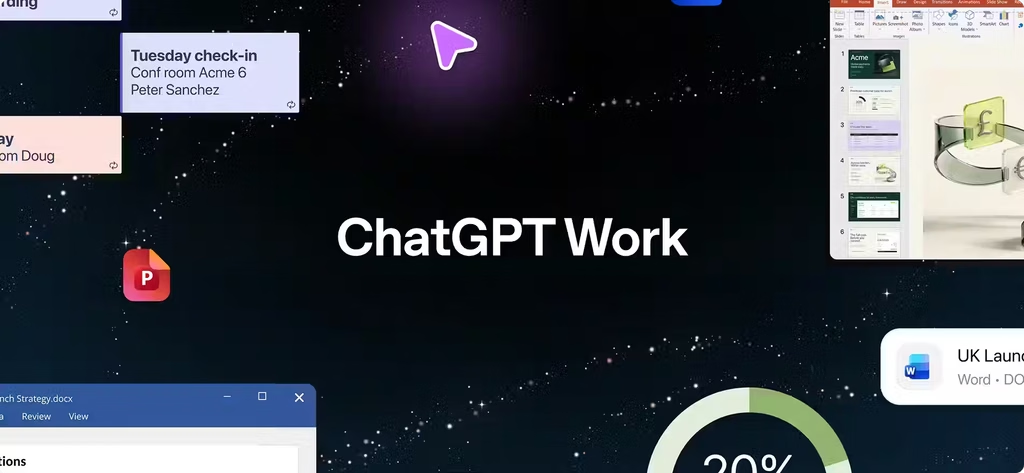
What if an AI assistant could do more than answer questions, write content, or suggest solutions? What if it could independently research information, navigate applications, organize files, execute complex workflows, and deliver completed projects? That is the practical ambition behind ChatGPT Work, OpenAI’s AI agent designed to handle longer, multi-step assignments.
Unlike a conventional chatbot that primarily generates responses, ChatGPT Work can work toward an objective across supported websites, connected applications, and files. It can gather information, prepare reports, build spreadsheets, create presentations, and coordinate tasks that would ordinarily require switching between several tools. OpenAI officially introduced ChatGPT Work on July 9, 2026, as part of its broader ChatGPT platform. Its launch announcement positioned Work as an agent capable of transforming goals into finished deliverables while allowing users to supervise progress, change instructions, and approve important actions.
ChatGPT Work is not a separate company or standalone AI model. It is an agent experience developed by OpenAI, the company established in 2015 by a founding group that included Sam Altman, Elon Musk, Greg Brockman, and Ilya Sutskever. Its history should therefore be distinguished from OpenAI’s founding and from the development of the underlying GPT models.
The platform also differs from Codex, OpenAI’s specialized software-development agent. While Codex concentrates on repositories, programming, debugging, and technical workflows, ChatGPT Work is designed for broader professional assignments spanning research, documents, business applications, and general task execution. OpenAI’s adoption figures offer context for its reach. On February 27, 2026, the company reported more than 50 million ChatGPT consumer subscribers and more than 9 million paying business users, according to its company disclosure.
These figures describe ChatGPT’s broader ecosystem, not ChatGPT Work specifically. They also predate Work’s public launch. As of October 27, 2026, we could not verify a credible public count of subscribers or active users specifically attributable to ChatGPT Work.
Our 15-person research team’s assessment
At Find Premium AI, our dedicated 15-person research team has researched and evaluated six leading AI-agent offerings to understand how effectively they handle real-world work. Our assessment considers more than the intelligence of the underlying models. We examine how well agents understand instructions, plan tasks, use tools, complete assignments, maintain context, operate efficiently, and deliver value relative to their cost.
Our team finalized its assessment on October 17, 2026, using seven weighted evaluation factors. The six offerings included Claude Cowork, ChatGPT Work, Perplexity Computer, Manus, Gemini Task, and Genspark Super Agent. ChatGPT Work achieved an overall score of 8.58 out of 10, placing it second in our comparison, narrowly behind Claude Cowork at 8.68 out of 10.
These scores represent our research findings under the conditions and evaluation framework we selected. They are not official industry rankings, guarantees of future performance, or claims that one agent will outperform every competitor on every assignment. In this article, we examine ChatGPT Work’s performance, compare the six offerings, assess available customer-review evidence, and explain which subscription offers the best value for different buyers.

Performance
ChatGPT Work’s most important capability is its ability to move beyond generating an answer and toward completing an assignment. A traditional AI assistant might explain how to perform market research or create a financial report. An AI agent can potentially execute several connected stages of that work, from information gathering and analysis to producing a deliverable.
But an agent’s usefulness depends on the entire process. Understanding instructions is only the beginning. It must also use the appropriate tools, recover from errors, respect constraints, and produce results that remain accurate when checked. Our assessment found ChatGPT Work particularly competitive in task completion, autonomy, and the breadth of its professional features. Its main relative weakness was prompt accuracy and context handling when compared with Claude Cowork.
AI models and reasoning capabilities
ChatGPT Work initially launched alongside OpenAI’s GPT-5.6 generation. Since then, its available models have evolved substantially. As of October 27, 2026, OpenAI’s model documentation identifies GPT-6.1 Sol, GPT-6.1 Terra, GPT-6 Sol, and GPT-6 Luna as models for ChatGPT Work and Codex. GPT-6 Astra is also available to eligible users, subject to plan allowances and model-access settings.
These options offer different balances of reasoning capability, speed, and resource consumption. GPT-6.1 Sol is designed for demanding professional work involving reasoning, coding, and complex task execution. OpenAI specifies a default context window of 500,000 tokens for Sol in Work and Codex, making it relevant to assignments involving substantial background material or extended interactions.
GPT-6.1 Terra focuses on efficient professional workflows, visual understanding, computer use, and clear writing. It is particularly relevant when an agent needs to interpret a screen, interact with software, or process visual material. GPT-6 Sol and GPT-6 Luna provide additional options with different capability and efficiency characteristics. Luna emphasizes faster, lower-resource operation, making it more suitable for relatively straightforward work.
GPT-6 Astra offers another option for particularly demanding assignments, although its higher resource consumption can affect how quickly a user exhausts their included allowance. One distinction is essential: GPT-6.1 Terra was released on October 26, 2026, nine days after our assessment was finalized. OpenAI’s model announcement describes improvements in visual reasoning, computer use, and efficiency. The company also reports favorable results on Agents’ Last Exam, OSWorld, and other technical benchmarks.
Those results are vendor-reported evaluations of the model in specified environments. They are not independent retests of our October 17 ChatGPT Work assessment. Differences in tools, configurations, reasoning settings, and production environments can affect real-world performance. Accordingly, our 8.58/10 score remains the original October 17 finding. We have not increased it to account for Terra’s subsequent release.
Users should also distinguish between models available in ordinary ChatGPT conversations and those offered specifically through Work. The exact internal model routing of every Work task is not publicly disclosed, and selectable options may vary by subscription, workspace permissions, platform, and rollout status.
Planning and complex task execution
Our research team awarded ChatGPT Work 9.0/10 for AI Intelligence & Planning. That score reflects our assessment of its ability to understand a goal, break complicated work into manageable steps, solve problems, and adapt when circumstances change. Consider an illustrative assignment involving a competitive market analysis. An agent might need to identify competitors, retrieve relevant information, compare their offerings, organize findings, and prepare a presentation.
The value comes from coordinating these stages instead of requiring the user to prompt a separate tool for every operation. ChatGPT Work supports this kind of workflow through its planning, research, file-handling, and deliverable-creation capabilities. However, strong planning does not guarantee that every step will be completed correctly. An incorrect source, misunderstood instruction, or failed application interaction can undermine an otherwise sensible plan.
This distinction is especially important because AI-agent workflows involve multiple opportunities for error. In our comparison, Claude Cowork received a higher planning score of 9.5, suggesting a meaningful advantage under the planning criteria our team applied. ChatGPT Work nonetheless remained competitive with Perplexity Computer, Manus, and Gemini Task, which also received 9.0.
Task completion and reliability
We assigned ChatGPT Work 8.5/10 for Task Completion & Reliability, matching Claude Cowork for the highest score among the six evaluated offerings. This factor carried the greatest weight in our assessment at 25%. We deliberately prioritize successful completion because an agent that generates impressive plans but consistently fails to deliver usable results has limited practical value.
ChatGPT Work can prepare research reports, organize information into spreadsheets, produce presentations, and work across connected files and applications. For example, a professional might use it to assemble information from several documents, compare data, identify important findings, and turn the analysis into a structured report.
A business team might delegate an initial presentation draft, then review and revise the content before distributing it. These are illustrative applications of its capabilities, not claims about specific undocumented experiments conducted by our researchers. The important limitation is that finished-looking work is not necessarily verified work.
A spreadsheet can contain an incorrect formula. A research report can misinterpret a source. A presentation can communicate an inaccurate conclusion convincingly. For important business decisions, users should inspect supporting evidence, verify calculations, review formatting, and confirm that the final result satisfies the original requirements.
Independent research supports this cautious approach to evaluating agents. The 2025 Remote Labor Index study examined economically valuable remote-work projects and found that the highest-performing agent in its tested group achieved a 2.5% automation rate. The original research evaluated different agent configurations before ChatGPT Work’s launch, so that result cannot be treated as ChatGPT Work’s success rate.
A separate March 2026 study examining 43 benchmarks and more than 72,000 tasks identified substantial differences between the activities represented in AI benchmarks and real-world occupations. Its research findings reinforce the need to judge an agent against the actual work it will perform. These studies do not invalidate our findings. They demonstrate why a model benchmark, a controlled agent experiment, and a practical product assessment should not be treated as interchangeable evidence.
Autonomy, tools, and integrations
ChatGPT Work scored 9.0/10 for Autonomy & Tool Use, tying Claude Cowork and Perplexity Computer. Its tools are central to its appeal. Through Work, users can authorize access to supported applications, work with files, interact with websites, and coordinate multiple actions toward a requested outcome.
Its cloud browser can read pages, click controls, enter information, and perform supported actions on websites, including some that require authentication. OpenAI’s browser documentation explains that cloud-browser tasks run on a separate computer and may continue after the user closes their own device. ChatGPT Work can also use scheduled or event-triggered tasks where supported, helping automate recurring work or respond to events in connected applications.
On the desktop app, eligible users may allow Work to interact with local files and applications. These capabilities depend on the operating environment and permissions granted. But autonomy has limits. A website may restrict automated interactions, a connected service may expose only certain actions, or an account may require additional authentication.
Work may pause to request permission, clarification, or approval, particularly before consequential actions such as payments or bookings. These safeguards can interrupt an automated process, but reducing unnecessary intervention should not mean removing appropriate oversight. For tasks involving sensitive data, financial commitments, legal obligations, or customer information, human confirmation remains important.
Prompt accuracy, context, and consistency
ChatGPT Work achieved 8.5/10 for Prompt Accuracy & Context. This was a solid result compared with most competitors, but it also exposed its clearest gap relative to Claude Cowork, which scored 9.5. Prompt accuracy matters when an assignment includes multiple conditions. A client might require a particular report structure, specific source exclusions, strict formatting, an exact number of sections, or revisions that preserve previously approved content.
An effective agent must remember and respect these instructions throughout the process, not merely acknowledge them at the beginning. Complex assignments can become vulnerable to context drift, missed exclusions, incorrect assumptions, or changes that unintentionally overwrite earlier decisions. ChatGPT Work’s result suggests strong capability under our evaluation framework, but users handling particularly constraint-heavy work should consider Claude Cowork’s higher score. Our practical recommendation is to provide clear objectives, required output formats, non-negotiable constraints, and measurable acceptance conditions before delegating a substantial task.
Speed and overall usability
ChatGPT Work scored 8.0/10 for Speed, placing it above Claude Cowork and Manus, both of which received 7.5. Gemini Task led this factor with 8.5. Importantly, our speed criterion measures the time required to obtain a usable and verified result, including retries, tool execution, and revisions.
An agent that produces an initial draft in seconds but requires repeated correction may offer less practical efficiency than one that takes longer to produce a dependable result. For Features, Usability & Value, ChatGPT Work scored 9.0/10, the highest result in our comparison. Its strengths include the breadth of supported workflows, file creation, application access, scheduling, model choices, and its integration into the existing ChatGPT environment.
Its usability is not perfect, however. Workspace permissions, model availability, cloud-browser compatibility, and usage allowances can complicate the experience. Privacy deserves particular attention. Business and Enterprise customers receive organizational controls and different data-handling arrangements from consumer subscriptions. Users should verify the protections, permissions, and retention arrangements relevant to their account rather than assuming that every plan offers identical safeguards.
Our seven evaluation factors
To evaluate the six AI agents consistently, Find Premium AI’s 15-person research team used seven weighted factors.
| Evaluation Factor | What It Measures | Weight |
|---|---|---|
| AI Intelligence & Planning | Understanding goals, breaking complex tasks into steps, solving problems, and adapting when circumstances change | 15% |
| Task Completion & Reliability | Completing tasks correctly from start to finish, producing usable results, verifying outcomes, and performing consistently | 25% |
| Autonomy & Tool Use | Using browsers, apps, files, and APIs effectively; managing multiple steps; recovering from errors; and minimizing unnecessary intervention | 15% |
| Prompt Accuracy & Context | Following instructions, constraints, formats, and exclusions; maintaining relevant context; and incorporating corrections | 15% |
| Speed | Time from request to a usable, verified result, including tool execution, retries, and revisions | 10% |
| Features, Usability & Value | Ease of use, integrations, scheduling, memory, exports, pricing, usage limits, privacy, permissions, and user controls | 15% |
| User Rating & Review Confidence | User satisfaction supported by authentic, recent, relevant reviews, considering review volume and diversity of sources | 5% |
These weights total 100%, with each evaluation factor rated out of 10. The scorecard’s overall scores reflect the seven weighted measurements. Our supplied material does not establish statistical confidence intervals, repeated-trial counts, or uncertainty ranges, so small differences should not be interpreted as statistically significant. With this framework established, the next question is whether ChatGPT Work provides the strongest combination of capabilities for a particular buyer.
Comparisons Before You Buy
Our October 17, 2026 assessment ranked six AI-agent offerings based on the seven factors. Each product has a different balance of reasoning, autonomy, reliability, speed, and usability. The overall ranking provides a broad comparison, but the category scores are often more useful when choosing an agent for a particular workload.
Overall AI-agent rankings
Claude Cowork finished first, with ChatGPT Work trailing by only 0.10 points. That is a narrow difference in our scoring system, not evidence that Claude Cowork will outperform ChatGPT Work in every situation.
Detailed performance comparison
The table covers planning, completion reliability, tool autonomy, contextual accuracy, speed, value, and customer-review confidence.
| Product | Overall Score | AI Intelligence & Planning | Task Completion & Reliability | Autonomy & Tool Use | Prompt Accuracy & Context | Speed | Features, Usability & Value | User Rating & Review Confidence | Best For |
|---|---|---|---|---|---|---|---|---|---|
| Claude Cowork | 8.68 | 9.5 | 8.5 | 9.0 | 9.5 | 7.5 | 8.5 | 6.5 | Projects combining narration, songs, sound effects and voice production |
| ChatGPT Work | 8.58 | 9.0 | 8.5 | 9.0 | 8.5 | 8.0 | 9.0 | 6.5 | Complete vocal songs and substantial music-production revisions |
| Perplexity Computer | 8.20 | 9.0 | 8.0 | 9.0 | 8.0 | 8.0 | 8.0 | 6.0 | Song drafts developed with references, remixing, stems and production exports |
| Manus | 8.13 | 9.0 | 8.0 | 9.5 | 8.0 | 7.5 | 8.0 | 4.0 | Podcasts, recorded dialogue, narration and editing audio inside a project |
| Gemini Task | 8.05 | 9.0 | 7.5 | 8.0 | 8.0 | 8.5 | 8.5 | 6.0 | Video soundtracks, instrumental backing, voiceovers and sound effects |
| Genspark Super Agent | 7.78 | 8.5 | 7.5 | 8.5 | 7.5 | 8.0 | 8.0 | 4.5 | Speech, voice cloning and music experiments with web/API options |
The results show why ChatGPT Work performed so well overall. It shared the highest task-completion and reliability score with Claude Cowork, tied several competitors on autonomy, and led all six offerings in features, usability, and value. However, it did not lead in planning, prompt accuracy, autonomy, or speed.
ChatGPT Work vs. Claude Cowork
Claude Cowork is the strongest overall competitor in our assessment. Claude scored 9.5 for both AI Intelligence & Planning and Prompt Accuracy & Context, compared with ChatGPT Work’s 9.0 and 8.5. That combination favors Claude Cowork for complex assignments involving detailed instructions, extensive context, and strict formatting constraints.
Both agents scored 8.5 for Task Completion & Reliability and 9.0 for Autonomy & Tool Use. ChatGPT Work performed better on speed, scoring 8.0 against Claude’s 7.5, and on features, usability, and value, scoring 9.0 against 8.5. For buyers who prioritize exact instruction following and sophisticated planning, Claude Cowork may justify its first-place position.
For buyers who value an adaptable workspace covering research, files, applications, and varied deliverables, ChatGPT Work may be the more practical option despite ranking second.
ChatGPT Work vs. Perplexity Computer
Perplexity Computer scored 8.20/10, placing third. Its 9.0 scores for planning and autonomy matched ChatGPT Work, indicating competitive strengths in organizing and executing multi-step assignments. However, ChatGPT Work scored higher in task completion and reliability, prompt accuracy, features and value, and customer-review confidence. Perplexity Computer is worth considering for research-centered assignments where information gathering, source comparison, and structured analysis are particularly important.
ChatGPT Work is the stronger choice under our framework for users who require a broader combination of research, application interaction, and finished business deliverables. Perplexity’s broader search product and Perplexity Computer should not be treated as identical experiences. Buyers should verify which specific Computer capabilities are included in their intended subscription.
ChatGPT Work vs. Manus
Manus achieved 8.13/10, finishing fourth. Its standout result was 9.5/10 for Autonomy & Tool Use, the highest autonomy score among all six offerings. This makes Manus an interesting option for buyers whose primary objective is delegating complex workflows with limited intervention. ChatGPT Work, however, led Manus in task completion and reliability, prompt accuracy, speed, features and value, and review confidence.
Autonomy alone does not establish that an agent will consistently deliver correct results. Buyers should consider how the system behaves when tasks fail, permissions are restricted, or its initial interpretation is wrong. Under our team’s balanced criteria, ChatGPT Work offers the stronger overall proposition, while Manus has an advantage for autonomy-focused evaluation.
ChatGPT Work vs. Gemini Task
Gemini Task ranked fifth with 8.05/10. Its strongest comparative result was speed, where it scored 8.5/10, ahead of ChatGPT Work’s 8.0. Gemini Task also achieved 9.0 for planning and 8.5 for features, usability, and value. However, it trailed ChatGPT Work in task completion, autonomy, prompt accuracy, and review confidence.
Gemini Task deserves consideration from users who value quick task execution and work extensively within Google’s productivity ecosystem. For more complicated multi-step projects where reliability and tool coordination matter more than speed alone, ChatGPT Work performed better in our assessment.
ChatGPT Work vs. Genspark Super Agent
Genspark Super Agent finished sixth with 7.78/10. It scored 8.5 for planning and autonomy, 8.0 for speed and value, and 7.5 for both task completion and prompt accuracy. Genspark may appeal to users interested in experimenting with varied research, content, presentation, and media-related workflows within an agent-oriented environment.
But our results suggest that additional oversight may be necessary when projects involve complicated instructions or substantial deliverable requirements. ChatGPT Work scored higher in every factor except speed, where both received 8.0.
Which AI agent is best for different users?
Our findings support different recommendations depending on the work involved.
| AI Agent | Best Suited For |
|---|---|
| Claude Cowork | Complex reasoning, detailed instructions, context-heavy assignments, and strict deliverable requirements |
| ChatGPT Work | General-purpose professional workflows, research, documents, spreadsheets, presentations, and connected application tasks |
| Perplexity Computer | Research-led assignments, source discovery, and structured information-gathering workflows |
| Manus | Highly autonomous workflows where minimizing intervention is a primary objective |
| Gemini Task | Speed-sensitive tasks and workflows closely connected to Google’s ecosystem |
| Genspark Super Agent | Experimentation across research, content production, and varied AI-assisted deliverables |
These recommendations are editorial interpretations of our measured scores and product positioning, not guarantees that a particular agent will succeed at every suggested task. Our team’s ranking was not predetermined to favor ChatGPT Work or any other product. Another evaluator using different assignments, priorities, or weights could reasonably reach a different order.
For example, giving prompt accuracy more weight would strengthen Claude Cowork’s position. Prioritizing autonomy could improve Manus’s relative ranking, while placing greater emphasis on speed could favor Gemini Task. For a broadly capable professional AI agent, ChatGPT Work remains one of the most competitive options in our research, even though Claude Cowork holds the highest overall score.
Customer Review
Product performance scores provide one perspective. Public customer reviews offer another, helping buyers understand broader satisfaction, usability concerns, and potential limitations. Our research material identifies Google Play Store and G2 as the selected sources for public-rating comparisons. We checked the original listings on October 27, 2026, while retaining the ratings and approximate review counts shown in our supplied research snapshot. That snapshot does not state its collection date, so its figures should not be assumed to represent October 17 specifically.
| Product | Source used | Public Rating | Votes & Reviews |
|---|---|---|---|
| Claude Cowork | Google Play Store | 4.5/5 | 828K+ reviews |
| ChatGPT Work | Google Play Store | 4.5/5 | 61.8M+ reviews |
| Perplexity Computer | G2 | 4.4/5 | 361+ reviews |
| Manus | G2 | 4.6/5 | 10+ reviews |
| Gemini Task | G2 | 4.4/5 | 635+ reviews |
| Genspark Super Agent | G2 | 4.3/5 | 19+ reviews |
These are the original five-star rating scales used by the respective platforms, not our team’s ten-point scores. The underlying listings can be inspected through the Claude app listing, ChatGPT app listing, Perplexity G2 reviews, Manus G2 reviews, Gemini G2 reviews, and Genspark G2 reviews.
What customer ratings reveal about ChatGPT Work
The broader ChatGPT Android application held a 4.8/5 rating with approximately 66.1 million displayed reviews when checked on October 27. That is higher than the 4.5/5 and 61.8M+ figure preserved in our supplied material. However, it would be misleading to present that improvement as direct evidence of ChatGPT Work’s performance.
The Google Play listing covers the entire ChatGPT Android application, including general conversations, writing assistance, voice interactions, image features, subscriptions, and numerous other capabilities. It does not isolate customer satisfaction with ChatGPT Work. Likewise, the Google Play rating for Claude by Anthropic should not be interpreted as a Cowork-specific score.
Google Play describes its headline counts as reviews, but these displayed totals should not be assumed to represent individual, detailed written evaluations of agent workflows. Its published rating guidance also explains that visible app ratings are weighted toward more recent submissions.
How the competitors’ reviews compare
The G2 listings provide more business-software-oriented evidence, although they also have important limitations. Perplexity maintained a rating of 4.4/5 from 363 reviews on October 27. Its G2 feedback highlights useful research capabilities and fast, cited responses while also identifying inconsistent source and citation quality as a recurring concern.
That limitation matters when an agent is being considered for evidence-intensive professional research. Manus illustrates a different problem: the importance of identifying the exact listing being reviewed. The selected G2 profile titled Manus showed 4.6/5 from ten reviews. However, another G2 agent listing titled Manus AI agent showed 2.4/5 from eight reviews, with listing metadata dated October 23, 2026.
Those are separate profiles with different review populations. Their ratings should not be averaged or treated as interchangeable. The disagreement also demonstrates why a small number of reviews deserves cautious interpretation. Gemini’s G2 listing showed 4.4/5 from 640 reviews, but the profile covers the broader Gemini product family rather than isolating Gemini Task.
Genspark AI’s listing showed 4.3/5 from 19 reviews. The reviewed feedback includes praise for ease of use and deliverable creation, alongside concerns about credits and the cost of larger workloads. These points are valuable for identifying questions to investigate, but they do not establish typical experiences across every subscriber or agent configuration.
Why we consider Google Play and G2
There are practical reasons to consider these platforms. Google Play offers substantial consumer-app rating volume and applies policies and moderation systems intended to limit abusive or manipulated feedback. G2 organizes reviews around software products and professional use cases, and it publishes its research methodology, including how products are categorized and evaluated.
Nevertheless, neither platform is immune to selection effects, incomplete reviews, differing user expectations, or product-scope mismatches. G2 may contain incentivized reviews, while Google Play’s very large app-level totals may reflect activities unrelated to the specific agent being assessed. Our supplied materials identify these preferred sources but do not document a formal source-selection audit. We therefore treat their relevance and limitations as an evidence-based editorial judgment rather than claiming that our researchers independently verified every reviewer.
Most importantly, public customer ratings are supplementary evidence. They do not independently validate our agent rankings or establish the reliability of individual Work tasks. Our User Rating & Review Confidence factor reflects a broader judgment about public sentiment and supporting evidence, not a mathematical conversion of app-store stars or G2 averages.
| Evaluated AI Agent | Public Rating Source | Live Listing, October 27 |
|---|---|---|
| Claude Cowork | Google Play Store — Claude by Anthropic | 4.5/5; approximately 828K displayed reviews |
| ChatGPT Work | Google Play Store — ChatGPT | 4.8/5; approximately 66.1M displayed reviews |
| Perplexity Computer | G2 — Perplexity | 4.4/5; 363 reviews |
| Manus | G2 — Manus | 4.6/5; 10 reviews |
| Gemini Task | G2 — Gemini | 4.4/5; 640 reviews |
| Genspark Super Agent | G2 — Genspark AI | 4.3/5; 19 reviews |
Pricing
An AI agent may be powerful, but its value depends on how much useful work a subscription actually enables. ChatGPT Work is not marketed as a separate subscription with its own fixed monthly price. Instead, it is included in eligible ChatGPT plans, subject to usage allowances and product-access conditions.
The following prices are publicly advertised US prices in USD, verified October 27, 2026. They are not necessarily the prices offered in every country and exclude applicable taxes and optional additional usage credits.
Available ChatGPT Work subscription options
| Subscription | Monthly Price | Annual Billing | Access and Key Limits | Recommended Buyer |
|---|---|---|---|---|
| ChatGPT Plus | $20/month | Not available | Work, cloud browser, eligible models, included allowance, five-hour and weekly usage limits | Individuals starting with AI-agent workflows |
| ChatGPT Pro 100 | $100/month | Not available | Higher included usage than Plus, Astra access, no five-hour Work limit, no Ultrafast | Regular individual users with heavier workloads |
| ChatGPT Pro 200 | $200/month | Not available | Higher included usage than Pro 100, Astra access, no five-hour Work limit, no Ultrafast | Heavy professional users |
| ChatGPT Pro 500 | $500/month | Not available | Highest Pro usage allowance, eligible Astra and Sol Ultrafast access | Very intensive individual workloads |
| ChatGPT Business Standard | $25/user/month | $20/user/month equivalent, billed annually | Work, Codex, shared administration, included usage and optional workspace credits; two-seat minimum | Small and growing teams |
| ChatGPT Business Premium | $125/user/month | $100/user/month equivalent, billed annually | Five times Standard’s included usage, no five-hour limit; two-seat workspace minimum, mixed seats supported | Teams with demanding agent workloads |
| ChatGPT Enterprise | Custom quote | Contract-specific | Work access with advanced organizational controls and negotiated usage arrangements | Larger organizations with security and governance requirements |
| ChatGPT Edu | Institution-specific | Institution-specific | Eligible Work access, subject to institutional licensing and administrative settings | Educational institutions |
Official subscription information is available through OpenAI’s Plus pricing, Pro tiers, and Business billing documentation. Free and Go do not provide the full paid cloud-browser experience included in this comparison. Work access, where applicable, also depends on supported platforms, regions, rollout status, and workspace permissions.
ChatGPT Plus – Best value for most individuals
At $20 per month, ChatGPT Plus is the most sensible starting point for a typical individual who wants to use ChatGPT Work regularly. It offers access to the core agent experience, supported cloud-browser workflows, and eligible Work models without requiring a Pro-level subscription. For someone researching topics, preparing documents, organizing spreadsheets, creating presentations, or handling occasional multi-step assignments, Plus provides a relatively affordable entry point.
However, its included agent allowance is limited. OpenAI’s usage guidance explains that consumption varies according to the selected model, task complexity, execution mode, and context requirements. Users regularly executing demanding workloads may exhaust their included allowance more quickly than expected. For light-to-moderate agent usage, however, Plus is our default recommendation.
ChatGPT Pro – For heavier workloads
Pro subscriptions are intended for people who need greater capacity. The Pro 100 tier costs $100 per month, while Pro 200 costs $200 per month and offers a larger included allowance. Pro 500, priced at $500 per month, provides the highest included usage among the Pro tiers and access to Ultrafast execution for eligible models.
Ultrafast requires careful financial consideration. OpenAI specifies that, on Pro 500, it consumes included Work and Codex usage at eight times the Standard rate for the same selected model. Once included usage is exhausted, Ultrafast consumes purchased credits at six times the Standard credit rate.
Lower latency can be valuable, but it is not equivalent to guaranteed higher task accuracy or a lower total cost. A professional consistently reaching Plus limits should consider Pro 100 before moving to higher tiers. Pro 200 and Pro 500 become more sensible when the additional capacity has a measurable benefit to the buyer’s workload. We would not recommend paying $500 per month simply to access the highest advertised tier without evidence that the workload justifies it.
ChatGPT Business – For teams and organizations
ChatGPT Business provides a more structured arrangement for users who need shared administration, workspace controls, and business-oriented data handling. Standard seats cost $25 per user per month under monthly billing, or the equivalent of $20 per user per month when billed annually. Premium seats cost $125 per user per month under monthly billing, or $100 per user per month when billed annually.
Premium includes five times the usage available with Standard seats and removes the five-hour usage limit. Business workspaces require at least two paid seats. Standard and Premium seats can be mixed within the same workspace, allowing organizations to purchase higher capacity only for the people who genuinely need it.
That flexibility is useful because not every employee will consume agent capacity at the same rate. Organizations should also examine permissions, data controls, security requirements, and credit spending policies before choosing a plan.
Monthly vs. annual billing
Annual billing can reduce recurring costs, but only when the subscription actually offers an annual payment arrangement. ChatGPT Plus and Pro are monthly subscriptions. OpenAI does not advertise discounted annual billing for those individual plans. A Plus subscription maintained for twelve months would cost:
$20 × 12 = $240
This is a cost projection, not a prepaid annual Plus offer. Business subscriptions provide a genuine monthly-versus-annual choice.
| Business Seat | Monthly Billing Cost Over 12 Months | Annual Billing Cost | Annual Savings |
|---|---|---|---|
| Standard | $300 per seat | $240 per seat | 20% |
| Premium | $1,500 per seat | $1,200 per seat | 20% |
For Standard, the savings calculation is:
($300 − $240) ÷ $300 × 100 = 20%.
For Premium:
($1,500 − $1,200) ÷ $1,500 × 100 = 20%.
The annual subscription requires an annual commitment. The displayed monthly equivalent is not the same as a cancellable monthly charge. For example, a two-person Business Standard workspace costs $50 per month under monthly billing, or $480 for two seats for a full year when billed annually.
Annual billing therefore saves $120 over twelve months for those two equivalent seats. For an organization using fifteen Standard seats, the difference becomes more substantial: $4,500 across twelve months under monthly billing versus $3,600 on annual billing, a $900 saving. That example assumes all fifteen seats remain active for the year, no optional credits are purchased, and the published US prices apply.
Monthly billing remains preferable for short projects, experimental deployments, or uncertain staffing requirements. Annual billing offers better value when the number of users and expected workload are reasonably predictable.
Which ChatGPT Work subscription should you choose?
For a typical individual buyer, ChatGPT Plus at $20 per month is our recommended starting plan. It provides access to the relevant agent features at the lowest broadly available paid price without requiring a substantial upfront commitment. People using Work occasionally should avoid purchasing higher-capacity subscriptions unless they demonstrably need them.
Frequent users who repeatedly exhaust their Plus allowance should evaluate Pro 100 first. Pro 200 and Pro 500 make sense only when the additional capacity or execution mode justifies the cost. For organizations, Business Standard is the logical baseline when shared workspace controls are necessary. Premium seats should be reserved for heavier users, while Enterprise is more appropriate when governance, compliance, or contractual requirements demand it.
Our team’s performance findings support this approach. ChatGPT Work’s strong scores for task completion, autonomy, and features make it suitable for a wide range of assignments, but the scorecard does not establish a fixed number of completed tasks per subscription. The most useful measure of value is therefore the cost of obtaining reliably completed work, including any credits consumed and time spent reviewing or correcting the result.
Conclusion
After evaluating six AI-agent offerings across seven weighted factors, Find Premium AI’s 15-person research team ranked ChatGPT Work second overall, with a score of 8.58/10, behind Claude Cowork’s 8.68/10. Its strongest advantages are versatility, task completion, tool use, and the breadth of features available within the ChatGPT ecosystem.
ChatGPT Work tied Claude Cowork for the highest Task Completion & Reliability score at 8.5, while leading every evaluated offering in Features, Usability & Value with 9.0. Its most important competitive limitation is prompt accuracy and context handling, where Claude Cowork demonstrated a higher result under our assessment framework.
For professionals who need an adaptable AI agent for research, file creation, data analysis, presentations, and connected application workflows, ChatGPT Work is one of the strongest options we evaluated. For buyers whose top priority is sophisticated planning and strict instruction fidelity, Claude Cowork deserves serious consideration. Manus may appeal to autonomy-focused users, while Perplexity Computer, Gemini Task, and Genspark Super Agent offer alternatives suited to different requirements.
On subscription value, we recommend ChatGPT Plus at $20 per month for most individual users, upgrading only when actual usage warrants it. Teams should consider Business Standard, selective Premium seats, or Enterprise according to their capacity and governance needs. Our October 17 rankings remain a snapshot of our research conditions. New models such as GPT-6.1 Terra may change future comparisons, but they should be tested before being credited with improvements to our existing scores.
Ultimately, the best AI agent is not necessarily the product with the highest ranking, the newest model, or the most expensive subscription. It is the one that can complete your actual work reliably, respect your requirements, and deliver sufficient value to justify its cost.
FAQ
1. Is ChatGPT Work better than Claude Cowork?
ChatGPT Work and Claude Cowork are closely matched, but each excels in different areas. In Find Premium AI’s October 17, 2026 assessment, conducted by our 15-person research team, Claude Cowork ranked first with 8.68/10, while ChatGPT Work ranked second with 8.58/10. Claude Cowork performed better in AI Intelligence & Planning (9.5 vs. 9.0) and Prompt Accuracy & Context (9.5 vs. 8.5).
However, ChatGPT Work scored higher in Features, Usability & Value (9.0 vs. 8.5) and Speed (8.0 vs. 7.5). For complex instructions and context-heavy assignments, Claude Cowork may be preferable. For versatile professional workflows involving research, documents, spreadsheets, and connected applications, ChatGPT Work is a strong alternative.
2. Can ChatGPT Work complete complex tasks without human supervision?
ChatGPT Work can independently execute many stages of complex assignments, including researching information, navigating supported websites, working with files, and creating deliverables. Our research team awarded it 9.0/10 for Autonomy & Tool Use and 8.5/10 for Task Completion & Reliability.
However, it is not completely autonomous in every situation. Website restrictions, authentication requirements, ambiguous instructions, and sensitive actions may require human intervention. Users should review important outputs, especially financial calculations, business decisions, and research findings. ChatGPT Work is best treated as a capable AI agent that reduces manual effort while allowing users to maintain control over consequential decisions.
3. How much does ChatGPT Work cost, and which subscription offers the best value?
ChatGPT Work is included with eligible ChatGPT subscriptions rather than sold separately. According to the US pricing reviewed for our article on October 27, 2026, ChatGPT Plus costs $20 per month, while Pro tiers cost $100, $200, or $500 per month depending on usage capacity. ChatGPT Business Standard costs $25 per user monthly or the equivalent of $20 per user monthly with annual billing, subject to a two-seat minimum.
For most individual professionals, our recommendation is ChatGPT Plus because it provides access to essential Work capabilities at the lowest broadly available paid price. Users with consistently demanding workloads may benefit from Pro, while organizations needing shared administration should consider Business.
4. What are the biggest advantages and limitations of ChatGPT Work?
ChatGPT Work’s biggest advantages are its broad task capabilities, integration with supported applications, file creation, and ability to coordinate multi-step workflows. It achieved the highest Features, Usability & Value score of 9.0/10 among the six agents evaluated by Find Premium AI.
Its limitations include occasional difficulty maintaining complex instructions, dependence on website and integration compatibility, variable usage consumption, and the need for human verification of important outputs. Claude Cowork scored higher in prompt accuracy, while Manus led in autonomy and Gemini Task in speed. ChatGPT Work is therefore particularly well suited to professionals seeking a balanced, general-purpose AI agent rather than a specialized tool optimized for one capability.
5. Is ChatGPT Work worth paying for in 2026?
Yes, for professionals who regularly need help completing multi-step digital tasks, ChatGPT Work can justify its subscription cost. It is particularly useful for research, data analysis, document preparation, presentations, and workflows involving multiple applications. Our 15-person research team ranked ChatGPT Work second among six evaluated AI agents, with an overall score of 8.58/10, reflecting strong reliability, autonomy, and usability.
However, its value depends on workload frequency, task complexity, and usage limits. Occasional users should start with the least expensive eligible plan, while heavy users should consider upgrading only when their requirements exceed the included capacity. The strongest reason to subscribe is not simply access to advanced AI models, but the potential to reduce repetitive work and produce useful deliverables more efficiently.