





Introduction
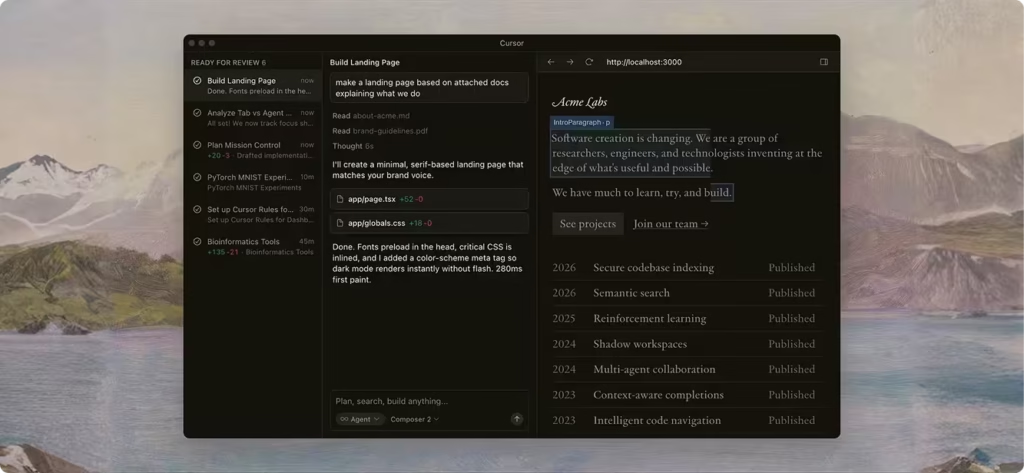
Picture a familiar moment: a seemingly small feature request opens six files, exposes a brittle database migration, and leaves a failing test whose stack trace points everywhere except the cause. This is where an AI coding product earns its place or becomes one more tab to manage. Cursor’s central promise is that the assistance stays inside the development loop: it can read repository context, edit across files, run tools, inspect results, and help revise the change without forcing the developer to re-explain the project continually.
That product grew out of Anysphere, founded in 2022 by MIT students Michael Truell, Sualeh Asif, Arvid Lunnemark, and Aman Sanger. Truell has said in a detailed founder interview that the team first spent roughly six months building AI-assisted CAD software, realized the market and founder fit were wrong, and pivoted toward programming after seeing the potential of early coding copilots. Cursor launched in 2023 and evolved from an editor with autocomplete into a broader agentic workspace. By our September 16, 2026 cutoff, its milestones included cloud agents, browser previews, self-hosted execution, the Cursor Projects beta, and an August 2026 acquisition announced through the company’s official newsroom.
Cursor is aimed primarily at professional developers, including individual contributors working in established repositories and teams trying to automate larger slices of delivery. The company does not publish a reliable, current subscriber total that we could verify. Its trust materials instead say that more than 50,000 companies use Cursor, while an April 2026 growth report reported $2 billion in annualized revenue reached that February. Those are meaningful adoption signals, but neither should be mistaken for a count of active users or paid seats.
For this review, we froze product and market evidence on September 16, 2026, and evaluated Cursor with the same seven-factor framework used for five leading alternatives. The weights are AI Intelligence 15%, Speed 10%, Coding & Web Development Quality 25%, Prompt Accuracy 20%, User Rating 10%, Review Confidence 5%, and Features & Usability 15%. Our resulting scores are an internal buying aid, not an official or universal leaderboard. They combine hands-on product assessment, a fixed workflow-oriented rubric, public product ratings, and external research. The rounded factor scores also should not be reverse-engineered to reproduce the overall score exactly; the underlying calculation retained more precision.
The methodology has limits. Results can move with the selected model, repository size, language, prompt quality, tool permissions, and how much verification a developer performs. A greenfield landing page, an old monolith, and a security-sensitive migration are different tests. Public ratings are self-selected, and model releases can change the practical experience faster than a long-term review cycle. We therefore treat close scores as close decisions, not as proof that one product wins every task.
Performance
The current model and product stack
The most recent major model release relevant at our cutoff was Grok 4.6, released through Cursor on August 12, 2026, together with SpaceXAI. It is available in the Cursor Models usage pool alongside Composer 2.5; it should not be described as a model built solely by Cursor. The company’s Grok announcement positions it for long-running agents, coding, web development, visual work, and other interactive tasks. Cursor reports that it matches GPT-5.6 Sol on the Artificial Analysis Intelligence Index and shows stronger first visual passes and more self-testing in Cursor’s own evaluations. Those are useful vendor results, not independent proof, and buyers should validate them against their own repositories.
Model choice is only part of the system. Cursor combines repository indexing, autocomplete, multi-file Agent work, terminal and tool access, browser previews, cloud agents, Git and pull-request workflows, and extensibility through MCPs, skills, and hooks. Its September product changelog also introduced Cursor Projects in beta: a persistent coordinator intended to retain context over months and delegate work across many subagents. Self-hosted machines let organizations keep code, builds, and secrets on their own execution infrastructure, while requests still pass through Cursor’s service layer. Together, these features make Cursor feel less like a chat box beside the editor and more like an operating surface for everyday software work.
Our seven-factor scorecard
Cursor scored 9.29/10 overall, placing third by a narrow margin behind Claude at 9.36 and OpenAI Codex at 9.33. Its clearest advantages were speed and product breadth; its main relative gaps were code quality and strict prompt fidelity compared with the two leaders.
AI Intelligence accounts for 15% of the result, and Cursor scored 9.4. This factor covers architectural reasoning, repository understanding, causal debugging, context retention, tool selection, recovery from failed approaches, and the handling of complex multi-step work. The score shows up most clearly in existing repositories. A developer can ask Cursor to trace an authentication bug, locate the affected schema and API paths, propose a repair, edit the relevant files, run tests, and react to the failures. Repository indexing and persistent context reduce the need to paste code manually. For refactors, it can follow references across files and keep a working plan visible. The remaining 0.6 matters, however: agents can still form a plausible but incorrect theory, overlook runtime behavior that is not represented in the repository, or “repair” a symptom while preserving the underlying design flaw. Claude and Codex therefore retain a modest reasoning advantage in our framework.
Speed contributes 10%, and Cursor scored 9.4, the highest result in our six-product comparison. We measured the time and consistency from a request to accepted, runnable code, including latency, retries, tool-call efficiency, and time to a verified revision. Fast autocomplete helps, but the larger gain comes from shortening the loop between instruction, edit, command, result, and revision. Cursor is particularly effective when a task contains several small dependent changes: update a type, propagate it through the backend, revise the UI state, fix tests, and inspect the rendered page. Speed should still be measured as time to an accepted change, not time to the first patch. A quick answer that creates two review cycles is not faster.
| Evaluation Factor | What It Measures | Weight |
|---|---|---|
| AI Intelligence | Architectural reasoning, repository understanding, causal debugging, context retention, tool selection, recovery from failed approaches, and handling complex multi-step work | 15% |
| Speed | Time and consistency from request to accepted, runnable code; includes latency, number of retries, tool-call efficiency, and time to a verified revision | 10% |
| Coding & Web Development Quality | Correctness, test pass rate, maintainability, architecture, security, frontend polish, responsiveness, accessibility, backend and database integration, and deployability | 25% |
| Prompt Accuracy | Fidelity to requested behavior, stack, file scope, UI details, constraints, exclusions, coding standards, and “do not change” instructions | 20% |
| User Rating | Normalized public satisfaction from credible software-review platforms, using the most product-specific and recent rating available | 10% |
| Review Confidence | Review authenticity, sample size, recency, source diversity, and whether the reviews describe the current product rather than an older version | 5% |
| Features & Usability | IDE, terminal, browser, cloud-agent and Git/PR workflows; repository indexing; previews; testing; deployment; rollback; integrations; controls; onboarding; and learning curve | 15% |
Coding & Web Development Quality carries the heaviest weight at 25%, and Cursor scored 9.1. This factor considers correctness, test pass rate, maintainability, architecture, security, frontend polish, responsiveness, accessibility, backend and database integration, and deployability. Cursor can generate polished interfaces, backend routes, data-access code, tests, and configuration, but quality depends heavily on the guardrails around the agent. Browser preview makes visual iteration more concrete, and terminal access lets the agent test its own work. Yet attractive output can conceal weak accessibility, missing error states, unsafe authorization assumptions, obsolete dependencies, or a migration that is hard to roll back. For production work, we would require the same checks as human-authored code: focused tests, static analysis, security review, migration rehearsal, and a readable diff.
Prompt Accuracy represents 20%, and Cursor scored 9.1. We assessed fidelity to the requested behavior, stack, file scope, UI details, constraints, exclusions, coding standards, and “do not change” instructions. The result is good, not absolute. Cursor performs best when the request names the desired behavior, allowed file scope, framework constraints, acceptance checks, and explicit exclusions. “Add team invitations” leaves architectural choices open; “add email invitations using the existing queue, change only these modules, preserve the current auth provider, include expiry tests, and do not alter the schema outside this migration” creates a much safer execution boundary. Developers should pause broad agents at design checkpoints instead of granting uninterrupted authority over a large change.
User Rating contributes 10%, and our fixed scorecard assigns Cursor 9.4. That score reflects normalized satisfaction from the most product-specific and recent credible review evidence; it is not a simple average of every public star rating. Our expanded September review scan found authentic ratings ranging from 1.6/5 to 5.0/5. We therefore interpret 9.4 as strong approval of the coding product on professional and developer-focused platforms—not as uniform satisfaction with every part of the customer experience.
Review Confidence contributes 5%, and Cursor also scored 9.4. We considered review authenticity, sample size, recency, source diversity, and whether comments described the current product rather than an older version. The expanded dataset improves source diversity: it includes professional software sites, an enterprise-review platform, a product community, a customer-experience site, and an official app store. High confidence does not mean the sources agree; it means we have enough substantial, product-specific evidence to see the disagreement clearly. We did not double-count Gartner market subsets, Apple country storefronts, or the overlapping SourceForge and Slashdot review network.
Features & Usability represents the final 15%, and Cursor scored 9.6, tying the best result in the field. We considered its IDE, terminal, browser, cloud-agent, and Git/PR workflows; repository indexing; previews; testing; deployment; rollback; integrations; controls; onboarding; and learning curve. The score reflects the continuity between editor, agent, terminal, browser, cloud execution, source control, and customization. An engineer can remain in one environment for exploration, implementation, validation, and review. That convenience can also enlarge the blast radius: the more tools an agent can reach, the more carefully permissions, secrets, network access, and destructive commands must be constrained.
What external evidence adds
The positive side of Cursor’s review profile is broad. Our September 16 capture recorded 5.0/5 from 948 reviews on Product Hunt, the largest high-score community sample we found. The US App Store showed 4.7/5 from 664 ratings. Among professional users, G2 reviews showed 4.6/5 from 315 reviews, Gartner reviews showed 4.5/5 from 150 ratings, and TrustRadius reviews showed 4.7/5 from 76 reviews and ratings. These sources support the view that developers generally value Cursor’s repository awareness, multi-file work, familiar editor experience, and agent capabilities.
| Product | Source used | Public Rating | Votes & Reviews |
|---|---|---|---|
| Claude | Google Play Store | 4.5/5 | 734K+ reviews |
| OpenAI Codex | Product Hunt | 5.0/5 | 87+ reviews |
| Cursor | Product Hunt | 5.0/5 | 947+ reviews |
| Devin | G2 | 4.3/5 | 83+ reviews |
| GitHub Copilot | G2 | 4.4/5 | 386+ reviews |
| Replit | Google Play Store | 4.5/5 | 50K+ reviews |
The negative side is too large to dismiss. Cursor’s dedicated Trustpilot profile showed 1.6/5 from 320 reviews, including 78% one-star submissions. The recurring complaints concerned on-demand charges, token consumption, support, refunds, speed, reliability, and agent or code quality. Trustpilot often captures post-purchase service and billing experiences rather than a controlled assessment of coding performance, but a sample of this size is still a material buying signal—especially for anyone considering heavy usage or annual billing.
Several smaller sources reinforce the positive direction without carrying the same weight. AlternativeTo reviews showed 4.6/5, although the aggregate rating count was not exposed and only five comments or reviews were visible. PeerSpot reviews showed 4.5/5 from two reviews, Capterra reviews showed 5.0/5 from four, and SourceForge reviews showed 5.0/5 from two. Their direction is useful, but their samples are too small to offset or confirm the larger platforms independently.
The responsible interpretation is polarization, not a blended star average. Professional software, enterprise, developer-community, and mobile sources are strongly positive; the large Trustpilot sample is sharply negative about the commercial and support experience. Platform audiences, moderation systems, questions, and rating behavior differ, so averaging all ten figures would create false precision. This is why our 9.4 User Rating remains a fixed normalized scorecard input while the buying analysis separately exposes the full range. Review Confidence is high because the evidence is numerous and diverse, not because sentiment is unanimous.
Independent research gives the productivity story useful friction. A 2025 randomized METR study observed 16 experienced open-source developers completing 246 tasks in mature repositories, primarily with Cursor Pro and Claude 3.5/3.7. Participants were expected to be 24% faster but were measured as 19% slower. This does not establish that 2026 Cursor slows every developer: it used older tools and models, involved maintainers deeply familiar with their codebases, and was not a current Cursor-only comparison. It does show that perceived acceleration can differ sharply from measured completion time, especially when reviewing and correcting AI output.
A broader 2026 research synthesis covering 23 studies found a moderate positive productivity effect overall but substantial variation, with smaller gains in open-source and enterprise settings. Taken together, the evidence favors task-level measurement. Track accepted cycle time, escaped defects, review burden, and rework not generated lines or how busy the agent appears.
Privacy, security, and operational limits
Cursor’s security page lists SOC 2 Type II, ISO 27001:2022, ISO 42001:2023, AIUC-1, and annual third-party penetration testing. Privacy Mode is available on free and paid plans; when enabled, Cursor says submitted code is not used for model training and zero-data-retention agreements apply to model providers. Its data policy adds important nuance: abuse and risk classifiers may retain flagged material under their policies, and requests still route through Cursor’s backend even when a customer supplies a model key. If Privacy Mode is off, Cursor may store and use prompts, codebase data, and actions to improve its products and train models.
For confidential work, we would enable Privacy Mode before indexing a repository, use the narrowest practical agent permissions, isolate execution, keep production credentials out of prompts and shell history, and require human approval for deployments, destructive database operations, dependency changes, and security-sensitive code. Self-hosted machines can keep execution and secrets on internal infrastructure, but they do not eliminate every data-flow consideration.
The practical limits are equally important. Cursor can hallucinate APIs, import vulnerable packages, over-edit adjacent files, consume an expensive model faster than expected, and lose the business context that lives outside the repository. Long-running cloud agents introduce coordination and observability questions as well as capability. The product works best as a high-agency collaborator inside a disciplined engineering system, not as an unreviewed replacement for one.
Comparisons Before You Buy
Cursor against the five leading alternatives
The overall scores are close enough that the factor profile matters more than the rank number. Cursor is the strongest fit when a buyer wants AI woven through everyday editor work and values fast iteration plus broad tooling. The alternatives become better choices when a narrower priority dominates.
| Product | Overall Score | AI Intelligence | Speed | Coding and Dev Quality | Prompt Accuracy | User Rating | Review Confidence | Features & Usability | Best For |
|---|---|---|---|---|---|---|---|---|---|
| Claude | 9.36 | 9.8 | 8.6 | 9.7 | 9.5 | 9.4 | 8.8 | 8.8 | Complex debugging, refactors, architecture, workflows. |
| OpenAI Codex | 9.33 | 9.6 | 9.0 | 9.6 | 9.3 | 9.4 | 7.6 | 9.4 | End-to-end development across every workflow |
| Cursor | 9.29 | 9.4 | 9.4 | 9.1 | 9.1 | 9.4 | 9.4 | 9.6 | AI embedded across everyday development |
| Devin | 9.03 | 9.0 | 9.1 | 8.9 | 8.8 | 9.0 | 8.8 | 9.6 | Teams coordinating agents across workstreams |
| GitHub Copilot | 8.91 | 8.8 | 9.0 | 8.7 | 8.6 | 8.8 | 9.5 | 9.6 | GitHub teams wanting AI in-IDE |
| Replit | 8.87 | 8.7 | 9.3 | 8.4 | 8.7 | 9.0 | 9.3 | 9.5 | Rapid full-stack building with hosting |
Cursor, at 9.29 overall, is the workflow-led choice. It recorded the fastest score in the comparison at 9.4, tied the best Features & Usability result at 9.6, and combined those strengths with 9.4 for both AI Intelligence and Review Confidence. Its position in third place is therefore not a sign of a weak product. It reflects a tradeoff: Cursor prioritizes a fast, integrated daily environment while conceding a small amount of code quality and instruction fidelity to the two leaders. We would choose it for developers who routinely move between understanding, editing, testing, previewing, and source control.
Claude leads overall at 9.36 and is the reasoning-led choice. Its AI Intelligence score of 9.8, Coding Quality score of 9.7, and Prompt Accuracy score of 9.5 all exceed Cursor’s 9.4, 9.1, and 9.1. In exchange, Claude is slower in our framework at 8.6 and offers a less complete feature environment at 8.8. We would pick Claude first for a difficult architectural investigation, high-risk refactor, or causal debugging task where deeper reasoning is worth a slower loop.
OpenAI Codex follows at 9.33 and is the execution-quality choice. It beats Cursor on AI Intelligence at 9.6, Coding Quality at 9.6, and Prompt Accuracy at 9.3. Cursor responds with higher Speed at 9.4 versus 9.0, stronger Review Confidence at 9.4 versus 7.6, and a small Features advantage at 9.6 versus 9.4. We would choose Codex when end-to-end execution and code quality outweigh editor speed, or when an organization wants an agent that spans more development surfaces. Its four-hundredths lead over Cursor is too small to treat as categorical; increasing the weight on Speed and Features could reasonably put Cursor first.
Devin scores 9.03 and is the coordination-led choice. Its 9.6 Features & Usability score ties Cursor, reflecting a strong environment for teams directing agents across workstreams. Every other measured factor is lower, including AI Intelligence at 9.0, Speed at 9.1, Coding Quality at 8.9, and Prompt Accuracy at 8.8. We would choose Devin when the main operating problem is delegating and coordinating autonomous work rather than accelerating one developer inside an editor.
GitHub Copilot scores 8.91 and is the ecosystem-led choice. It ties Cursor on Features & Usability at 9.6 and has slightly stronger Review Confidence at 9.5. Cursor has the clearer capability advantage: AI Intelligence is 9.4 versus 8.8, Speed is 9.4 versus 9.0, Coding Quality is 9.1 versus 8.7, and Prompt Accuracy is 9.1 versus 8.6. Copilot becomes the better organizational fit when GitHub-native administration, familiar in-IDE assistance, and easier adoption matter more than maximum agent reasoning.
Replit scores 8.87 and is the build-and-host choice. It comes close to Cursor on Speed at 9.3 and Features & Usability at 9.5, but the gap widens on AI Intelligence at 8.7 and Coding Quality at 8.4. We would choose Replit for a beginner, founder, or small team that wants to move from prompt to a hosted full-stack application with minimal infrastructure setup. Cursor is the stronger fit for professional developers working deeply inside existing repositories.
Plans, pricing, and the annual decision
Cursor’s individual plans include a free Hobby tier and three paid tiers. The annual option displays a 20% discount on the monthly rate. The totals and savings below are calculated from the prices shown on the September 16 Cursor pricing page; taxes are excluded.
Team pricing follows the same 20% annual pattern. Teams Standard is $40 per user monthly or $32 effective monthly on annual billing, making the annual total $384 per seat and the savings $96. Teams Premium is $120 per user monthly or $96 effective monthly on annual billing, for $1,152 per seat and a $288 saving. Premium supplies about five times the Standard limits. Enterprise pricing is custom.
Every paid plan includes a set amount of model usage rather than a simple promise of unlimited premium inference. Cursor’s usage documentation separates Cursor Models, including Grok 4.6 and Composer 2.5 from third-party models charged at their API price. After an included limit, customers can enable on-demand usage billed in arrears; requests are not silently moved to an inferior model. Model selection therefore changes how quickly the allowance is consumed. The vendor says daily Agent users commonly land around $60–$100 a month in total usage, while power users often exceed $200. Treat those figures as planning guidance, not a guaranteed bill.
The review evidence makes this billing structure more than a footnote. Usage charges, token consumption, support, and refunds were recurring themes in the negative customer-experience sample. Before enabling on-demand billing, set a deliberate budget, monitor model consumption, and confirm who can authorize extra usage on a team account.
For teams, third-party model use also carries a $0.25-per-million-token Cursor rate, while first-party Grok and Composer usage is exempt. Regional pricing can differ. In India, a Start plan was listed at ₹649 per month including tax, but it excludes third-party models, on-demand usage, Bugbot, Auto, Automations, and the SDK, so it is not equivalent to global Pro.
We found no fixed-duration trial for the paid tiers on the pricing page. Hobby is the no-card evaluation route. That distinction matters: a free plan can show whether the editor and interaction model suit you, but its limited allowance may not reveal a full month of agent-heavy work. Annual billing is economically straightforward: every listed annual rate saves 20%, so it beats monthly billing if you remain for roughly ten months or longer. The harder question is uncertainty. Models, allowances, and working habits can change quickly; annual savings have little value if a developer stops using the tool, needs a higher tier, or discovers that review overhead cancels the speed gain. Monthly billing preserves the option to reassess as the product and workload evolve.
For the most likely reader of this review, a professional developer evaluating Cursor for regular individual work—our default recommendation is Pro on monthly billing at $20. It unlocks the representative paid experience without committing to a year before you know your real model mix and usage. Measure it on live work for several weeks. If usage is stable and Pro remains sufficient, the $192 annual option becomes sensible; if daily Agent work repeatedly pushes beyond the allowance, move to Pro+ based on observed consumption rather than aspiration.
The exceptions are practical. Beginners and occasional coders should stay on Hobby until its limits interrupt real work. Freelancers with steady client repositories can justify annual Pro after the evaluation period because $48 saved is certain once use is durable. Daily agent users should test Pro+ monthly, while consistently heavy multi-agent users may need Ultra. Teams should pilot Standard monthly with a representative group and measure accepted cycle time, review load, defect rate, and on-demand charges before choosing an annual contract or Premium limits. High-stakes organizations should evaluate Enterprise controls and security requirements separately from developer preference.

Conclusion
Cursor earns its 9.29/10 because it makes AI feel native to the working rhythm of software development. Its 9.4 Speed score and 9.6 Features & Usability score are the headline strengths: repository understanding, multi-file editing, terminal tools, previews, cloud execution, and source-control workflows sit close together. AI Intelligence at 9.4 is strong enough for serious debugging and refactoring, while the 9.1 scores for Coding Quality and Prompt Accuracy are reminders that fast, fluent output still needs engineering judgment.
It is our best fit for professional developers who want AI embedded across everyday development, particularly those who value a tight edit-test-preview loop in existing repositories. Claude is the stronger first choice for the hardest reasoning and architectural work. OpenAI Codex is the better first choice when end-to-end execution and maximum code quality matter more than editor speed. Devin favors coordinated agent workstreams, GitHub Copilot favors GitHub-centered adoption, and Replit favors rapid building with hosting already attached.
The buying decision should include more than capability. Product Hunt’s 5.0/5 from 948 reviews, G2’s 4.6/5 from 315, and the US App Store’s 4.7/5 from 664 show substantial enthusiasm. Trustpilot’s 1.6/5 from 320 reviews shows equally substantial frustration with billing, support, refunds, and reliability. Independent research also shows that perceived speed and measured delivery time can diverge. Privacy Mode, careful permissions, human review, tests, usage controls, and cost monitoring are essential parts of using the product well.
As of September 16, 2026, we would buy Cursor Pro monthly first, validate it against real repository work, and move to annual billing only after usage and value are predictable. Cursor is not the universal winner in our ranking, but it may be the most complete daily environment for developers who want an agent close at hand without surrendering the controls that make software dependable.
FAQ
Why did Cursor rank below Claude and OpenAI Codex despite leading in speed and features?
Cursor’s 9.29 overall score reflects a tradeoff. It earned the highest Speed score at 9.4 and tied for the best Features & Usability score at 9.6, making it exceptionally effective for continuous editor-based development. Claude and Codex performed slightly better in higher-weight areas such as coding quality, architectural reasoning, and strict prompt adherence. Cursor is therefore the stronger everyday workflow choice, while Claude may be preferable for complex debugging and Codex for high-quality end-to-end implementation.
Can Cursor reliably handle production codebases without close supervision?
Not consistently enough to remove human review. Cursor is strong at understanding repositories, coordinating multi-file changes, running tests, and correcting failures. However, it can still misunderstand runtime behavior, exceed the requested file scope, introduce insecure assumptions, or produce migrations that are difficult to reverse. Production changes should require focused tests, static analysis, dependency checks, security review, and human approval for deployments or destructive operations. Cursor works best as a high-agency engineering collaborator not an autonomous production maintainer.
Which Cursor plan offers the best value for a professional developer?
Cursor Pro on monthly billing is the safest starting point. At $20 per month, it provides the representative paid experience without committing to a full year before you understand your model usage. The $192 annual option saves $48, but it makes sense only after several weeks of predictable use. Developers performing daily agent-heavy work may need Pro+, while occasional users should remain on Hobby. Before enabling on-demand usage, set a budget and monitor model consumption because unexpected charges are a recurring customer complaint.
Why are Cursor’s public ratings so dramatically different across platforms?
The platforms measure different parts of the customer experience. Product Hunt recorded 5.0/5 from 948 reviews, G2 showed 4.6/5 from 315, and the US App Store showed 4.7/5 from 664, strong evidence that users value Cursor’s coding workflow. Trustpilot, however, showed 1.6/5 from 320 reviews, with complaints frequently involving billing, usage charges, refunds, support, and reliability. The responsible conclusion is that Cursor’s product experience is widely admired while its commercial and support experience is considerably more divisive.
Is Cursor appropriate for confidential or security-sensitive code?
Potentially, but only with the correct controls. Privacy Mode should be enabled before indexing confidential repositories because Cursor states that submitted code is not used for training when the mode is active. Self-hosted machines can keep execution, builds, and secrets on internal infrastructure, but requests still pass through Cursor’s service layer even when using a personal model key. Organizations should restrict agent permissions, isolate execution, exclude production credentials, review data-retention terms, and require human approval for security-sensitive changes.