





Introduction
Devin is best understood as an autonomous software-engineering environment, not merely an autocomplete tool. Cognition was founded in 2023 by Scott Wu, Steven Hao, and Walden Yan, according to a contemporary company profile. Its March 2024 launch post introduced an agent that could plan, use a shell, edit code, browse the web, and work through engineering tasks with less moment-to-moment supervision than a conventional coding assistant.
The product has since moved from a single-agent demonstration toward a broader work system. Devin 2.0 added an agent-oriented IDE, parallel agents, interactive planning, repository search, and automatically generated wikis in April 2025, as its version announcement explains. Devin 2.2 followed in February 2026 with faster startup, computer-use testing, a Linux desktop, and self-verification features; Cognition documents that progression in its release notes. The performance section below separates later model, harness, and feature updates instead of presenting them as another numbered Devin release.
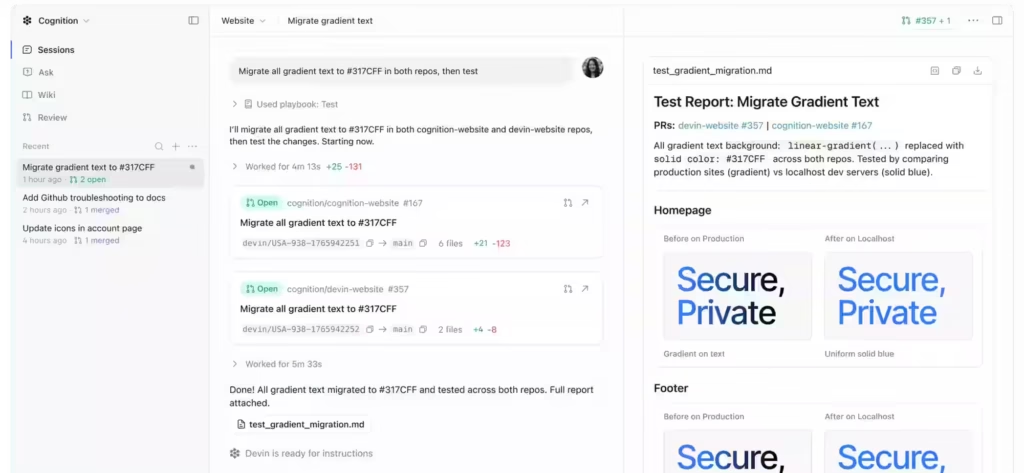
On June 2, 2026, Cognition renamed Windsurf as Devin Desktop. The Desktop announcement describes it as a full IDE with an agent manager, combining Windsurf’s editor foundation with a command center for local and cloud agents. The current Desktop page emphasizes Spaces for shared context, Kanban-style task visibility, diff review, pull-request tracking, autocomplete, and support for multiple agents through the Agent Client Protocol.
Adoption is harder to quantify than product scope. Cognition does not publish a verified subscriber, paid-user, active-user, customer, or team count. The closest public scale signal is financial: on September 8, 2026, the company announced a $2 billion funding round at a $48 billion valuation and said its annualized revenue run rate had risen from $492 million in May to almost $900 million. Those are company-reported figures relayed by a Reuters report, not a substitute for audited usage data.
Our bottom line is equally specific. Devin is best for developers and teams coordinating several coding agents or parallel workstreams, provided they can hand off well-bounded work and maintain rigorous review. In our six-product assessment, it scores 9.03/10, placing fourth behind Claude, OpenAI Codex, and Cursor. Its clearest advantage is orchestration and breadth; its main weaknesses are the verification burden, less predictable usage costs, and the difficulty of comparing reviews across the Windsurf-to-Devin transition.
Performance
What the latest Devin actually is
“Latest” refers to several different layers, which should not be collapsed into one claim:
- Devin Desktop is the current name for Windsurf. It retains a full editor, extensions, keybindings, language-server support, autocomplete, terminal access, and Git workflows while making multi-agent coordination the default surface. Spaces can group sessions, pull requests, files, and shared context, while the command center tracks local and cloud agents in one view. Cognition describes these inherited and expanded capabilities on its Desktop page.
- Devin Local succeeded Cascade as the primary local agent. Cascade remains documented as an agentic assistant inside Devin Desktop, while Cognition’s June announcement identifies Devin Local as its successor. The Cascade documentation says Cascade can search and analyze a codebase, use the terminal and web, call MCP tools, detect and install dependencies, maintain plans and task lists, and continue through multi-step work. That makes the Windsurf heritage relevant, but it should not be mistaken for a separate current product generation.
- Devin 2.2 is the latest numbered product release in scope. Launched February 24, 2026, it added computer-use testing, screen recordings, a Linux desktop, self-verification, and faster cloud-machine startup. These are vendor-described capabilities rather than independent measures of reliability.
- SWE-2 is the latest in-house coding model in scope. Released September 10, 2026, SWE-2 is a model inside Devin rather than a new Devin product version. Cognition’s model research says it was post-trained from Kimi K3 and designed to lower the number of agent turns and the cost of longer tasks.
- Fusion is an execution harness, not a model. Announced September 11, 2026, Fusion pairs a frontier “lead” model for planning and review with a cheaper “sidekick” model for implementation and testing. The Fusion details describe persistent context across both agents in Devin Desktop and the CLI.
- Code Scans is the newest major product feature at the cutoff. Announced September 16, 2026, it turns broad goals into repository investigations, prioritized findings, and proposed pull requests through a map-reduce-style agent workflow. The scan release is useful evidence of product direction, but its customer outcomes are vendor-selected case studies.
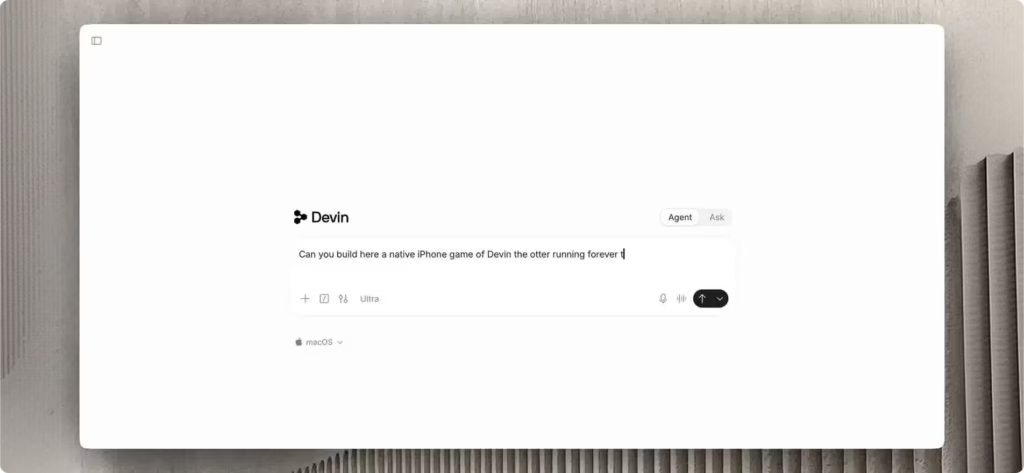
- Cloud macOS support broadens the work Devin can execute. The September 15, 2026 Mac release added Xcode, Simulator, native compilation, and automated interaction with iOS and macOS applications in the cloud.
This distinction matters because Devin is not one model with one fixed capability level. The product site presents a managed environment spanning web, desktop, CLI, IDE, Git, pull-request, terminal, browser, and cloud-machine workflows. Devin Desktop adds the editor and command-center layer, while ACP support broadens the ecosystem beyond Cognition’s own agents. A result attributed to SWE-2 does not automatically establish the quality of every Devin configuration, and a feature release does not prove that an agent will complete a particular repository task correctly.
Our seven-factor read
We use seven weighted factors. The overall score is a composite judgment, not an official benchmark or a measure published by Cognition.
| Evaluation Factor | What It Measures | Weight |
|---|---|---|
| AI Intelligence | Architectural reasoning, repository understanding, causal debugging, context retention, tool selection, recovery from failed approaches, and handling complex multi-step work | 15% |
| Speed | Time and consistency from request to accepted, runnable code; includes latency, number of retries, tool-call efficiency, and time to a verified revision | 10% |
| Coding & Web Development Quality | Correctness, test pass rate, maintainability, architecture, security, frontend polish, responsiveness, accessibility, backend and database integration, and deployability | 25% |
| Prompt Accuracy | Fidelity to requested behavior, stack, file scope, UI details, constraints, exclusions, coding standards, and “do not change” instructions | 20% |
| User Rating | Normalized public satisfaction from credible software-review platforms, using the most product-specific and recent rating available | 10% |
| Review Confidence | Review authenticity, sample size, recency, source diversity, and whether the reviews describe the current product rather than an older version | 5% |
| Features & Usability | IDE, terminal, browser, cloud-agent and Git/PR workflows; repository indexing; previews; testing; deployment; rollback; integrations; controls; onboarding; and learning curve | 15% |
- AI Intelligence – 9.0/10, weighted 15%. This covers architectural reasoning, repository understanding, causal debugging, context retention, tool choice, recovery after a failed approach, and complex multi-step work. Devin is capable across a repository and can maintain long-running workflows, but Claude and Codex score higher in our assessment for the hardest reasoning and debugging work.
- Speed – 9.1/10, weighted 10%. We evaluate time and consistency from request to accepted, runnable code, including latency, retries, tool efficiency, and time to a verified revision. Devin’s parallelism and autonomous execution help, although raw generation speed can be misleading when review uncovers rework.
- Coding & Web Development Quality – 8.9/10, weighted 25%. This is the heaviest factor and includes correctness, test performance, maintainability, architecture, security, frontend polish, responsiveness, accessibility, backend and database integration, and deployability. Devin produces useful end-to-end work, but its score reflects unevenness across task types and the need for human verification.
- Prompt Accuracy – 8.8/10, weighted 20%. We assess fidelity to requested behavior, stack, file scope, interface details, constraints, exclusions, coding standards, and “do not change” instructions. Devin can execute detailed plans, yet a highly autonomous agent also has more room to make an incorrect assumption and propagate it through multiple files.
- User Rating – 9.0/10, weighted 10%. This normalizes the most relevant and recent product-specific public rating available in the supplied evidence. It is a sentiment signal, not a controlled quality test.
- Review Confidence – 8.8/10, weighted 5%. This reflects review authenticity, sample size, recency, source diversity, and whether reviewers appear to describe the current product. Devin’s business-software reviews are relevant, but the sample is much smaller than several competitors’ and may span older product generations.
- Features & Usability – 9.6/10, weighted 15%. We include the IDE, autocomplete, terminal, browser, local and cloud agents, Git and pull-request workflows, repository indexing, previews, testing, deployment, rollback, integrations, controls, onboarding, and learning curve. Devin ties Cursor and GitHub Copilot at the top of this factor in our assessment because it combines a full editor with unusually strong visibility across parallel agents, shared workspaces, reviews, and integrations.
The pattern is more useful than the 9.03 total alone. Devin’s 9.6 in features and usability is its standout result; its 8.8 in prompt accuracy and 8.9 in coding quality are the constraints. That is exactly the profile we would expect from an ambitious autonomous system: it can cover more of the lifecycle, but every extra action expands the surface area for an incorrect interpretation, weak test, insecure change, or unnecessary edit.
Where the evidence holds and where it bends
In its model research, Cognition reports that SWE-2 reached 50.0% on FrontierCode 1.1 Main, 73.0% on DeepSWE 1.1, and 92.8% on Terminal-Bench 2.1. It also reports that, at medium reasoning effort, SWE-2 used 58% fewer turns and had 81% lower average cost than SWE-1.7. The published Fusion details report a comparable score with 38% lower average cost when one tested frontier model was paired with SWE-2. These numbers are promising, but they are vendor-run or partner-run results using particular models, harnesses, reasoning settings, and scoring rules. FrontierCode also uses three runs per task and selects the best score across tested reasoning settings. We would treat the results as evidence of engineering progress, not as a guaranteed success rate for a buyer’s codebase.
Independent repository evidence is more mixed and more informative. A 2026 independent study analyzed 7,156 reviewed, closed pull requests produced by five coding agents. Devin accounted for 2,252 pull requests across 32 active weeks and had 61.6% overall acceptance. It was the only agent in that dataset with a consistently positive weekly trend, rising from roughly 60% toward 80%, but with substantial week-to-week variation. In a common eleven-week comparison window from May through July 2025, Devin’s acceptance rate was 68.0%, behind Codex at 79.9%, Cursor at 74.4%, and Claude at 72.6%, while level with GitHub Copilot.
Those results need their own caveat. The study is observational, covers older product versions, and cannot fully equalize repositories, developers, task difficulty, or agent-selection behavior. A merged pull request is also not the same as defect-free code. Still, the study results support the practical conclusion behind our score: Devin can generate accepted work at meaningful scale, but task category matters. Its test-related pull requests were accepted more often than its bug-fix pull requests, so teams should validate performance on their own recurring work rather than extrapolate from a single headline rate.
Comparisons Before You Buy
The six-tool scorecard
The table below reproduces the internal assessment used for this article. Scores are on a ten-point scale, and the overall result applies the weights described above.
| Product | Overall Score | AI Intelligence | Speed | Coding and Dev Quality | Prompt Accuracy | User Rating | Review Confidence | Features & Usability | Best For |
|---|---|---|---|---|---|---|---|---|---|
| Claude | 9.36 | 9.8 | 8.6 | 9.7 | 9.5 | 9.4 | 8.8 | 8.8 | Complex debugging, refactors, architecture, workflows. |
| OpenAI Codex | 9.33 | 9.6 | 9.0 | 9.6 | 9.3 | 9.4 | 7.6 | 9.4 | End-to-end development across every workflow |
| Cursor | 9.29 | 9.4 | 9.4 | 9.1 | 9.1 | 9.4 | 9.4 | 9.6 | AI embedded across everyday development |
| Devin | 9.03 | 9.0 | 9.1 | 8.9 | 8.8 | 9.0 | 8.8 | 9.6 | Teams coordinating agents across workstreams |
| GitHub Copilot | 8.91 | 8.8 | 9.0 | 8.7 | 8.6 | 8.8 | 9.5 | 9.6 | GitHub teams wanting AI in-IDE |
| Replit | 8.87 | 8.7 | 9.3 | 8.4 | 8.7 | 9.0 | 9.3 | 9.5 | Rapid full-stack building with hosting |
This is a non-official ranking, not a universal league table. A different weighting or workflow can change the order. In particular, OpenAI Codex could reasonably rank first for a buyer who prioritizes end-to-end development across multiple workflows, weights coding quality more heavily, or discounts consumer-style public ratings. The difference between first and fourth is only 0.33 points, so product fit matters more than the ordinal position.
The more useful comparison is by job:
- Choose Claude for complex debugging, refactors, architecture, and reasoning-heavy workflows. It leads our AI-intelligence and coding-quality scores but is slower and less feature-complete as an orchestration environment.
- Choose OpenAI Codex for strong end-to-end development across varied workflows. It nearly matches Claude on code quality and exceeds Devin on intelligence and prompt adherence, while Devin has the edge in our feature score.
- Choose Cursor when AI should live inside everyday editing. It is faster in our assessment, matches Devin’s feature score, and has stronger review confidence. Devin is better suited to dispatching discrete jobs and coordinating agents away from the editor.
- Choose Devin for developers and teams coordinating several coding agents or parallel workstreams. Devin Desktop combines a full IDE with a command center for local and cloud agents, shared context, review, Git, and pull-request workflows. Its advantage is not just delegation, but visibility into what several agents are doing at once.
- Choose GitHub Copilot for organizations centered on GitHub that want familiar in-editor assistance and the strongest review-confidence score in this set. Devin offers broader autonomy, but Copilot can impose less process change.
- Choose Replit for rapid full-stack building with integrated hosting. It is quick and accessible, while Devin is the stronger fit for existing repositories, deeper engineering workflows, and managed agent execution.
Ratings are a separate signal.
Public ratings can reveal satisfaction and friction, but they are not directly comparable across platforms. The supplied rating snapshot used for this September 16 assessment contains the following values:
| Product | Source used | Public Rating | Votes & Reviews |
|---|---|---|---|
| Claude | Google Play Store | 4.5/5 | 734K+ reviews |
| OpenAI Codex | Product Hunt | 5.0/5 | 87+ reviews |
| Cursor | Product Hunt | 5.0/5 | 947+ reviews |
| Devin | G2 | 4.3/5 | 83+ reviews |
| GitHub Copilot | G2 | 4.4/5 | 386+ reviews |
| Replit | Google Play Store | 4.5/5 | 50K+ reviews |
The supplied snapshot does not print an exact capture date, so we cannot responsibly invent one. These are the values used in the cutoff-date assessment, not claims about live ratings after September 16, 2026.
Source choice changes what a rating means. G2 is well aligned with business-software purchasing and gives Devin a relevant, if modest, sample. Product Hunt is product-specific but community-selected; Codex’s perfect average rests on only 87-plus reviews, which is why its review-confidence score is lower than Cursor’s. Google Play provides enormous volume, and its rating policy gives greater weight to recent ratings, but mobile-app sentiment is only a partial proxy for Claude’s or Replit’s desktop, terminal, and cloud workflows. Review confidence therefore measures the fitness of the evidence as well as its size; it is not another popularity score.
For Devin specifically, 4.3/5 from 83-plus G2 reviews supports a positive user-rating score but not a claim of market dominance. The June 2026 Desktop announcement also creates a comparability problem: older Windsurf reviews may focus on the editor and Cascade, older Devin reviews may focus on the autonomous cloud agent, and newer Devin Desktop reviews may combine both experiences. The 8.8/10 review-confidence score is therefore respectable but below Copilot, Cursor, and Replit because the sample is smaller and may span materially different products, names, and generations.
The plan we would buy
As of the cutoff, the public pricing page lists four paid paths plus a free tier. Cognition’s quota documentation says self-serve plans use daily and weekly allowances measured by token consumption, with extra usage billed at the selected model’s API list price. Its broader usage documentation describes ACU-based enterprise billing and legacy credit-based contracts. Because consumption can change with the model, context size, task length, agent actions, and cloud infrastructure, total usage is less predictable than a simple flat-price editor subscription. The public page does not publish a fixed numeric allowance for each paid plan, so comparisons based only on the monthly sticker price are incomplete.
The twelve-month figures above are simple arithmetic on monthly renewals; they are not annual-plan prices or savings. No public annual billing option or annual discount is shown for these plans. A Teams workspace with one full developer seat is therefore $120 per month, or $1,440 across twelve monthly renewals, before any additional usage charges.
For most serious evaluators, we would buy one month of Pro at $20 and run a controlled pilot on real, non-critical repository work. Define a representative task set, record accepted output rather than attempted output, include review and correction time, and compare total cost per merged change with the existing workflow. Pro is the cleanest subscription recommendation because it exposes the material product cloud agents and broader model access without committing immediately to a team base fee or enterprise contract.
We would move to Teams only after at least two conditions are true: several engineers need shared agent workflows, and the pilot shows that review-adjusted throughput justifies the base and seat costs. We would choose Max only after measured Pro usage repeatedly hits its allowance; paying ten times as much merely to avoid thinking about quotas is not a sound default. Enterprise is appropriate only when identity, network isolation, administrative control, support, procurement, or data terms are mandatory.
Before any larger commitment, ask Cognition to put the following in writing: exact included usage, the formula and rates for overage, model availability by surface, data retention, zero-retention scope, support response targets, service availability, repository isolation, renewal pricing, and the offboarding process. The public platform terms say paid subscriptions renew automatically, payments are non-refundable, and cancellation must occur before renewal to avoid the next charge. They also say paid customers can opt out of model training and enable zero-data-retention arrangements with model providers; on Teams, that control belongs to the administrator.
The persona-level decision is straightforward:
- Solo developer: Start with Pro if you routinely have bounded backlog work to delegate. Prefer Cursor, Codex, or Claude if you mainly want fast, continuous collaboration inside your own coding loop.
- Startup: Pilot Pro on tests, migrations, maintenance, and well-specified features. Choose Replit for rapid hosted prototypes; choose Cursor or Codex when founders still want hands-on control over every edit.
- Agency: Teams can make sense when several client workstreams need parallel execution and formal review, but isolate repositories and measure rework carefully. Seat economics deteriorate quickly if agents sit idle or senior engineers must rewrite their output.
- Enterprise: Evaluate Enterprise only with security, legal, platform, and engineering owners involved. The technical upside is agent coordination at scale; the risk is multiplying a flawed instruction or weak control across many repositories.
We would skip a paid Devin subscription when most work is exploratory, requirements change faster than tasks can be specified, or the team lacks the test coverage and code-review capacity to supervise autonomous changes. Autonomy is leverage only when the organization has a reliable way to verify what it produces.
Conclusion
Devin earns its 9.03/10 because it is one of the most complete agentic engineering environments in this comparison. Its 9.6 feature-and-usability score reflects real breadth: the Windsurf-derived IDE, autocomplete, shared Spaces, local and cloud agents, terminal and browser use, pull-request review, macOS execution, Code Scans, and a growing model-and-harness layer. It is especially compelling for developers and teams whose bottleneck is coordinating several coding agents or parallel workstreams rather than generating the next line of code.
It does not lead our ranking because breadth is not the same as dependability. Claude and Codex score higher on intelligence and coding quality, while Devin’s own public and independent evidence shows meaningful variation by task and version. Devin Desktop also narrows Cursor’s old editor-workflow advantage, but the recent Windsurf-to-Devin transition makes historical reviews harder to compare, and model-sensitive quotas make usage less predictable than a simple editor subscription. The vendor benchmarks indicate rapid progress; the independent pull-request study still argues for disciplined, repository-specific validation.
Our decisive recommendation is to subscribe to Pro for one month, not Teams or Max by default. Use the pilot to measure accepted changes, review time, defects, security findings, and total cost. Upgrade only if parallel agent work produces a durable advantage after human verification. For a team with mature tests, clear tickets, and enough review capacity, Devin can be a force multiplier. Without those controls, it can simply produce more code and more uncertainty faster.
FAQ
Is Devin Desktop simply Windsurf with a new name?
No. Cognition renamed Windsurf to Devin Desktop in June 2026, but the change also repositioned the product. It retains Windsurf’s full editor, autocomplete, extensions, terminal, keybindings, and Git workflows while adding an Agent Command Center for supervising local and cloud agents. Spaces group sessions, files, pull requests, and shared context, while the Kanban-style interface shows which agents are running, waiting for review, or finished. The Desktop announcement describes it as an expansion of Windsurf rather than a replacement stripped of its original IDE features.
Is Cascade still Devin Desktop’s main coding agent?
Devin Local is now the primary local agent and the successor to Cascade. Cascade is the Windsurf-era agent whose workflows and capabilities helped shape Devin Desktop. Its Cascade documentation describes codebase search and analysis, terminal and web access, MCP tool calls, dependency installation, planning, task lists, checkpoints, and multi-step execution. Buyers should not treat old Cascade reviews or benchmarks as direct evidence of Devin Local’s current performance, even though many of the underlying workflows remain relevant.
Why does Devin rank fourth despite receiving a 9.6 for features and usability?
Features account for only 15% of the overall score. Coding quality and prompt accuracy carry a combined weight of 45%, and Devin scores 8.9 and 8.8 in those categories. Its overall 9.03 therefore reflects a product with exceptional workflow coverage but slightly less consistent reasoning, instruction fidelity, and code quality than Claude or Codex.
Choose Devin over Cursor when coordinating several agents matters more than keeping one assistant embedded in the editing loop. Choose it over Claude or Codex when parallel execution, cloud environments, shared agent context, and centralized review are more valuable than obtaining the strongest possible result from one reasoning-heavy task.
Is Devin’s real cost predictable from the monthly subscription price?
Not completely. The subscription price provides access, but it does not necessarily represent the final cost of sustained agent use. Devin’s quota documentation says self-serve allowances refresh daily and weekly, while consumption depends on the selected model, token volume, context size, and task length. Additional usage is billed using the model’s API list price. Enterprise arrangements may instead use Agent Compute Units or legacy credits.
Before choosing Max, Teams, or Enterprise, run representative bug fixes, feature work, and repository-wide tasks on Pro. Record quota consumption and total cost per accepted pull request. That will provide a more useful budget forecast than comparing monthly plan prices alone.
How much confidence should buyers place in Devin’s public reviews?
Treat the reviews as evidence of satisfaction, not as one clean measure of the current product. Reviews written before June 2026 may describe either the Windsurf editor and Cascade or Devin’s separate cloud agent. Reviews written after the transition may cover the combined Devin Desktop experience. That makes averages across different dates and product surfaces difficult to interpret.
The supplied snapshot gives Devin 4.3/5 from 83-plus G2 reviews, supporting a positive user-rating score but not proving current performance across every workflow. A serious evaluation should pair those reviews with a one-month pilot measuring accepted pull-request rate, human review time, reopened defects, test and security failures, and usage cost per merged change.