


Introduction
Grammarly began as a writing aid long before generative AI became part of its pitch. Max Lytvyn, Alex Shevchenko, and Dmytro Lider founded the company in 2009. It started with a paid editor, released a free browser extension in 2015, and later added tone guidance, generative writing assistance, and specialized agents. The company adopted the Superhuman name in 2025; Grammarly remains its writing product. On September 16, 2026, Superhuman reported 40 million daily active users for Grammarly. That measures daily use, not paid subscriptions. We could not verify a current public count of paying subscribers.
The buying question has changed with the product. Grammarly still corrects writing as it happens, but it also offers drafting and specialized feedback in a document workspace. Our team assessed the expanded product through research and experiments for a scorecard finalized September 22, 2026. The supplied snapshot gives the scores and assessment criteria, but no individual prompts or experiment results. We treat it as our researched editorial judgment, not a public benchmark or an industry-wide verdict.
Performance
Grammarly placed fifth among six products, scoring 8.73/10, in our September 22 scorecard. The overall result follows the seven stated factor weights. Each factor score below is ours, on a 10-point scale; none is a public review site’s star rating.
| Evaluation Factor | What It Measures | Weight |
|---|---|---|
| AI Intelligence | Evaluates architectural reasoning, debugging, context retention, tool use, planning, and recovery. | 15% |
| Speed | Measures delivery speed and consistency, including retries, tooling, tests, and revisions. | 10% |
| Writing and Content Creation Quality | Originality, coherence, style, consistency, factual grounding, adaptability, and multimedia support. | 25% |
| Prompt Accuracy | Instruction compliance, completeness, source fidelity, tone, constraints, and revision reliability. | 20% |
| User Rating | Weighted public satisfaction from credible review platforms | 10% |
| Review Confidence | Combines authenticity, sample size, recency, relevance, diversity, and model-version confidence. | 5% |
| Features & Usability | Evaluates UX, workflows, research, collaboration, integrations, governance, accessibility, and setup burden. | 15% |
Grammarly’s Speed score of 9.8 was the highest in our group, as was its Review Confidence score of 9.3. Those marks fit its most convincing use: helping someone finish emails, proposals, customer replies, and routine drafts in the places they already write. Its 8.8 scores for writing quality and prompt accuracy still leave room for an editor to check a complex brief or a sourced article. The AI Intelligence score of 7.0 reflects a deliberately broad rubric that includes software engineering tasks; it is not a separate grade for proofreading.
What its AI releases tell us
The most recent model-related detail we could verify is Superhuman’s September 16 engineering disclosure. It describes an unnamed grammatical error correction model with more than one billion parameters that supplies Grammarly’s continuous inline suggestions. The disclosure explains the work needed to serve suggestions quickly at scale; it does not provide an independent writing-quality test or identify that correction model as the engine behind every generative agent. A 2025 company account names Azure OpenAI and OpenAI as generative AI partners, but we found no publicly named current foundation-model version for Grammarly’s writing agents. A correction model, a model provider, and a product agent should not be treated as the same release.
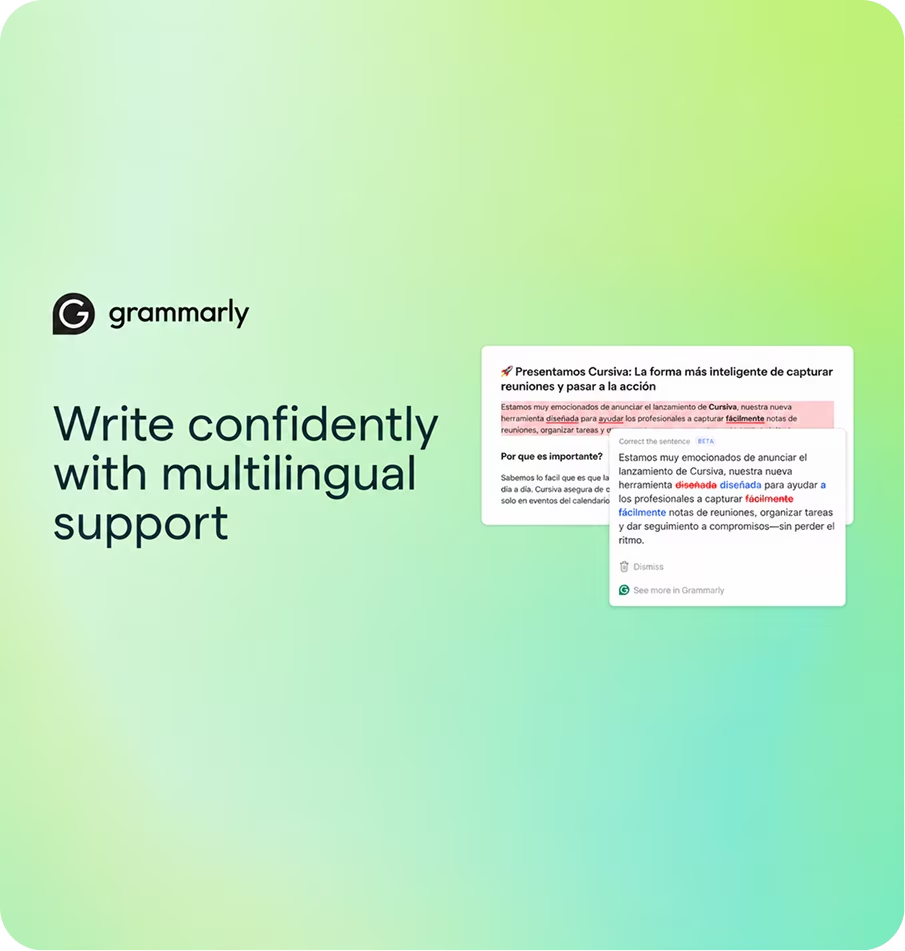
The product features are more concrete. Grammarly’s 2025 agent announcement described Proofreader, Reader Reactions, and Citation Finder: tools for revising prose, anticipating a reader’s questions, and finding possible evidence for claims. Its March 2026 language expansion added real-time grammar and spelling correction in 17 more languages in beta. Grammarly said advanced clarity, tone, and fluency suggestions for those newly added languages were still forthcoming at the time. An August Blackboard update extended Authorship reporting to an institutional workflow; it was not a newly identified drafting model.
These features broaden the help available around a draft, but the distinction between suggesting evidence and verifying a claim matters. A 2026 research paper compared Grammarly’s feedback with human annotators on 53 argumentative writing samples. It reported 92% precision in flagging issues and 91% precision in corrections, alongside 51% recall of the sentence-level issues identified by annotators. The researchers used Grammarly’s free version in 2020, so their figures cannot be assigned to today’s Pro agents. They do show why a useful editing pass may still miss material that a human reader catches.
There is a more recent caution about source handling. In March 2026, The Verge‘s hands-on report found broken or irrelevant links in Grammarly’s Expert Review agent and reported that its suggestions used real writers’ names without their permission. Superhuman subsequently disabled it. That retired feature does not establish that every current Grammarly citation is faulty. It does make it essential to open and check suggested sources before publication.
Why we selected G2, and what it misses
G2 was our lead professional software review source, not the winner of a star-rating contest. In our September 22 research file, G2’s Grammarly category listing showed 4.7/5 from 12,230 reviews. Capterra’s Grammarly review listing showed the same 4.7/5, from 7,224 reviews; its page was last updated September 17 and was checked again September 23. G2 gave us the larger professional software sample, dated written feedback, and listings for alternatives such as Jasper and Writesonic on the same platform. G2’s published review policy describes sign-in, human moderation, and conflict checks. Together, those details make it a useful primary reference for our buying question. They do not make Capterra’s reviews invalid or mean G2 endorsed our scorecard.
| Product | Source used | Public Rating | Votes & Reviews |
|---|---|---|---|
| Claude | Google Play Store | 4.4/5 | 747K+ reviews |
| ChatGPT | Google Play Store | 4.5/5 | 61.3M+ reviews |
| Gemini | Google Play Store | 4.4/5 | 46.6M+ reviews |
| Jasper | Capterra | 4.8/5 | 1.8K+ reviews |
| Grammarly | G2 | 4.7/5 | 14K+ reviews |
| Writesonic | Trustpilot | 4.6/5 | 6K+ reviews |
The count needs careful labeling. 12,230 is the figure displayed on G2’s proofreading category page in our September snapshot; G2’s broader Grammarly product listing displayed 14,073 reviews when checked on September 23. We should identify which page a number comes from, rather than combine the two displays or portray their difference as a one-day surge in reviews. G2 also permits incentivized reviews, including some invited by sellers. Its accumulated feedback spans multiple versions of Grammarly, so its 4.7/5 cannot isolate satisfaction with the latest agents.
The strongest counterweight in the added research is Grammarly’s grammarly.com profile on Trustpilot. It stood at 3.2/5 from 10,464 reviews in our September 22 file; the Trustpilot profile showed 3.2/5 from 10,466 reviews when checked on September 23. Recent reviews and the platform’s summary raise concerns about renewals, support, intrusive prompts, and suggestions that miss context, while also describing useful everyday corrections. Only 226 of the displayed reviews were from the preceding 12 months, so the large lifetime total does not represent 10,000 recent judgments on Grammarly AI. Even with that limit, the lower rating is substantial evidence a buyer should see, particularly before an annual purchase.
App and extension stores supply another useful check, with a different scope: the U.S. iPhone and iPad App Store showed 4.7/5 from 224K ratings, while the Chrome listing showed 4.5/5 from 43.1K ratings in September checks. Those larger pools speak chiefly to particular app and extension experiences. Conversely, SourceForge’s higher 4.8/5 came from just 38 reviews and ratings on its product listing. Our choice of sources weighs product relevance, review detail, and sample strength together; it does not simply select the highest rating or largest count.
Our 9.4/10 User Rating and 9.3/10 Review Confidence remain the finalized team scores from September 22. They are neither G2 ratings converted to ten points nor a claim that the disagreement between G2 and Trustpilot has vanished. The supplied material does not give a platform-by-platform calculation from which to reconstruct those factor scores.
Comparisons Before You Buy
Our September 22 order provides context for the choice, not a rule every buyer has to follow:
| Product | Overall Score | AI Intelligence | Speed | Writing/ Content Quality | Prompt Accuracy | User Rating | Review Confidence | Features & Usability | Best For |
|---|---|---|---|---|---|---|---|---|---|
| Claude | 9.41 | 9.9 | 8.1 | 9.9 | 9.7 | 9.2 | 8.3 | 9.1 | Deep Writing Work |
| ChatGPT | 9.36 | 9.6 | 8.9 | 9.2 | 9.4 | 9.2 | 8.9 | 9.9 | For research, drafting, editing |
| Gemini | 9.17 | 8.9 | 9.6 | 9.4 | 8.8 | 8.8 | 8.2 | 9.8 | Google Workspace users |
| Jasper | 8.90 | 7.6 | 8.7 | 8.9 | 9.3 | 9.4 | 8.8 | 9.5 | Brand Campaign Teams |
| Grammarly | 8.73 | 7.0 | 9.8 | 8.8 | 8.8 | 9.4 | 9.3 | 8.9 | Writing Quality Teams |
| Writesonic | 8.63 | 7.4 | 8.4 | 8.6 | 8.8 | 9.4 | 9.0 | 9.2 | Students, non-native English writers, and Proofreaders |
For a demanding brief that must become a substantial draft, Claude is the stronger choice in our assessment: its 9.9 Writing and Content Creation Quality and 9.7 Prompt Accuracy exceed Grammarly’s 8.8 in both factors. ChatGPT offers a broader workbench across drafting and other output formats, reflected in its 9.9 Features & Usability against Grammarly’s 8.9. Gemini deserves a close look for work centered in Google’s ecosystem; Google’s Workspace guidance describes writing and refining directly in Docs and Gmail. Grammarly makes its best case when frequent, in-place editing matters more than starting every piece from a complex brief.
Jasper sits 0.17 points above Grammarly overall in our assessment and scores 9.5 versus 8.9 for Features & Usability. Its Canvas guidance describes project settings for brand voice, target audience, and campaign goals, which suit teams producing related campaign assets. Jasper’s Capterra listing showed 4.8/5 from 1,855 reviews when checked on September 23; Capterra describes verification and possible nominal incentives in its review method. That rating informs our view of user experience but does not measure Jasper against our seven-factor scorecard.
Writesonic sits 0.10 points below Grammarly overall, yet its article writer is aimed at research-led, search-oriented article production. A buyer whose work is dominated by that pipeline could reasonably rank Writesonic first under different priorities. Its Trustpilot listing showed 4.6/5 from 5,764 reviews when checked September 23, but only nine were from the preceding 12 months. Our earlier source image rounded the count to 6K+; we cannot reconcile that display with the current exact count from the available evidence. Neither platform ratings nor a tenth of a point in our overall scores should replace a trial of the buyer’s actual workflow.
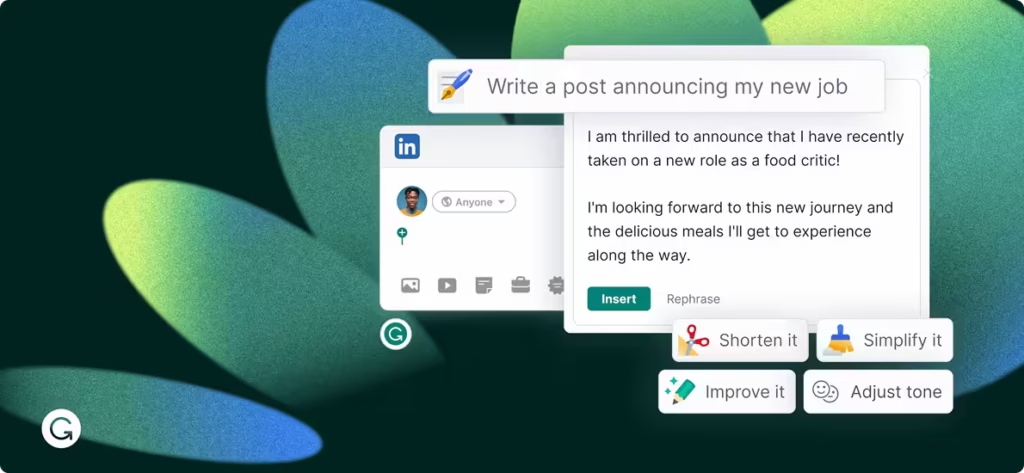
Our paid pick is Grammarly Pro billed annually for an individual or small team that already knows it needs advanced editing throughout the year. Grammarly’s plan details include full-sentence rewrites, tone adjustments, and team controls; the Pro page lists 2,000 generative AI prompts per member per month. Start with Grammarly Free, which lists 100 AI prompts per month, if basic correction meets your needs or if you have not yet tested whether Pro improves your work enough to justify paying.
At the standard web prices listed in U.S. dollars on September 23, 2026, standalone Grammarly Pro is $30 per member per month on monthly billing or $144 per member paid upfront for a year. The annual price works out to $12 per month, but it is one annual payment. An annual plan costs less than five monthly payments ($150) but more than four ($120), so the savings begin if you use it for five months or longer. Monthly billing is the more sensible commitment for a short project or while testing the product, especially in light of the mixed review evidence. Grammarly’s pricing details say regional rates and currencies may differ at checkout.
Pay attention to the plan name at checkout. The separate suite terms list Superhuman Pro at $12 per member per month billed annually, with Grammarly Pro access included. On monthly billing, Superhuman Pro costs $15 per member per month, but full Grammarly Pro access requires an additional $15 monthly add-on. Grammarly also offers Plus to eligible customers in selected regions, with pricing that varies by market under its regional terms. Check the entitlement and local checkout price before comparing offers.
Subscriptions renew automatically at the standard rate; a promotion applies for one term under the billing policy. Grammarly’s cancellation guide says cancellation stops the next renewal while paid features remain available through the current term. Its refund policy says refunds are issued only when required by law. Given the complaints visible on Trustpilot, confirm the plan, renewal amount, and account used for billing before making the annual commitment.
Conclusion
Grammarly AI is easiest to recommend for daily writing that benefits from quick, in-place editing. Our September 22 assessment gave it 8.73/10 and fifth place. It scored highly for speed and review confidence but trailed tools suited to deeper reasoning, complex briefs, and broader content production. Its documented agents offer more help around a draft, but the independent research and the withdrawn Expert Review feature give us reason to keep a human responsible for completeness and sources.
The added ratings make the verdict more cautious. G2 was our lead professional review source because its feedback was relevant, substantial, and moderated, not because its 4.7/5 was the highest available rating. Capterra supports much of that positive picture; Trustpilot’s 3.2/5 raises a serious, different set of buyer concerns. Our ranking remains a researched editorial judgment under stated weights. A buyer who places greater weight on campaign production, drafting complex documents, Google Workspace integration, search-oriented articles, or shorter commitments could reasonably reach a different order.
Choose annual Grammarly Pro once you have established its editing value in your own work. Otherwise, use Free or try Pro on a monthly plan before committing; choose another tool when its primary workflow fits your job better.
FAQ
Is Grammarly AI good for writing content, or mainly for proofreading?
Grammarly is strongest when you already have something to write or revise: an email, proposal, customer reply, or routine draft. Its inline corrections, rewrites, and tone suggestions help you finish work where you already write. It can also assist with drafting, but the September 2026 review found it less suited to complex briefs and substantial, research-heavy content. The review scored its writing quality 8.8/10 and its overall performance 8.73/10; those are editorial scores, not public ratings.
Can I trust Grammarly AI’s facts and suggested citations?
Treat them as leads to check. Grammarly can suggest sources and improve the wording around a claim, but a suggested citation does not establish that the source supports it. Open each link, check the relevant passage, and verify important facts before publishing. This matters especially because Grammarly’s former Expert Review agent drew criticism for broken or irrelevant links and was subsequently disabled. That episode does not mean every current suggestion is wrong; it does mean source verification remains the writer’s responsibility.
Is Grammarly Pro worth paying for?
Start with Free if you mainly need basic corrections or have not yet tested the advanced tools. In the review’s September 2026 snapshot, Free included 100 AI prompts per month, while Pro included 2,000 per member, plus features such as full-sentence rewrites and tone adjustments. Pro makes the strongest case when those features save you time regularly. The listed U.S. web price was $30 monthly or $144 paid upfront annually; at those prices, annual billing becomes cheaper after five months of use. Check the price and renewal terms at checkout.
How does Grammarly compare with ChatGPT, Claude, and other writing tools?
Choose based on where the work happens. Grammarly fits frequent editing inside everyday writing workflows. In the review’s scorecard, Claude was stronger for substantial drafts and demanding instructions, while ChatGPT offered a broader set of tools and output formats. Gemini is worth considering for work centered in Google Workspace, Jasper for coordinated campaign content, and Writesonic for search-oriented articles. These are differences in workflow, not a claim that one tool wins every writing task.
Why are Grammarly’s customer ratings so different across review sites?
The sites capture different experiences. In the September 2026 research snapshot, G2 showed 4.7/5 on its proofreading category listing, while Grammarly’s Trustpilot profile showed 3.2/5. G2’s professional software feedback supports its usefulness; Trustpilot raises concerns about billing, support, intrusive prompts, and suggestions that miss context. Both collections include reviews from different product versions, so neither rating measures the latest AI features alone. If you are considering an annual plan, test your own workflow and check the renewal details first.