




Introduction
Here’s a thing most AI research tools can do: tell you a paper exists. Here’s a thing Scite tries to do instead: tell you what other scientists said about that paper afterward. Did later studies back it up? Push back on it? Or name-drop it on their way to something else?
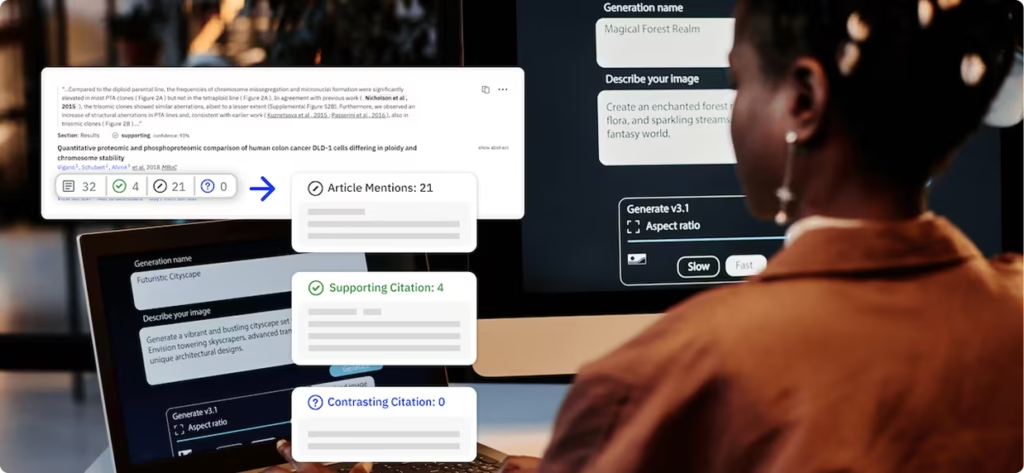
That difference matters more than it sounds. A citation count tells you a study got attention. It doesn’t tell you whether that attention was a standing ovation or a pile-on. Scite’s answer is the “Smart Citation.” It pulls the actual sentence where one paper cites another and labels it supporting, contrasting, or mentioning. Its AI chat tool, Scite Assistant, is built on that same index.
The idea is older than the company. In 2014, Josh Nicholson and co-founder Yuri Lazebnik proposed classifying citations this way in response to the reproducibility crisis in cancer research. Nicholson told that origin story in a 2019 interview, where he also named an early team that included CTO Milo Mordaunt and Patrice Lopez, the creator of GROBID.
Scite was founded in 2018 in Brooklyn, New York. Its company blog says the product launched publicly in May 2019, in the same post that announced a $1.5 million Phase II grant from the National Institutes of Health. By March 2022, Scite said it had crossed one billion Smart Citations. Scite Assistant showed up in April 2023, first pitched as a way to fact-check ChatGPT against the literature.
Then, later that year, new owners. Research Solutions (NASDAQ: RSSS) announced the deal on November 27, 2023. Its investor presentation put the enterprise value at $14.8 million, plus an earnout tied to recurring revenue. The deal closed on December 1, 2023. Today, Scite runs as Scite, LLC, a wholly owned subsidiary, and Nicholson is now Chief Strategy Officer at Research Solutions. We found no further ownership changes through September 30, 2026.
So how many people actually pay for it?
Honest answer: we don’t know the current number, and neither does anyone outside the company. The only paid headcount ever disclosed is about 21,000 active B2C subscribers. That figure comes from the November 2023 acquisition announcement and was measured as of October 31, 2023. We looked for something newer in Research Solutions’ releases, SEC filings, and earnings calls. Nothing.
What Research Solutions does publish is Scite’s consumer (B2C) annual recurring revenue. It climbed from $3.2 million in October 2023 to $6.4 million at the end of 2024, then to $6.7 million by June 30, 2025. Research Solutions’ annual results for fiscal 2026 show it slipping to $6.3 million by June 30, 2026, down about 5.6% year over year.
Scite’s homepage says 2 million researchers trust the product. That’s Scite talking about Scite. The number isn’t audited, and Scite doesn’t say how many of those people pay. Now, about us. We’re the Find Premium AI team, and we’ve spent a long stretch testing AI tools built for information and research. On September 25, 2026, we finalized hands-on scores for the top six tools in this category.
Scite came sixth of six, with an overall score of 7.84. We didn’t decide that in advance. We didn’t go in hoping to crown Scite, or to sink it. The ranking is where the testing landed. But last place in this group isn’t the whole story. (It rarely is.) Scite does one job that none of the general-purpose assistants do natively, and for some of you, that job matters more than anything else on the scorecard. So stick around. We’ll show you how Scite works, how accurate its signature feature really is, how it stacks up against ChatGPT, Gemini, Claude, Perplexity, and Gemini Notebook, what real users say, and which plan (if any) deserves your money.
Performance
What Scite AI is in 2026
Scite isn’t one app anymore. It’s a small toolkit. The Scite homepage lists Assistant, Search (full-text citation search), Collections for organizing and monitoring papers, Reference Check, a browser extension, a Zotero plugin, an API, and an MCP integration.
At the heart of it all is still Smart Citation. Scite finds the sentences where one paper cites another, then a classifier labels each one. In the team’s 2021 paper in Quantitative Science Studies, that classifier was a fine-tuned SciBERT deep-learning model. We found no published description of a newer production model. Scite Assistant sits on top of that index. You ask a question. It drafts an answer grounded in papers Scite has indexed, with references you can click to open and read. Under the hood, it appears to be retrieval-augmented generation running on third-party language models, not a large language model Scite built itself. But Scite hasn’t publicly said which models power the native Assistant, and we found no announced model-supply partnership with OpenAI, Anthropic, or anyone else.
The bigger 2026 story is where you can use Scite. Research Solutions launched Scite MCP on February 26, 2026. It lets ChatGPT, Claude, Microsoft Copilot, and other MCP-compatible tools query Scite’s index directly. At launch, it was for paid subscribers and covered only open-access content—a Claude directory connector followed in April 2026. The connector announcement says you need both a Scite subscription and a paid Claude plan. One distinction worth keeping straight: these are distribution deals, not supply deals. They put Scite’s evidence inside other assistants. They don’t mean those companies power Scite’s AI. And the shift is already showing up in the numbers. On the September 9, 2026 earnings call, Nicholson said tool calls from AI agents had overtaken queries in Scite’s own Assistant interface by June.
How big is the index?
Big, by Scite’s own count.
Scite’s homepage currently claims 1.6 billion-plus citations; 300 million-plus articles, preprints, books, patents and datasets; and 44-plus publisher agreements. On the earnings call, Nicholson confirmed the 1.6 billion figure for classified citation statements. He put the publisher count at “around 40,” a touch below the homepage number. Keep in mind that both figures come from the company. Nobody has independently audited Scite’s scale since the 2021 paper, which reported about 880 million classified statements drawn from roughly 25 million full-text articles.
What Scite AI does well
It asks a question the other tools don’t. ChatGPT or Perplexity can find you a study on intermittent fasting. Scite can show you the sentences where later researchers cited it, sorted by whether they agreed. Picture a peer reviewer, a grant writer, or a medical writer checking whether a landmark finding still holds. Without Scite, that’s hours of opening PDFs one by one. With it, the evidence is lined up and waiting.
The references are real. Because Assistant draws from an index of actual papers, it’s harder for it to conjure a source out of thin air than it is for a chatbot running loose. A small HKUST library test in 2024 ran one question through Scite, Elicit, Consensus, and Scopus AI. Scite returned about 10 references that generally supported its summary, and the librarian found no hallucinated sources. That was one prompt. Call it encouraging, not conclusive.
When it assigns a label, it’s usually right. In Scite’s own 2021 evaluation, precision was 0.741 for supporting and 0.852 for contrasting. Translation: when Scite flagged a citation as “contrasting,” it usually was a genuine disagreement. It meets you where you already work. The Zotero plugin, browser extension, citation alerts, and now the MCP and Claude connector mean you don’t have to move into Scite’s interface to use its data.
Where Scite AI falls short
It misses a lot of disagreement. The same 2021 paper that reports high precision also reports low recall: 0.576 for supporting and 0.451 for contrasting. In plain English? Scite’s own numbers suggest it catches fewer than half of the contrasting citations that exist. And contrasting statements are rare to begin with (about 0.8% of the index in 2021), which makes them hard for a model to learn.
An independent team found worse.
Librarians at the University of Minnesota published a 2023 evaluation in Hypothesis. They hand-coded 98 citations to retracted pharmacy papers. The human coders found 42 supporting, 39 mentioning, and 17 contrasting citations. Scite labeled 2 as supporting and 96 as mentioning. Its recall for contrasting was zero, and the authors judged overall accuracy low, with a strong pull toward “mentioning.”
That study is disputed, and it’s only fair to say so.
In a 2025 reply, Scite-affiliated authors argued that the librarians used different definitions of supporting and contrasting from the ones the model was trained on. They also argued that a sample limited to retracted papers in systematic reviews is unusually narrow. The original authors answered with a further letter clarifying their definitions and methods. We haven’t reviewed that final letter in full, so we won’t declare a winner.
Here’s what both sides’ evidence agrees on, though: the direction of the error. Scite tends to under-detect disagreement and file it under “mentioning.” So if a paper shows zero contrasting citations, don’t read that as “nobody ever challenged it.” Coverage depends on full text. Scite can only classify a citation if it can read the citing paper. In the Minnesota study, Scite couldn’t classify 118 of the 313 references It found because It lacked the full text.
Florida State University’s library guide describes Scite as more useful for STEM, focused on DOI-bearing journal articles rather than books, and narrower than Web of Science or Scopus. Historians and legal scholars will feel that gap. Assistant still needs a second look. The University of Pretoria’s library guide warns that Assistant may cite a paper for a claim it doesn’t support, and that papers only days or weeks old may not appear yet. A June 2026 HKU review noted irrelevant results despite fact checks, and about one-third of the results were preprints by default. It doesn’t weigh evidence quality. A supporting citation from a tiny pilot study counts the same as one from a large trial. Scite’s own authors list this among their limitations.
Who should use it
Scite is built for people whose job is checking. That includes PhD students and academics who want to see how a key paper has been received before building on it. Systematic reviewers screening for challenged findings. Medical and science writers confirming that a claim still stands. Journal editors and peer reviewers auditing a reference list (Reference Check and citation alerts are especially handy for this crowd). Journalists chasing a scientific claim can get real value too, as long as they read the actual snippets instead of trusting the badge counts.
Who should look elsewhere? Anyone who needs current news or web sources. Business analysts working from reports and filings. Researchers in the humanities or law. And casual users who just want a broad, readable research brief will be happier with the general assistants. If what you want is an AI that reads and synthesizes your own documents, Claude or Gemini Notebook fits that job more closely.
How Scite AI scored across our 7 factors
| Evaluation Factor | What It Measures | Weight |
|---|---|---|
| AI Intelligence | Reasoning, planning, tools, context, adaptation, and analysis. | 15% |
| Speed | Consistent delivery time for verified research outputs, including iterations and revisions. | 10% |
| Information and Research Quality | Source discovery, selection, freshness, citations, synthesis, gaps. | 25% |
| Prompt Accuracy | Scope adherence, completeness, accuracy, uncertainty, and avoiding unsupported claims. | 20% |
| User Rating | Weighted public satisfaction from credible review platforms | 10% |
| Review Confidence | Editorial calibration of verification, relevance, recency, diversity, and product fit. | 5% |
| Features & Usability | Search, sources, files, citations, workflows, accessibility, and limits. | 15% |
Below are Scite’s exact scores from our September 25, 2026 scorecard, along with each factor’s weight in the overall score. For each one, we’ll tell you what we measured, why Scite landed where it did, and what that means for you.
AI Intelligence (15%): 7.3. This factor looks at multi-step reasoning and planning, handling many documents at once, choosing search or analysis tools, keeping context, and changing course when evidence conflicts. It’s Scite’s lowest research score and the lowest in the group. Claude led at 9.4. The reason is structural. Scite’s smarts live in its index and its classifier, not in open-ended planning. Ask it to design a multi-stage investigation, and it behaves more like a clever search engine than an analyst. In practice: you do the planning, and Scite supplies the evidence.
Speed (10%): 8.2. This measures how consistently a tool gets you from request to a usable, checkable answer, retries and verification included. It’s our editorial judgment, not a stopwatch reading. Scite placed third here, behind Perplexity (9.2) and Gemini Notebook (8.5), and ahead of all three deep-research modes. That tracks with its design. Scite isn’t writing you a long report. And checking a claim is quick when the citing sentence is sitting right there.
Information & Research Quality (25%): 7.8. This is our heaviest-weighted factor. It covers source discovery and coverage, primary-source selection, freshness, faithful claim-level citations, synthesis of agreement and disagreement, and honesty about evidence gaps. It’s also where Scite’s strengths and its weaknesses collide. The strength: real, inspectable scholarly citations. The weaknesses: full-text gaps, a STEM and journal bias, lag on the newest papers, and under-detection of disagreement. The general tools scored between 8.6 and 9.3, largely because they reach far more kinds of sources.
Prompt Accuracy (20%): 7.8. This tests whether a tool respects scope, format, dates, exclusions, and source limits; answers every subquestion; keeps uncertainty visible; and avoids invented references. Scite’s grounding helps with that last point. But the mismatched citations that library guides and users report (a paper attached to a claim it doesn’t quite make) cost it here. ChatGPT and Claude both scored 9.1.
User Rating (10%): 9.1. This one comes from public star ratings, not our testing. We add Scite’s G2 rating (4.7 out of 5, 27 reviews) to its Trustpilot rating (4.4 out of 5, 274 reviews). Adding two five-star scores is the same as averaging them (4.55) and doubling to a 10-point scale. The upshot: users like Scite about as much as they like Gemini Deep Research, which also scored 9.1. And the spread across all six tools is tight, running only from 9.1 to 9.5.
Review Confidence (5%): 6.0. This is our judgment of how much weight those public ratings can bear. We looked at verification, sample size, research relevance, recency, source diversity, and whether the reviews match the current product. Scite scored lowest. Its G2 sample is small. Its Trustpilot reviews mix product feedback with billing disputes. And many reviews predate the 2026 MCP and connector changes. The general assistants hit our 7.5 ceiling because their ratings cover the parent app rather than the research mode specifically.
Features & Usability (15%): 7.7. This covers search and source controls, file and connector support, citation inspection, export workflows, learning curve, and usage-limit friction. On citation inspection, Scite outclasses everyone in the group. The Zotero plugin, alerts, dashboards, and MCP support help, too. But reviewers describe a learning curve and laborious uploads, and FSU reported dashboards that didn’t update reliably. Next to ChatGPT (9.3) and Gemini Deep Research (9.2), Scite feels like a specialist’s instrument.
Comparisons Before You Buy
Here’s the full scorecard from our September 25, 2026 testing.
| Product | Overall Score | AI Intelligence | Speed | Information and Research Quality | Prompt Accuracy | User Rating | Review Confidence | Features & Usability | Best For |
|---|---|---|---|---|---|---|---|---|---|
| ChatGPT | 8.94 | 9.3 | 7.1 | 9.2 | 9.1 | 9.4 | 7.5 | 9.3 | Complex sourced reports from files |
| Gemini Deep Research | 8.87 | 9.1 | 7.5 | 9.3 | 8.8 | 9.1 | 7.5 | 9.2 | Google Workspace integrated research briefs |
| Claude | 8.73 | 9.4 | 7.7 | 8.7 | 9.1 | 9.3 | 7.5 | 8.3 | Nuanced synthesis of long documents |
| Perplexity | 8.72 | 8.5 | 9.2 | 8.8 | 8.6 | 9.2 | 7.5 | 8.7 | Fast current cited information lookups |
| Gemini Notebook | 8.45 | 8.1 | 8.5 | 8.6 | 8.5 | 9.5 | 6.2 | 8.5 | Study selected documents and notes |
| Scite AI | 7.84 | 7.3 | 8.2 | 7.8 | 7.8 | 9.1 | 6.0 | 7.7 | Citation context and literature auditing |
One detail jumps out. The gap between Scite and fifth-place Gemini Notebook (0.61 points) is wider than the gap between first place and fifth (0.49 points). Why? The top five are general research assistants. They plan, search widely, and write. Scite is a specialist. And our weights reward generalist strengths: research quality (25%) and prompt accuracy (20%) together make up almost half the score.
Where Scite trails. It posted the lowest scores in AI Intelligence, Information & Research Quality, Prompt Accuracy, Features & Usability, and Review Confidence in the group. So if you want a structured, multi-source report on an unfamiliar topic, ChatGPT and Gemini Deep Research did that best in our testing. If you want careful reasoning across long documents, Claude is the stronger pick. And for quick, current, cited answers from the open web, Perplexity was both fast (9.2) and reliable.
Where Scite holds its own. Its Speed score of 8.2 beats all three deep-research modes, and its User Rating ties Gemini Deep Research. More importantly, the job in its “best for” column (citation context and literature auditing) is something none of the other five offers natively. The others cite sources. Scite tells you how those sources have been received.
Could a reasonable researcher rank these differently? Yes. We’d expect some to. Our weights reflect a broad reader who wants one tool for information and research. Shift the priorities, and the order shifts with them. A reader who cares most about reasoning and faithful instruction-following could put Claude first. It posted the top AI Intelligence score (9.4) and tied ChatGPT on Prompt Accuracy (9.1). Someone who puts speed first would likely move Perplexity up.
And a research integrity officer or systematic reviewer might add a factor our scorecard doesn’t have, like citation-context auditing, and weight it heavily. Through that lens, Scite climbs, because no other tool here does that job. Our ranking is our considered judgment. It isn’t the only defensible one. Also: many of you won’t have to choose at all. Through the MCP integration and Claude connector, a paid Scite subscriber can now pull Smart Citations into ChatGPT or Claude. Pairing a top-ranked generalist with Scite as a checking layer is a smart setup for heavy academic users.
Customer Review
For the public-rating side of our scoring, we leaned on two platforms: Trustpilot and G2. On Trustpilot, Scite holds 4.4 out of 5 from 274 reviews. We checked it on September 25, 2026, and again on September 30, 2026. Both figures held steady. Our September 25 snapshot also showed a 4.5 TrustScore badge. That small gap is normal, since Trustpilot gives recent reviews more weight in the TrustScore. We use the 4.4 page rating. Scite’s Trustpilot profile shows 76% five-star and 10% one-star reviews, with 63 reviews in the past 12 months. The profile also notes that Scite has no recent history of inviting customers to review, so these reviews were most likely written unprompted.
| Product | Source used | Public Rating | Votes & Reviews |
|---|---|---|---|
| ChatGPT | Google Play Store | 4.5/5 | 61.8M reviews |
| Gemini Deep Research | Google Play Store | 4.4/5 | 46.9M reviews |
| Claude | Google Play Store | 4.4/5 | 753K+ reviews |
| Perplexity | G2 | 4.4/5 | 368+ reviews |
| Gemini Notebook | Google Play Store | 4.6/5 | 325K+ reviews |
| Scite AI | Trustpilot | 4.4/5 | 274+ reviews |
On G2, Scite’s current listing shows 4.7 out of 5 from 27 reviews, dated July 2023 to May 2026 (checked September 25 and September 30, 2026). Individual ratings on the G2 listing range from 4 to 5 stars, and only one review is labeled incentivized. A quick heads-up if you go looking: G2 also has a separate page called “SciTE.” That’s an unrelated code editor. Different product entirely.
Why these two? Because they vet reviewers in different ways, and that makes them useful side by side. G2 checks every reviewer before a review goes live, through LinkedIn, a business email, or a validated personal email. A person on its moderation team reviews each submission for conflicts of interest. Its review standards also allow private screenshots as proof of use, label incentivized reviews, and give those reviews less weight in scoring. G2’s reviewers skew professional.
Trustpilot is open. Anyone can review, and proof of purchase isn’t required. Instead of checking up front, it relies on post-submission detection. But it publishes its enforcement numbers, which we appreciate. Its Trust Report says it removed 4.5 million fake reviews in 2024, 7.4% of submissions, 90% of them automatically. Its business rules ban incentives and selective invitations, and paying customers can’t buy the removal of negative reviews. Trustpilot’s larger sample is especially good at surfacing billing and support problems.
We set several other listings aside. That doesn’t make them wrong. They measure something different, or they say too little. The Chrome and Firefox extension ratings (4.1 and 4.6 out of 5, from 41 ratings and 10 reviews) rate only the extension. The legacy Capterra, GetApp, and Software Advice pages each show 4.2 out of 5 from 5 reviews, but they appear to share one small pool, and at least one review seems to be about that unrelated code editor. A legacy G2 page shows 5.0 out of 5 from just 2 reviews. WorthEPenny (3.0 out of 5, 29 reviews) is a coupon directory. And Trustburn (4.0 out of 5, 12 reviews) marks Scite’s company details as unverified.
What users love. Smart Citations, again and again. People like seeing how a paper was cited, not just how often. Reviewers value references that are real and checkable, and some prefer Scite to Google Scholar for exactly that reason. One doctoral student credited it with helping them finish a literature review in days. G2 reviewers mention ease of use, accurate citation checks, and time saved.
What users grumble about. Most one-star Trustpilot reviews are about money, not the product. People report annual renewals they didn’t see coming, refund refusals, and slow support. Scite’s replies usually point to its generally non-refundable terms, though it did offer a refund in at least one case.
A second cluster of complaints is about Assistant accuracy: off-topic references and, in one 2025 review, quotes and sources the reviewer said were fabricated. G2 reviewers mention slowness, repetitive answers, and the occasional misclassified citation. You may notice that positive Trustpilot reviews sometimes arrive in clusters, like late November 2024 and July 2026. That can reflect a class adopting the tool or a busy stretch of the academic calendar. We see no evidence of anything improper, and Trustpilot says Scite hasn’t recently invited reviews.
How that lines up with our testing. Mostly, users and our scores agree. The praise for Smart Citations matches our view that citation auditing is Scite’s standout. The complaints about mismatched or irrelevant references line up with our 7.8 scores for research quality and prompt accuracy, and with the library guides’ warnings. The one place we part ways is speed. Some G2 reviewers call Scite slow; our 8.2 put it third in the group. The difference comes down to what we measured. Our Speed factor judges time to a checkable answer, not raw response time, and a quick citation check is exactly where Scite shines. Billing complaints fall outside what our testing measures. But they did shape our pricing advice, which is next.
Pricing
Fair warning: Scite’s pricing needs more care than usual this week. So we’ll show you what we could verify, and where the sources disagree. All prices are in US dollars. What the pricing page showed on September 30, 2026. Scite’s pricing page was running a fall sale, 30% off, set to end on September 30, 2026. That’s the same day we checked. Here’s what it showed:
At those sale rates, Basic works out to $168 a year and Pro to $420 a year. We couldn’t capture monthly-billing prices from the live page. Scite’s regular prices. Scite’s plan documentation, which isn’t dated, lists the regular prices. Here’s the wrinkle. These two sources don’t reconcile. The sale’s yearly Basic total ($168) is higher than the documentation’s regular annual Basic price ($144). The sale prices equal exactly 70% of the documented monthly prices ($20 and $50), not the annual ones. So either the documentation is out of date, or the sale discount is calculated from monthly rates. We can’t tell which. And the page’s “Save $67” and “Save $84” labels don’t match any simple difference we could calculate.
Since the sale ends today (30th September, 2026), expect the $14 and $35 prices to disappear. Confirm the final price on the pricing page at checkout before you enter your card details. We also couldn’t verify whether displayed prices include tax, or whether Scite offers regional pricing. Its terms say payments are made in US dollars. Trials, discounts and refunds. The pricing page offers a 7-day free trial that automatically converts to the plan you picked. So if you’re just kicking the tires, cancel before it ends.
Student and academic discounts are available on request, with no published percentage. Scite also says institutions can arrange access, and many universities already license it. Check with your library first. You may already have it. The published terms from Research Solutions (last updated May 1, 2025) say payments are non-refundable except where the agreement says otherwise, and that one-year terms renew automatically unless canceled at least 60 days before expiry.
Those terms read like an invoiced contract for organizations, and we couldn’t load the consumer terms on scite.ai. So we can’t confirm exactly how self-serve cancellations work. Given the renewal complaints on Trustpilot, do yourself a favor: set a calendar reminder a few weeks before your renewal date.
Which plan gives you the most for your money?
A student with a one-semester thesis may do better paying monthly for Basic ($14 a month at the price shown) for a few months. It costs more per month, but you won’t be locked into a non-refundable year you don’t need. A full-time researcher or doctoral student who’ll use Scite all year gets the best value from Basic on annual billing, at $8 a month. That covers what most individuals need: Assistant, Search, Smart Citation reports, alerts, and enough MCP credits for regular use inside ChatGPT or Claude. Pro makes sense only if you need API access, heavy MCP use (2,500 credits), very large collections, or patent, clinical trial, and grant data. Scite labels it “Most popular,” but pharma analysts and grant offices are the likelier fit. Most individuals won’t need it. A lab or department should go through Team & Enterprise and talk to sales.
Our recommendation: Basic Annual, at $ 8/month. It’s the cheapest way to get the part of Scite that no competitor replicates, and billing yearly saves you about 40% compared with paying month to month. When should you skip it? If your institution already provides Scite. If you only need occasional Smart Citation lookups inside another assistant (the free Connect plan may be enough). If you need the API or specialist datasets (that’s Pro). If you work mainly in the humanities or law. Or if you’re not sure you’ll still need it a year from now.
How Scite’s value compares. At $8 a month billed yearly, Scite Basic costs well under half of what the general assistants charge. But it’s a narrower tool. Claude’s pricing lists Pro at $17 a month billed annually, or $20 monthly, with Research included. OpenAI’s help center lists ChatGPT Plus at $20 a month with no annual option for Plus, and notes that new sign-ups for the $200 Pro tier have been paused since September 10, 2026. Google’s AI plans list Google AI Pro at $19.99 a month, which includes Deep Research and expanded Gemini Notebook features. Perplexity’s official plan pages didn’t show prices when we checked, so we’ve left it out of this comparison. Bottom line: for about $20 a month, any of those generalists will do more, for more people. Scite earns its price when checking the evidence is the job, not a side task.
Conclusion
Scite AI finished sixth of six in our testing, with a 7.84. For what we measured, that’s a fair result. As an all-round AI for information and research, it trails ChatGPT, Gemini Deep Research, Claude, Perplexity and Gemini Notebook on reasoning, research quality, prompt accuracy and usability. But its biggest strength is one none of them replicate: showing you how the scholarly literature has responded to a paper, one citing sentence at a time.
Its biggest weakness? That signal is incomplete. The classifier misses a good share of disagreement, and coverage thins out wherever full text is locked away, or the field isn’t STEM. Scite is best for researchers, reviewers, and science writers who need to audit claims, not generate them. If that’s you, we recommend Basic Annual at $8 a month, after you confirm the price at checkout. If it isn’t, put your money into a generalist first, and consider Scite later as a checking layer. One last piece of advice: read the snippets, not just the badges. Use it that way, and Scite becomes a sharp second opinion on the evidence. Not a replacement for your judgment. A better-informed version of it.
FAQ
Why did Scite AI rank last if it’s the best tool for checking citations?
Because our scorecard measures an all-round research tool, and Scite is a specialist. Research quality (25%) and prompt accuracy (20%) make up almost half the score. Those factors reward tools that plan, search widely and write reports, which is what the top five do. That’s why the gap between Scite (7.84) and fifth-place Gemini Notebook (8.45) is wider than the gap between first and fifth place. None of the other five shows natively how later research received a paper. If citation auditing is your main job, Scite’s last place says more about our weighting than about its usefulness to you.
If Scite shows zero contrasting citations, does that mean nobody challenged the paper?
No. This is the most important thing to understand before you trust Scite. When Scite does label a citation “contrasting,” it’s usually right, with 0.852 precision in its own 2021 evaluation. But it catches fewer than half of the contrasting citations that actually exist: recall was 0.451. An independent 2023 study of citations to retracted papers found Scite caught none of the 17 contrasting citations human coders identified. Scite disputes that study, but both evaluations show it tends to file disagreement under “mentioning.” Read the citing snippets, not just the badge counts.
Can I use Scite inside ChatGPT or Claude instead of switching tools?
Yes. Since the Scite MCP launch on February 26, 2026, ChatGPT, Claude, Microsoft Copilot and other MCP-compatible tools can query Scite’s index directly. A dedicated Claude connector followed in April 2026, and it requires both a Scite subscription and a paid Claude plan. By June 2026, calls from AI tools had overtaken queries in Scite’s own Assistant. The free Connect plan gives you 25 MCP credits a month for exactly this, but no access to Scite’s own Assistant or Search. For heavy academic work, we suggest pairing a top-ranked generalist with Scite Basic as your checking layer.
Is Scite useful for humanities, law or very recent research?
Less so. Scite can only classify a citation if it can read the full text of the citing paper. In one independent study, it couldn’t classify 118 of the 313 references it found for that reason. University library guides describe it as strongest in STEM and focused on journal articles with DOIs rather than books. They also warn that papers only days or weeks old may not appear yet. Historians, legal scholars and anyone tracking breaking research will feel those gaps. A general assistant like Perplexity will serve them better for current sources.
Does Basic Annual really cost $8 a month?
Almost. Scite’s pricing page shows Basic at $8 a month billed yearly, compared with $14 billed monthly. That’s our recommended plan. The page’s “Save $67” label, though, implies a yearly charge of about $101, not the $96 that twelve payments of $8 would add up to. The $8 is probably rounded down from about $8.42. Either way, you save about 40% compared with paying monthly. These prices include a 30% fall sale ending September 30, 2026, so check the total at checkout. And because payments are generally non-refundable, set a reminder before your renewal date.