




Introduction
A clean first draft is the easy part now. What takes time is getting a piece through the awkward middle: sorting out the brief, checking a claim, finding the right shape for the argument, and revising without sanding off the writer’s voice. ChatGPT is useful because it can stay with you through much of that work. It is also capable of making a weak idea sound finished, which is exactly when an editor needs to pay attention.
OpenAI launched ChatGPT as a research preview on November 30, 2022. The company dates back to 2015, when it published its founding announcement. What began as a text conversation now includes web research, files, data analysis, images, voice, projects, custom assistants, and document creation. OpenAI reported more than one billion weekly active users on August 31, 2026. Its separate subscriber figure was more than 50 million as of March 31. Weekly users and paid subscribers are different measures.
In our six-product assessment, ChatGPT scored 9.36/10, just behind Claude at 9.41/10. That 0.05 gap is too small to settle a purchase on its own. ChatGPT makes the stronger case when research, drafting, analysis, and delivery happen in the same workflow. Claude has the edge when the writing itself demands the most care. Our scores are editorial judgments based on the seven factors below; they are not an industry standard.
Performance
ChatGPT is a product, not a single model
The model you get depends on your plan. On our September 22, 2026 cutoff, OpenAI’s model guide listed GPT-5.6 Sol as the everyday Chat model for eligible paid users. Plus subscribers could choose Medium or High reasoning, with more options on higher plans. Free and Go defaulted to GPT-5.6 Luna. GPT-6 Pro, powered by GPT-6 Astra, was a higher-compute option for qualifying Pro, Business, and Enterprise users.
There is a naming wrinkle here. OpenAI announced GPT-6 Sol and GPT-6 Luna for ChatGPT Work, Codex, and the API on September 22, but said in its launch post that neither was yet available in standard Chat. OpenAI’s September 14 release notes also said Plus and Pro conversations would no longer move automatically from Instant into Thinking. You choose how much reasoning to use. A quick headline rewrite and a source-heavy report are different jobs; the setting can affect both the wait and the quality of the answer.
OpenAI’s account of GPT-5.6 highlights better work with documents, spreadsheets, presentations, tools, and longer professional tasks. That is relevant to writers who do more than generate copy. It is still a first-party description of the model, not a direct test of your next assignment.
How the score breaks down
We scored seven factors out of 10 and weighted them to a total of 100%. The table shows the methodology used behind each mark.
| Evaluation Factor | What It Measures | Weight |
|---|---|---|
| AI Intelligence | Evaluates architectural reasoning, debugging, context retention, tool use, planning, and recovery. | 15% |
| Speed | Measures delivery speed and consistency, including retries, tooling, tests, and revisions. | 10% |
| Writing and Content Creation Quality | Originality, coherence, style, consistency, factual grounding, adaptability, and multimedia support. | 25% |
| Prompt Accuracy | Instruction compliance, completeness, source fidelity, tone, constraints, and revision reliability. | 20% |
| User Rating | Weighted public satisfaction from credible review platforms | 10% |
| Review Confidence | Combines authenticity, sample size, recency, relevance, diversity, and model-version confidence. | 5% |
| Features & Usability | Evaluates UX, workflows, research, collaboration, integrations, governance, accessibility, and setup burden. | 15% |
The rubric reaches beyond prose. AI Intelligence includes architectural reasoning, repository and document understanding, debugging, context retention, tool choice, multi-step planning, and recovery after a failed approach. Those measures give general-purpose tools an advantage over writing specialists. Speed covers the whole trip to an accepted result, including runnable code and checks when relevant; API performance is a proxy, not a measurement of the consumer app. Writing quality covers originality, structure, voice, long-form consistency, editing, factual support, citations, channel adaptation, and supporting media. Prompt Accuracy includes both stated and implied constraints. User Rating means Weighted public satisfaction from credible review platforms.
Review Confidence uses a separate heuristic: authenticity and moderation (30%), log-scaled sample size (25%), recency (20%), relevance to the current product and model (15%), and corroboration across sources (10%). Features & Usability covers the editor and chat experience, projects and reusable instructions, research, brand controls, media, collaboration, integrations, export, admin and privacy controls, accessibility, and the effort of learning the product.
The weighted result is 9.36. ChatGPT’s highest mark is Features & Usability at 9.9; its lowest is Speed at 8.9, where Grammarly scores 9.8 and Gemini 9.6. Claude’s 9.9 for writing quality and Gemini’s 9.4 both beat ChatGPT’s 9.2. Those gaps are more informative than treating the overall ranking as a verdict for every writer.
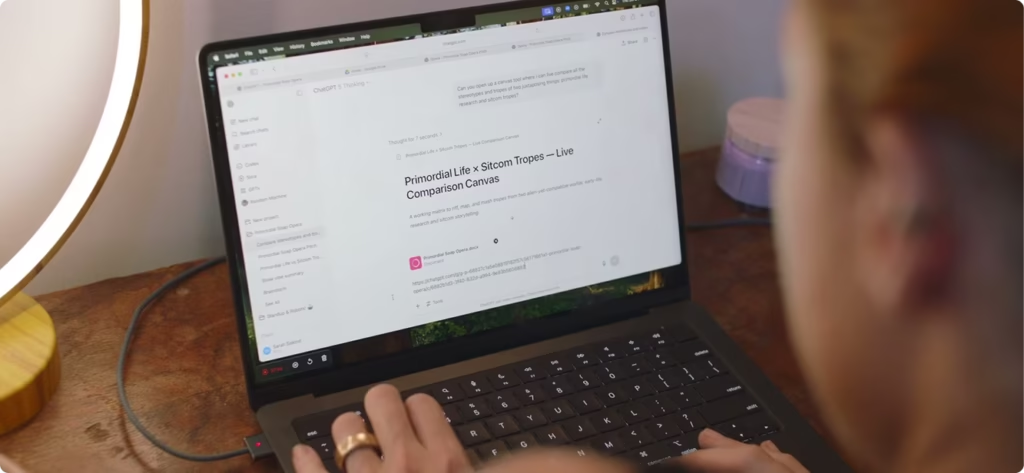
The 9.9 for features makes sense when you look at an ordinary content assignment. You might have interview notes, a source PDF, a spreadsheet, and a brief that changes halfway through. ChatGPT’s product overview brings search, deep research, file analysis, images, voice, projects, memory, custom GPTs, and document work into one place. You can move between the materials without repeatedly explaining the project to a new tool. You also have to learn where everything lives, and access depends on the plan.
The writing itself still needs judgment. ChatGPT can give a messy draft a clear spine, expose a missing step in an argument, or produce several useful ways to address an audience. It can also turn a tentative point into a confident sentence, or smooth away the peculiar phrasing that made the piece yours. Checking the source and reading the final draft aloud remain worthwhile steps.
What the research can and can’t tell us
There is good evidence that AI helps with bounded writing tasks. In a preregistered experiment, Shakked Noy and Whitney Zhang assigned 444 college-educated professionals short tasks such as reports, plans, press releases, and sensitive emails. Access to generative AI cut completion time by about 40% and raised evaluator-rated quality by about 18%. The study used an earlier model generation and short, self-contained assignments. It cannot tell us whether those gains persist through months of reporting and stakeholder edits.
A separate preregistered study points to a different cost. Anil Doshi and Oliver Hauser had 293 people write eight-sentence stories with no AI idea, one AI idea, or five. Assistance lifted average ratings for novelty and usefulness, especially for less naturally creative writers. The assisted stories also grew more similar to one another. That sounds familiar to anyone who has read a stack of competent, interchangeable AI-assisted copy. A distinctive brief and specific source material gives the editor something better to work with.
Why we looked at Google Play reviews
We used the official Google Play listing as the main public-rating signal. It is OpenAI’s Android app, so the reviews are about ChatGPT itself, and the sample is much larger than those on specialist review sites. Our September 22 snapshot showed 4.5/5 from 61.3M+ reviews. Google Play was one input to the 9.2/10 User Rating, not a number we simply doubled.
| Product | Source used | Public Rating | Votes & Reviews |
|---|---|---|---|
| Claude | Google Play Store | 4.4/5 | 747K+ reviews |
| ChatGPT | Google Play Store | 4.5/5 | 61.3M+ reviews |
| Gemini | Google Play Store | 4.4/5 | 46.6M+ reviews |
| Jasper | Capterra | 4.8/5 | 1.8K+ reviews |
| Grammerly | G2 | 4.7/5 | 14K+ reviews |
| Writesonic | Trustpilot | 4.6/5 | 6K+ reviews |
People review the entire app, of course. Favorable comments often mention convenience, quick help, and the number of tasks it can handle. Complaints commonly concern limits, factual errors, forgotten context, changing model behavior, subscriptions, and support. These are patterns in visible comments, not measured incident rates. A billing complaint tells you little about its ability to edit an essay; a five-star review for convenience tells you little about citation accuracy.
The displayed average also varies by country, device, and storefront. Our wider research saw regional figures roughly between 4.5/5 and 4.8/5, while counts continued to change. Keeping the 4.5/5 and 61.3M+ from the same snapshot avoids mixing measures from different times or places. The number suggests broad satisfaction, but the day-to-day fit still depends on what you ask the tool to do.
Comparisons Before You Buy
Here are all six overall results. Each seven-number profile runs in this order: AI Intelligence / Speed / Writing and Content Creation Quality / Prompt Accuracy / User Rating / Review Confidence / Features & Usability. Every number is out of 10.
| Product | Overall Score | AI Intelligence | Speed | Writing/ Content Quality | Prompt Accuracy | User Rating | Review Confidence | Features & Usability | Best For |
|---|---|---|---|---|---|---|---|---|---|
| Claude | 9.41 | 9.9 | 8.1 | 9.9 | 9.7 | 9.2 | 8.3 | 9.1 | Deep Writing Work |
| ChatGPT | 9.36 | 9.6 | 8.9 | 9.2 | 9.4 | 9.2 | 8.9 | 9.9 | For research, drafting, editing |
| Gemini | 9.17 | 8.9 | 9.6 | 9.4 | 8.8 | 8.8 | 8.2 | 9.8 | Google Workspace users |
| Jasper | 8.90 | 7.6 | 8.7 | 8.9 | 9.3 | 9.4 | 8.8 | 9.5 | Brand Campaign Teams |
| Grammerly | 8.73 | 7.0 | 9.8 | 8.8 | 8.8 | 9.4 | 9.3 | 8.9 | Writing Quality Teams |
| Writesonic | 8.63 | 7.4 | 8.4 | 8.6 | 8.8 | 9.4 | 9.0 | 9.2 | Students, non-native English writers, and Proofreaders |
Claude: when every sentence matters
For a voice-sensitive essay, book chapter, or difficult rewrite, Claude deserves the first look. It leads ChatGPT by 0.7 in writing quality and by 0.3 in both AI Intelligence and Prompt Accuracy. Anthropic’s September 22 model announcement emphasizes clearer writing and closer attention to writing rules; those are the very things this kind of assignment needs.
ChatGPT has more room to work around the draft. It is 0.8 ahead in Speed and Features & Usability, and 0.6 ahead in Review Confidence; the two tie on User Rating. If the piece requires research, source files, visuals, and multiple finished formats, that broader workspace may save more time than a slightly stronger first draft. The overall scores, 9.41 and 9.36, leave room for either decision.
Gemini: a good fit for a Google-heavy day
If the brief, source material, and edits already live in Google’s apps, Gemini has a practical advantage. It scores 9.6 on Speed and 9.4 on writing quality, ahead of ChatGPT by 0.7 and 0.2 respectively; its Features & Usability score is close at 9.8. Moving less material between systems can matter more than a narrow overall ranking.
ChatGPT’s 9.36 overall tops Gemini’s 9.17. Much of that advantage comes from reasoning and following complex instructions, where it scores 9.6 and 9.4 respectively. It makes sense for a varied research and production workflow. For a team already centered on Gmail, Docs, Drive, and Google’s research tools, Gemini deserves a real trial on their own work.
Jasper: built for a campaign team
Jasper’s platform is organized around brand voice, audience and product context, campaign agents, governance, and repeatable production. That makes sense when several people need to turn one approved message into many consistent assets. A solo writer may use little of that infrastructure.
ChatGPT wins this scorecard by 0.46 overall, with a particularly large 2.0-point lead in AI Intelligence. Jasper’s User Rating is higher at 9.4 versus 9.2, while its Prompt Accuracy is close at 9.3 versus 9.4. The deciding question is how much of your work requires shared brand controls. For a solo writer doing open-ended work, much of Jasper’s infrastructure might sit unused.
Grammarly: the tool you meet while writing
Grammarly works where the sentence already is. Inline suggestions, tone guidance, organizational knowledge, and broad app integration make it useful for everyday proofreading and consistency. Its 9.8 Speed score is the best in this group. It also leads ChatGPT by 0.2 in User Rating and 0.4 in Review Confidence.
ChatGPT is better equipped for the work before a draft exists: deciding what to say, finding support, and building or rethinking an argument. It leads Grammarly by 2.6 in AI Intelligence and 1.0 in Features & Usability, with smaller leads in writing quality and Prompt Accuracy. The overall difference is 0.63. If your main frustration is correcting text across many apps, Grammarly solves a more immediate problem; if you need to develop the piece, ChatGPT offers more.
Writesonic: a more specialized bet
The current Writesonic platform stresses SEO, generative-engine optimization, AI-search visibility, and producing content at scale. Our study’s original best-for label—students, non-native English writers, and proofreaders—does not fully capture that positioning. A buyer should judge the search workflow they plan to use, rather than the label alone.
ChatGPT is 0.73 ahead overall. The sharpest gap is in AI Intelligence, 9.6 to Writesonic’s 7.4. Writesonic edges it on User Rating (9.4 to 9.2) and Review Confidence (9.0 to 8.9). ChatGPT gives a writer more room to change course from one assignment to the next. A team producing and monitoring search-led content may value Writesonic’s particular tools more.
Which plan is worth paying for?
For an individual writer, ChatGPT Plus at US$20 per month is the place to start. OpenAI’s Plus terms list monthly billing, with no annual option. Plus adds GPT-5.6 Sol reasoning for eligible users, higher limits, file uploads and analysis, image generation, voice, deep research, projects, tasks, and custom GPTs. The limits can vary with system conditions, so paying does not remove them entirely.
Free is fine for occasional brainstorming or a light edit if Luna’s tool allowances and tighter limits do not interrupt you. Pro is for the person who regularly hits those limits or needs GPT-6 Pro. OpenAI’s Pro terms list US$100 per month for five times Plus usage. A US$200 tier with twenty times Plus usage remained available to existing subscribers, but new sign-ups and upgrades had been paused since September 10, 2026. Neither individual Pro tier offers annual billing.
Business starts to make sense when a team needs a shared workspace, central administration, organizational controls, and OpenAI’s default commitment not to train on workspace data. Under the current Business pricing, Standard is US$25 per user per month on monthly billing or US$20 billed annually. Premium is US$125 monthly or US$100 on the annual rate. Both have a two-seat minimum; Enterprise pricing is custom.
There is a real annual discount for Business. Standard saves US$5 per seat each month, or US$60 over 12 months. Premium saves US$25 per seat each month, or US$300 over a year. Both are 20% reductions. A settled team with steady usage can take the saving; a new or seasonal team has a reason to try monthly billing first. Plus and Pro offer no annual saving because they are monthly-only. All prices here are in US dollars before tax, and local billing and availability may differ.
If you are building an automated publishing system or an app, budget for the API separately. A ChatGPT subscription does not include usage-based OpenAI API pricing.

Conclusion
ChatGPT earns its place when an assignment refuses to stay in one lane. It helps with the brief, the sources, the draft, the revisions, and the formats that follow. That breadth explains much of its 9.36 score and makes Plus the most sensible starting plan for a typical solo writer.
It is not the automatic winner. Claude is the better choice when deep prose quality and careful instruction following matter more than workflow breadth. Gemini makes more sense for many Google Workspace teams. Jasper earns its place in governed brand campaigns, Grammarly in fast inline improvement, and Writesonic in search-led production and visibility work. Their higher scores in particular factors are more useful than a forced universal ranking.
The condition that should change the decision is the shape of the work. If most of the value comes from one specialist need, buy the specialist. If the job repeatedly moves from evidence to draft to revision to deliverable, ChatGPT’s range is unusually hard to replace but only when a human remains responsible for facts, sources, nuance, and final voice.
FAQ
Is ChatGPT better for writing content from scratch, or is it mainly useful for editing existing drafts?
ChatGPT performs well across the entire content lifecycle rather than only one stage of writing. It can help transform a rough idea into an outline, develop a first draft, rewrite content for different audiences, summarize research, and create variations for different channels. Its strongest advantage is not simply generating sentences; it is moving between research, drafting, analysis, revision, and final-format production in one workspace.
However, the article notes that ChatGPT should not be treated as an unattended author. Without human review, it can produce generic transitions, overly polished but unsupported claims, or writing that loses a distinctive brand voice. The most effective workflow is using ChatGPT as a collaborative writing system while keeping human judgment responsible for facts, sources, and final editorial decisions.
Why does ChatGPT score higher as a writing platform even though some competitors score better for pure writing quality?
ChatGPT’s advantage comes from being a broader content-production environment rather than only a writing model. In the evaluation, ChatGPT scored 9.9/10 for Features & Usability, its highest category, because it combines research, file analysis, image generation, projects, memory, custom GPTs, and document workflows in one ecosystem.
The article acknowledges that Claude scored higher in Writing and Content Creation Quality, particularly for deep prose work and voice-sensitive writing. However, ChatGPT’s strength is handling the complete workflow from gathering information and analyzing sources to producing and repurposing content. The better choice depends on whether a writer needs a specialized writing partner or a broader production workspace.
Can ChatGPT reliably follow complex writing instructions, such as brand voice, formatting rules, and content restrictions?
ChatGPT is highly capable at following detailed instructions, which is why the evaluation gave it 9.4/10 for Prompt Accuracy. The assessment considered factors such as compliance with explicit requirements, maintaining format constraints, matching tone and audience, preserving source fidelity, and handling multi-part briefs.
However, instruction accuracy is not permanent across unlimited revisions. The article highlights that during long editing cycles, earlier requirements—such as exclusions, formatting rules, or voice guidelines—can sometimes be lost. A practical solution is maintaining a short acceptance checklist and reviewing each major revision against the original brief.
Does ChatGPT actually improve professional writing productivity, or does it just make content generation faster?
Research discussed in the article suggests that AI assistance can improve both speed and output quality when used for structured tasks. A referenced study involving 444 professionals found that generative AI reduced completion time by about 40% and increased evaluator-rated quality by about 18% for short professional writing tasks.
The key productivity gain comes from reducing friction: writers can move faster from research notes to drafts, from drafts to revisions, and from one format to another. However, the article emphasizes that these benefits apply most strongly when AI handles bounded tasks with human oversight rather than replacing editorial judgment entirely.
Which ChatGPT plan provides the best value for professional writers and content creators?
According to the article’s evaluation, ChatGPT Plus at US$20 per month is the recommended option for most solo professional writers and content creators. The reason is that it provides access to higher usage limits, file uploads and analysis, image generation, voice features, deep research, projects, tasks, and custom GPTs without requiring a higher-cost professional tier.
The article distinguishes this from Free, Pro, and Business plans. Free is suitable for occasional writing and light revisions, while Pro is aimed at users with much heavier usage requirements. Business becomes relevant when teams need shared workspaces, administration, and organizational controls.